Director of the Electroacoustic Music Studio (SME) at the Krakow Music Academy, president of the Muzyka Centrum association, founder of the international Audio Art Festival, and long-serving president of the International Confederation of Electroacoustic Music (CIME/ICEM). In this comprehensive dialogue with Myroslav Trofymuk, he surveys four decades of continuous innovation: from Boguslaw Schaeffer’s graphic scores, playing soccer to Bach inside Krzysztofory Gallery, and martial law underground samizdat, to Gogo Boys, the reconstruction of Edward Ihnatowicz’s Senster cybernetic sculpture, weekly GroupLab workshops, and Gilles Deleuze’s rhizomatic topology of creative freedom.
Marek Chołoniewski (born 1953) is a towering Polish composer, sound artist, conservatory professor, and curator, occupying a foundational position in Central European experimental music. A protege of Boguslaw Schaeffer and the inaugural assistant to Jozef Patkowski at the Krakow Electroacoustic Music Studio (SME), which he has directed since 2000. Founder of the historic Muzyka Centrum Art Association (1977), founder of the Audio Art Festival (1993), president of the Polish Society for Electroacoustic Music (PSeME), and long-standing president of the International Confederation of Electroacoustic Music (CIME/ICEM). In this panoramic dialogue, he explores the lifelong synthesis between institutional infrastructure and subterranean autonomy.

The 1970s Thaw, Boguslaw Schaeffer, and the Mystique of the Thirteenth Day
The 1970s represented a singular era in Poland: following prolonged political tension, a liberal thaw opened cultural vectors toward the West. This serendipitously coincided with my conservatory training. Initially I pursued pipe organ under Leszek Werner, followed by music theory under Marek Stachowski, and composition with the avant-garde pioneer Boguslaw Schaeffer. Concurrently, Jozef Patkowski established the Electroacoustic Music Studio (SME) at the Music Academy in Krakow, where I was appointed his first assistant. These disparate trajectories fused into a singular kinetic force.
 LIVE54:44Plejrek 84 – 26.04.2017 - SMEvia: Electroacoustic Music Studio
Yet the decisive creative awakening arrived through my wife Krystyna: we married in 1976, and in June 1977 our son Tomek was born alongside the inaugural concert of Muzyka Centrum! We resolved to establish an autonomous platform outside conservatory walls, committing to stage concerts strictly on the thirteenth day of every month without exception. Our maiden gathering transpired on June 13, 1977, at the Pod Jaszczurami club. That monthly cadence has endured uninterrupted across four decades, yielding over eight hundred curated events!
I harbor absolute faith in the rejuvenation of vitality through disciplined regularity. Gilles Deleuze’s philosophy articulates my internal cosmos: reality does not unfold as vertical bureaucratic hierarchies, but as a horizontal rhizome — a multidimensional, interconnected meshwork of potentials. We structured Muzyka Centrum upon Boguslaw Schaeffer’s concept of a ’quasi-contract’ — a mutual moral compact binding artists without bureaucratic paperwork. Armed with over six hundred international graphic scores sent to Schaeffer from across the globe, we performed radical open-form compositions, instrumental theater, and happenings. We played soccer inside Krzysztofory Gallery while Bach and Tchaikovsky blared from tape reels! We systematically eradicated artificial borders dividing academic rigor from spontaneous street joy.

Seven Seasons Without Subsidy: Martial Law and Subterranean Fortitude
How did Muzyka Centrum endure the draconian crackdowns of martial law declared in December 1981?
We formally registered the Muzyka Centrum Art Association on May 18, 1981, with sixteen co-founders. A mere seven months later, General Jaruzelski declared martial law, outlawing public assembly and freezing independent associations. We promptly retreated deeper underground. Throughout our initial four seasons, we operated entirely without external funding, pooling personal coins to hire basements and mimeograph program sheets.
Our inaugural state grant arrived in December 1984 — fully seven years after our foundation! Seven uninterrupted years of monthly presentations fueled purely by volunteer passion and devotion to acoustic truth. Today’s emerging creators struggle to conceive operating without institutional subsidies. Yet that ascetic independence forged an unbreakable moral backbone for our collective.
In 1987, I attended Ars Electronica in Linz, encountering the emergent field of ’Audio Art’ — acoustic practice at the intersection of emerging technologies, kinetic spatialization, and live performance. It became my defining horizon. In 1993, we launched the inaugural international Audio Art Festival across Krakow, Warsaw, and Wroclaw, supported by the newly established Goethe-Institut. The festival evolved into a celebrated global nexus for sonic experimentation.

From Gogo Boys Punk-Pop to the High Andes and Dickson Dee
We resisted retreating into academic isolation. In 1985, composer Krzysztof Knittel arrived at the studio to record a score for oboist Mariusz Pedzialek, discovering he had left his manuscript behind in Warsaw. An analog Korg Polysix sat plugged into the console. We powered it up, began jamming, and within an hour hatched the anarchic punk-pop duo Gogo Boys! We recorded an album of deranged avant-pop set to Janusz Dziubak’s concrete verse, including the infamous anthem ’A Blind Man Walks the Street Carrying Beef Tenderloin’.
 LIVE39:02ХАТНЄГРАННЯ 99 - eclectic syncretism - LIVE AT VOX ELECTRONICA 2019via: Krzysztof Knittel
Subsequently, we birthed Pociąg Towarowy (Freight Train), enlisting writer Piotr Bikont, saxophonist Wlodek ’Kinior’ Kiniorski, and jazz royalty Tomasz Stanko alongside Andrzej Przybielski. We inhabited legendary underground sanctuaries: Warsaw’s Dziekanka and Krakow’s Krzysztofory.
Later, alongside Lukasz Szalankiewicz (Zenial), I formed Dizzy Kinetics. We toured across South America, performing an improvised concert at the foothills of Machu Picchu inside the Coricancha Incan Temple in Cusco, hand-distributing flyers along cobblestone alleys. In China we toured alongside Hong Kong sonic pioneer Dickson Dee, collaborating with Japanese Butoh dancer Miho Iwata. Preserving that guerrilla readiness remains vital to me: jumping into an automobile to perform in Lviv for Ostap Manuliak’s Vox Electronica or the steppes of Kazakhstan with Denis Kolokol, executing work unburdened by institutional pomp.

GroupLab and Senster: Subverting the Institution from Within
Your credentials encompass a dizzying array of institutional titles: Conservatory and Fine Arts Professor, SME Director, CIME/ICEM President, PSeME Chairman. How does this square with underground freedom?
Institutional titles are utterly meaningless in themselves. Only two elements possess authentic weight: people and tangible creative output! I never coveted administrative prestige — these are unremunerated civic responsibilities. At every CIME general assembly, I plead with delegates to elect a successor, yet colleagues insist I continue stewarding the confederation. My academic post exists solely as a resource terminal: providing studios, hardware, and administrative shelter to radical emerging experimenters.
This ethos spawned GroupLab (our weekly Wednesday workshops). Every Wednesday evening, our studio doors swing wide to the public: conservatory students sit alongside street DJs, fine arts sculptors, hackers, and itinerant travelers. We solder circuit boards, construct DIY analog synthesizers, and execute free improvisation unburdened by academic grades or curatorial gatekeeping. It is pure open-source sonic alchemy.
A parallel triumph was resurrecting Edward Ihnatowicz’s legendary 1970 cybernetic sculpture ’Senster’. Together with Dr. Anna Olszewska of AGH University, we tracked down this pioneering biomimetic machine deteriorating in a Dutch warehouse, transported it to Krakow, and restored its hydraulic anatomy, acoustic radar, and digital logic. That was not a state-mandated directive; it was the passion of committed individuals breathing life into history.

Audiomat at Bunkier Sztuki and the Extraterritoriality of Sound
A kindred impulse birthed Audiomat, realized alongside Marcin Barski. Procuring a refurbished vending machine, we installed it inside the cafe of Bunkier Sztuki Gallery through our close bond with proprietors Jacek Zakowski and Olgierd Witynski. We dispense student releases on CD for five zlotys under Creative Commons licenses. It yields zero profit, yet creates daily physical encounters between passersby and radical sound.
Authentic art is extraterritorial. It acknowledges no ministerial boundaries, geopolitical walls, or ideological dogmas. So long as we possess the capacity to listen deeply, to perceive sound as the breathing pulse of space, and to assemble without fear — genuine independence will never die.
- GroupLab [band / project]band / ensemble. KORINNIA map (1 conversation)
- Dickson Dee [person](2006–2007). producer. KORINNIA map (1 conversation)
- Miho Iwata [person]person (Japan). KORINNIA map (1 conversation)
- Gilles Deleuze [person](1925–1995). researcher (France). KORINNIA map (1 conversation) · Robert Curgenven: Air as Instrument, Pipe Organ Resonance, and…
- Bogusław Schaeffer [person](1929–2019). composer, music theorist, playwright, graphic artist (Poland). Linked with: Academy of Music in Kraków, Warsaw Autumn, Kraków. Nests: T04 “A mentor who gives freedom” · T04 A mentor who gives freedom · Antek Michnik and Myroslav Trofymuk: The Paradox of [NIE]ZALEZNOSC
- Anna Olszewska [person](2017–2018). person. Linked with: Kraków. KORINNIA map (1 conversation)
- Pociąg Towarowy [band / project]band / ensemble (Poland). KORINNIA map (1 conversation)
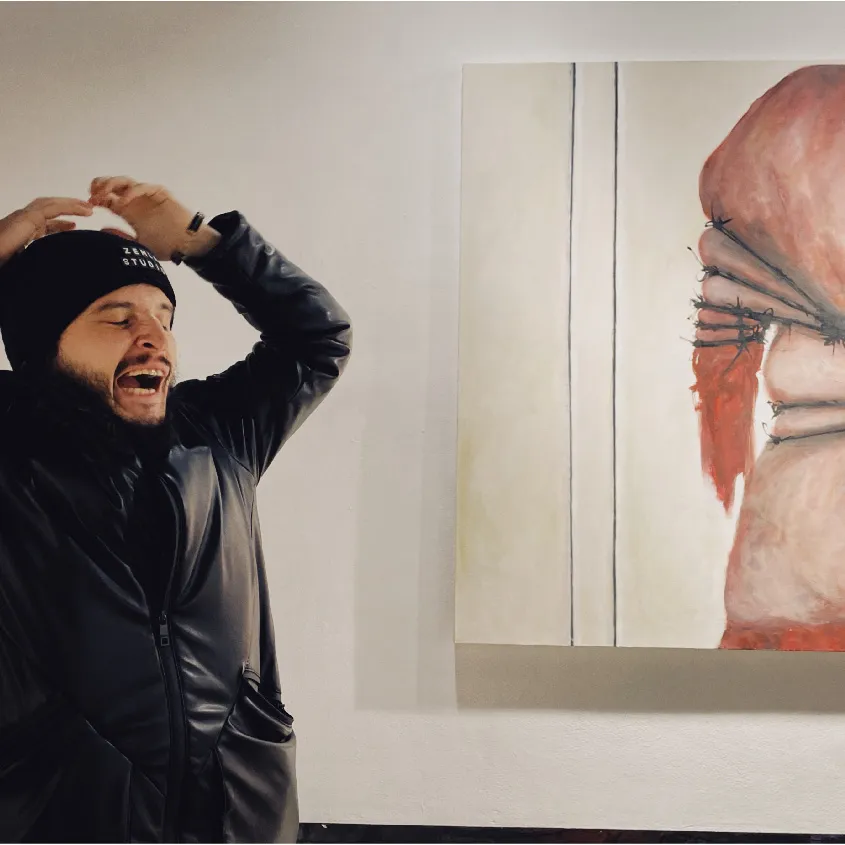
Dr. Myroslav Trofymuk
Born in Lviv. Designer, director, musician, researcher, founder of ZEMLA STUDIO. Master of classical philology and digital marketing, PhD in the history of Ukrainian literature. Member of the National Union of Journalists of Ukraine. Since 2022 he has authored the CENTRUM MUNDI audio show for Polish Radio for Ukraine, continuing the same research into the contemporary music scene in Ukraine and Poland.
Full bio →