
Introduction: Architecture, Music, and the Thresholds of Perception
Plastic Trees Garden opens this episode with an inquiry into the nexus of natural environments, architectural form, and sound. Within Krakow’s Szolayski House (Kamienica Szolayskich, a branch of the National Museum in Krakow), as part of the extensive retrospective exhibition Sections: Gallery of Polish Architecture of the 20th and 21st Centuries (Przekroje. Galeria Architektury Polskiej XX i XXI Wieku), Australian-Irish composer and sound artist Robert Curgenven (RECORDEDFIELDS) presented his spatial sound installation Threshold Works No. 17. The work transforms the physical architecture of the building into a monumental acoustic filter, investigating the threshold between the interior and exterior realms.
The correlation between architecture and music has deep historical roots, receiving radical theoretical formulation in the 20th century through the work of Iannis Xenakis. Yet Curgenven’s focus lies not in frozen geometric proportions, but in the invisible substance that animates these volumes: air itself. As presenter Mirek Trofymuk notes, drawing upon the conceptual framework of Dante’s Divine Comedy, before one can descend into the underworld or ascend toward the light, the traveler first wanders through a dark wood — the realm of raw natural environment. It is precisely from this primeval forest that our conversation begins, tracing air masses, acoustic matter, and spatial memory.

Air as Visceral Medium: From the Australian Monsoon to the Physics of Sound
Robert, while countless musicians and sound artists focus on instruments, synthesizers, or digital algorithms, your practice revolves centrally around air itself. How did you arrive at the realization that air is the primary medium of your work?
It was more of a sudden realization than a deliberate intellectual choice. For nearly ten years, on and off, I lived in the tropics of Northern Australia, around Darwin. When the monsoon rolls in, the air becomes unimaginably thick, sticky, and hot. It is so saturated with humidity that you feel it physically coated upon your skin like a tactile layer. Living in those conditions fifteen or twenty years ago gave me a deeply visceral, corporeal awareness of the air.
Without air, we cannot breathe; it is the absolute foundation of our vitality and existence. But equally, almost every sound we perceive — just as you hear my voice right now — travels exclusively through the oscillation of air particles. Of course, we experience subterranean bass through tactile surfaces or bone conduction, but I recognized that my sonic practice is directly governed by specific atmospheric pressure, humidity, and temperature. Air is the formal, material conduit through which acoustic energy propagates.
The physics here is entirely uncompromising: between minus forty and plus forty degrees Celsius, the speed of sound shifts by ten percent. Between a completely arid room and one hundred percent relative humidity, there is another three percent variance in velocity. A physical analogy illustrates this well: a table with a single central monopole stands securely because that central pillar directly engages the fundamental harmonic mass at the center of the surface; displace the pillar off-center, and the table instantly topples. Similarly, when constructing an architecture out of sound waves — where you aim for harmonics to interact and generate additional overtones, or modulate one another via difference frequencies to produce undertones — acoustic phase becomes decisive. The slightest shift in temperature, pressure, or humidity alters phase alignment, causing the acoustic edifice either to cohere in resonance or collapse entirely.
The Hotel Cracovia Experiment and Helmholtz Resonance
Part of the material for Threshold Works No. 17 was recorded inside the modernist shell of Hotel Cracovia, which is now part of the National Museum. My objective was to deploy the absolute minimum acoustic power to move the maximum acoustic air mass within the space. Every architectural chamber possesses a specific acoustic mass. I deployed just two pure sine wave generators and a compact loudspeaker. The goal was to excite the room’s air volume into physical resonance without overwhelming the space with brute volume.
When you open a window in such a chamber, a remarkable acoustic exchange ignites between interior and exterior. The sine generators agitate the air inside, motivating it to pump outward, while outdoor atmospheric pressure forces air back inside. What forms is a macroscopic Helmholtz resonance — precisely the acoustic phenomenon that occurs when you blow across the mouth of an empty bottle. Scaled to an entire architectural room, it becomes an unmistakable physical dialogue. You literally hear the air breathe through the window aperture, dissolving the oppositional dualism of inside and outside.
This speaks directly to our ontology — our mode of being in the world. If you remove air, human ontology ceases to exist. We are merely soft ’meat packets’ navigating the planet for seventy or eighty years, and air is the non-negotiable phenomenological baseline of our existence. Looking back at my years living in the monsoonal tropics, I see how inseparable these dimensions are. Working outdoors and collaborating with Indigenous Australians in the Northern Territory fundamentally reshaped how I conceptualize scale, acoustic distance, and space.

Desert Acoustics, Infrasound, and Songlines
When you find yourself in the vastness of the Australian desert, the sheer physical scale is staggering. A sound wave at two hertz has a physical wavelength of seventy-five meters. When hundreds of kilometers of open terrain stretch between monolithic rock formations, colossal infrasonic waves propagate through the atmosphere at extraordinarily low frequencies. For tens of thousands of years, this imperceptible acoustic terrain shaped how Indigenous peoples navigated the land, mapped spatial topologies, and conceptualized time itself.
These songlines and spatial mappings represent a profound continuous feedback loop between human consciousness and physical geography. Therefore, even when working in Europe with massive pipe organs, I constantly return to these first principles. My philosophical inquiry is always: where does this phenomenon originate? What is the irreducible ontological baseline? From that point of origin, I construct form, whether working across open continental expanses or inside sealed European chambers.
Over the past fifteen years in Europe, my work has focused primarily on enclosed architectural environments, especially during colder months when buildings are acoustically hermetic. It is a sustained interrogation into physical materiality. Concurrently, I seek to dismantle rigid dualisms — mind versus body, nature versus culture, subject versus object. Reality is an integrated system harboring irreducible pluralism. My objective is not to impose an authoritarian hierarchy of concepts, but to provide a crucible where these multifaceted elements can resonate simultaneously.
Tradition vs. Innovation: Tuning Systems, Scores, and Frozen Time
In our program, we frequently examine the tension between tradition and innovation, nature and technology. You utilize cutting-edge electroacoustic technology, yet your primary material is the displacement of air — a physical reality predating Archimedes and formal scientific systems. How do these twin poles intersect in your practice?
At its core, sound is precisely the displacement of particles through pressure differentials; our hearing registers microscopic fluctuations in the medium. As epochs change, material conditions inevitably evolve: the composition of water, atmospheric density, environmental quality. Consider whiskey distillation: a fiercely conservative tradition where practitioners historically resisted innovation, yet when water chemistry or timber properties alter, one must innovate simply to preserve the foundational essence of the craft.
The exact same phenomenon governs music. For instance, the pitch standardization reforms of the mid-nineteenth century mean that a piece originally composed in B is now frequently performed in C under modern tuning standards. When a contemporary musician reads the historical score, they are exciting entirely different frequencies! The physical topology of the sound has been fundamentally altered. The ink on the paper no longer corresponds to the material acoustic existence of the work as it lived when it was composed.
A written musical score is like jotting down the exact minute on a piece of paper and handing it to you: ten minutes later, that inscription is completely obsolete because time has marched on. Notation is a representational technology that may preserve tradition, or just as easily ossify and distort it. When a tradition survives through living oral practice — like a spoken language retaining its ancestral formants, cadences, and harmonic inflection — it stays alive. To innovate responsibly within a tradition requires direct mentorship under a master. Only then can you distinguish which parameters are inviolable structure, and where creative play can flourish.
The Violence of Beating Frequencies: Gamelan, Accordions, and Medieval Temperaments
In a recent discussion with electronic composer Oleksa Moroz (Alex Bodeko / Hein Ali), we touched on reconstructing medieval musical scores through modular synthesis. When the historical sound has vanished, we are left to imagine its contours and forge equivalents through contemporary analog instruments.
Exactly! Performance of a medieval work in meantone quarter-comma, fifth-comma, or the historical temperaments of Neidhardt or Vallotti — as opposed to post-1750 equal temperament standard since Bach — reveals an entirely different physical acoustic reality. Depending on room humidity, microscopic frequency beatings emerge between neighboring intervals. In oral traditions, this physical sensation is paramount. While living in the tropics, I studied Javanese gamelan: there, sounding certain pitch combinations consecutively is strictly forbidden because the beating frequency becomes so violent and acoustically turbulent that it shatters the harmonic sonority.
Do you know which instrument carries historical culpability for obliterating regional folk temperaments across the world? The accordion. When factory-manufactured accordions flooded European villages in the nineteenth century, traditional players tuned their fiddles, pipes, and hurdy-gurdies to the rigid equal temperament hardwired into the accordion’s metal reeds. It constituted acoustic homogenization, erasing microscopic nuances of localized vocal and instrumental temperaments. Before that, organs and harpsichords often featured split-key manuals — housing upwards of fifty-three keys per octave to accommodate pure meantone harmonies!
This invokes the political economy of art. The medieval altarpieces preserved in Krakow’s museum galleries were commissioned by wealthy ecclesiastical and secular patrons to project status. These visual artifacts survived because canvas and wood endure. But the acoustic environments within which they vibrated are permanently lost. It parallels contemporary efforts to resuscitate the Cornish language in Britain: having had no living speakers for over two centuries, linguists approximate its phonetics through Irish or Welsh Gaelic, but how those vowels physically resonated in historical air remains an unsolvable mystery.

Cranial Resonance and Polyphonic Memory: Traditional Singing
In Ukrainian traditional culture, pockets of archaic polyphonic singing endure across rural villages in Polissya or the Carpathians, where elderly women transmit vocal heritage from mouth to mouth without musical notation. How does acoustic transmission function at this deep, corporeal level?
Archaic open-throat singing relies on the skull and sinus cavities functioning as acoustic resonators. The singer does not merely emit sound from vocal folds — she maps frequencies directly into the architecture of her head. Cheekbone geometry, cervical muscle tension, cranial bones: the entire physical anatomy serves as a resonator generating dense polyphony. It is an embodied, somatic tradition. Observe Georgian singers standing shoulder-to-shoulder with arms locked: they sense sympathetic vibrations transmitted through their neighbor’s skeletal frame, tuning intervals via bone conduction rather than external acoustic feedback.
In this lineage, tradition lives directly through physiology. You train the song into your unique bodily form while adhering to ancestral rules: these core structures cannot change, while these ornamentations remain open to improvisation. Indigenous Australians have sustained spatial narratives of constellations and desert topography for over sixty thousand years through this very oral method! It functions as an empirical navigational matrix far more resilient than paper maps, which distort or rot upon contact with moisture.
This is precisely why I reject representational approaches to sound art. I do not capture field recordings as ornamental postcards. When church bells appear in my work, I am not fascinated by the bell as an isolated sonic object; I am engaging with bells as a sociopolitical technology that historically demarcated territory, enforced ecclesiastical dominion, and regulated diurnal labor. Sounds constitute constellations disclosing how territories are structured. They function not as linear narratives with tidy beginnings and ends, but as a four-dimensional field unfolding in space-time.
Deleuzian Concepts and the Non-Denotable Center
Behind monumental installations and spatial performances lies a foundational creative catalyst. What was your initial impetus to devote your life to sound and construct such intricate aesthetic architectures?
I began studying the organ when I was seven or eight — more than forty years ago. Sound is the discipline I have inhabited longest, where my capabilities function most fluently. But the existential question has always been: why create anything at all? Why add another artifact to the staggering pile of material debris humanity has accumulated on earth? I produce relatively few works, but every recording is governed by rigorous conceptual intent, orbiting an underlying center.
My background is rooted in philosophy. I studied Gilles Deleuze and Felix Guattari’s final collaboration, What is Philosophy? I finished reading it the exact week before Deleuze took his own life in September, twenty-five years ago. The central thesis of that work is that philosophy is not about contemplation, reflection, or communication; philosophy is the practice of creating concepts. I strive to do the same through sound: inventing concepts that trace a trajectory toward a center that cannot be explicitly denoted, but can be visceralized by the listener.
At the concert at the cultural center two weeks ago which you attended, I sought to render that concept palpably physical. You sit in the auditorium feeling the surrounding air animate and displace with almost violent kinetic force. It provokes a primordial physiological response — the fight-or-flight impulse — yet simultaneously reminds you that you are anchored among others, sharing an unspoken collective encounter.
Every audience member, conditioned by their spatial coordinates in the room, perceives an entirely singular acoustic composition, because phase interference creates distinct physical nodes at every seat. It forms a social assemblage. Art should provide a vehicle for revelatory transformation, though that demands an uncompromising sound system capable of rendering raw physical acoustic energy. I refuse to mass-produce commodities for passive consumption; my commitment is toward fostering conscious, collective presence.
Loss of Context, Compression, and Infrasound
You record extensively across unorthodox architectural sites and outdoor terrains. Yet once a recording enters digital networks or FM radio broadcast, it inevitably undergoes technical compression. How do you navigate the detachment of sound from its site of origin?
Traditional recording studios are engineered explicitly to sterilize spatial acoustic context in pursuit of clinical clarity. For me, site context and temporal specificity are essential. When sound is extracted from a space to become an artifact, it endures an arduous chain of transcoding: dynamically compressed during mastering, downsampled for CD, crushed by FM broadcast limiters, decoded by household receivers, and ultimately squirted through tiny phone or laptop transducers. The emergent artifact bears scant resemblance to the raw physical event.
This transcoding degradation is especially catastrophic for low frequencies. Infrasound and fundamental sub-bass occupy massive dynamic headroom, and streaming algorithms like Spotify ruthlessly excise them because standard consumer earbuds cannot physically reproduce them. Consequently, my work sounds utterly castrated on commercial streaming platforms — stripped of the somatic foundation designed to physically oscillate the listener’s torso. Nevertheless, I adamantly refuse to abandon sub-bass, because it constitutes the physical bedrock of architectural resonance.

The Modernist Trajectory: From the Gdansk Shipyards to Nowa Huta
This very chamber in the Szolayski House where we are conversing holds singular significance. Exactly three years and one day ago, on September 28, 2019, I made the final recordings for Threshold Works No. 17 right here. I had just two hours of access. But that entire ten-day sonic pilgrimage began at the Baltic Shipyards in Gdansk on the 30th anniversary of the Solidarnosc movement, concluding in the industrial blast-furnace district of Nowa Huta in Krakow — the southern pole of that identical historical arc.
I deliberately curated an architectural trajectory of buildings conceived or operationalized between 1961 and 1989. The conceptual framing is crucial: anyone can walk into a random building, open a sash, and document reverberation. But I demanded a geopolitical and architectural spine. It mirrors James Turrell’s Skyspaces: eighty-seven installations worldwide, fifteen of which I have experienced, all tethered rhizomatically to his monumental mother-work at Roden Crater in Arizona.
Furthermore, this work enters into direct conversation with Oskar Hansen’s Open Form and his Linear Continuous System (LSC). Between Gdansk and Krakow stretches an unbroken linear axis charted not only by political revolt, but by the physical hydrology of the Wisla River. Back in 2005, I navigated the Wisla by boat from Krakow down to Sandomierz. The Wisla is the sovereign lifeblood of Poland, conducting the spirit of historical epochs.
Szolayski House harbors an extraordinary courtyard enclosed by lush trees — a hidden botanical haven in the dense stone center of Krakow. On that brilliant late-September day, the wind moved through the tree crowns with an acoustic cadence completely unlike any other urban recording. That gale moving through the courtyard foliage became the spine of the composition, and a photograph of the canopy forms the album cover. All the irreducible components were already present; my task was to combine them judiciously to uncover the latent concept.
Socialist modernist architecture was bureaucratic, austere, engineered for ideological surveillance and institutional control. Today, just outside those monolithic windows churns unfettered capitalism, consumerism, and retail spectacle. The architectural frame survives, but the reality it encloses has been turned inside out. I harnessed these structures to register the seismic shift in the Zeitgeist — peering through historical acoustic portals into our precarious present.
Sound Ecology, Dan Flavin, and the Fluorescent Zeitgeber
In this context, how do you locate the political dimension of sound and urban ecology? Contemporary cities frequently devastate natural environments, entombing humans inside concrete corridors. Is this an inescapable civilizational fate?
Architecture is our habitat and shelter. We are fragile, fleshy beings ill-equipped to survive sub-zero blizzards or scorching droughts unaided. Buildings simultaneously devastate the natural landscape while making human existence within it possible: that is our irreducible paradox. Sound cultivates acute presence in this tension. Notice the fluorescent lamp above us: throughout our dialogue, it has emitted a high-frequency continuous whine. Initially grating, the auditory cortex soon habituates, transforming it into an invisible floor of our acoustic ecology.
That lamp buzz operates as a true Zeitgeber — a biological time-giver. The ballast circuit attempts to fire the gas discharge, fails, and re-triggers with relentless periodicity. Simultaneously, that steady frequency measures the acoustic parameters of this corner of the room, betraying its construction era. It parallels the minimalist light installations of Dan Flavin, which demand vintage 1960s fluorescent fixtures emitting distinct spectral wavelengths. When those specific bulbs become entirely extinct, does Flavin’s artwork cease to exist?
Returning to politics: philosophy governs how we relate to ourselves and immediate reality; politics governs how we negotiate relations with each other; economics governs how societies manage aggregated masses of capital and resources. Every aesthetic and ethical decision involves an opportunity cost: opening one portal permanently closes another. Contemporary geopolitics traps societies in an anxious Bardo state — a liminal suspension hovering between anticipated catastrophe and paralyzed stasis. My sound avoids reductive slogans or easy soundbites, forcing engagement with this uneasy terrain.
Consider the central railway station in Milan (Milano Centrale) — a quintessential monument of totalitarian fascist architecture. Its cavernous acoustics were engineered to instill awe and subjugate the individual citizen before the state’s crushing monumentality. Yet if a commentator were to praise the acoustic efficacy of that vaulted expanse in a soundbite, it could instantly be distorted into political endorsement of fascism. That is precisely why I reject journalistic simplifications and demand thorough context.
The Organ as Pneumatic Machine: Pure Tones and Coloration
Alongside my organ registrant collaborator Grace Jephson, we approach the pipe organ not as an antique museum vehicle for rehearsing classical repertoire, but as a living pneumatic engine. The pipe organ is a colossal acoustic pumping apparatus. Its flute ranks are fundamentally acoustic sine waves draped in subtle overtone coloration. Engaging the organ demands listening not to keyboard dexterity, but to the mechanics of the bellows pressurizing windchests and air exhausting through wooden and metal pipes.
That explains why I deployed pure sine tone generators inside these architectural spaces. Had I introduced acoustic cello, voice, or clarinet, listeners would fixate on instrumental timbral romance rather than the enclosing architecture. A sine generator possesses zero harmonic color: it is an uncompromising acoustic probe forcing the room’s standing wave resonances to articulate themselves. It represents sculpturing air in space, balancing Apollonian formal rigor against Dionysian fluid turbulence.

Indoor Weather Systems: Smoke Machines, Fog, and the Collapse of Depth
Have you experimented with theatrical fog or haze machines to render physical acoustic wave currents visually perceptible to audiences?
During recent rehearsals in Germany, we activated a smoke machine in a cavernous, darkened hall featuring warm parquet flooring. I halted the sound design entirely, utterly mesmerized by the thermodynamic phenomena unfolding before us. Within minutes, the atmosphere stratified into two meteorological bands: dense cumulus-like fog hovered inches above the parquet, while high cirrostratus strata stabilized above. The haze revealed the room’s microclimates and thermal layers with startling clarity.
Suspended fog triggers what I term dimensional collapse. It obliterates depth perception: human binocular vision cannot gauge proximity or distance. Coupled with stroboscopic or phase-modulated lighting — where illumination pulses track the acoustic phase shifts — the brain suffers severe sensory overload. Proprioception, our innate internal awareness of bodily orientation, destabilizes. Under ideal conditions, a solid white gallery wall appears to ripple like liquid mercury.
I am deeply intrigued by generating indoor weather systems. A year ago in the Arctic, we encountered violent polar depressions over the Barents Sea. We walked into a cinema, and emerged two hours later into howling gales exceeding 100 kilometers per hour — over thirty meters per second. Polar low-pressure depressions do not merely blow air; they violently vacuum atmosphere inward toward barometric sinkholes, transferring colossal thermodynamic energy from sea to sky.
In my youth, I frequented extreme underground metal shows, which undoubtedly nurtured my affinity for brutal storms. Yet in sound art, I eschew battering the audience with blunt maximum decibels. Layering hurricane noise over distorted synthesizers is merely piling a hat upon a hat — an uninformative assault. True artistic power resides in calibrated restraint and incremental disclosure, allowing auditory cognition to apprehend microscopic metamorphoses within the air.
Cosmic Optimism: Soviet Brutalism and Avant-Garde Churches
Has the architecture of Eastern Europe and Ukraine captured your attention, particularly modernist and brutalist monuments?
Unequivocally. The sole Christmas gift my partner and I exchanged in years was symbolic: I gave her an anthology on Nordic performance art, and she presented me with an exhaustive monograph on Soviet brutalism, encompassing structures across Ukraine, Mongolia, and the Caucasus. I harbor immense affection for that architectural lineage. Environmentally, these concrete monoliths are thermodynamically unsustainable, yet demolishing them generates an even greater ecological catastrophe.
The educational curator presenting today’s symposium in Krakow specializes in interwar architecture across Eastern Poland. In 2005, I journeyed across Podkarpacie from Wetlina through Rzeszow toward Jelenia Gora. In village after village, we encountered extraordinary churches that appeared to defy gravity itself! Paradoxically, during that interwar epoch, ecclesiastical institutions became primary patrons of radical avant-garde design.
Monumental brutalist edifices — civic circuses, puppet theaters, cosmic pavilions — radiate immense futurist optimism. They transcend quotidian utilitarian housing. It mirrors the Aurora Borealis we witnessed in the Arctic. Gazing upward, one realizes they are observing cosmic weather: solar wind ejected forty-eight hours prior across interplanetary space, colliding with upper atmospheric particles to release photons of light.
In the interwar Dom Kultury where I performed, the venue houses massive 22-inch subwoofer diaphragms. Their physical excursion can literally ventilate an entire building through displacement alone! This has nothing to do with personal hubris; it is about utilizing architectural resonance and transducers to expand human somatic consciousness beyond the blink of individual biological life.
Decolonization, Scars, and Reclaiming Architectural Space
For people in Ukraine and Eastern Europe, Soviet brutalism often embodies the scars of totalitarian occupation and ideological violence. How does one navigate such traumatized spatial heritage through acoustic art?
I comprehend that acutely. I completed university inside a severe brutalist complex erected in Australia in 1967. Colonial erasure in Australia was brutal: arriving 240 years ago, British settlers obliterated Indigenous stone and earthworks while systematically expunging their existence from historiography. Decolonization demands addressing historical trauma without naively discarding every spatial structure left behind.
A potent methodology of deterritorialization was the European squatter movement of the 1960s through 1990s: communities appropriated abandoned institutional or industrial complexes, reinhabiting them to invert authoritarian functions into autonomous cultural zones. Conversely, vernacular architecture often possesses terrible acoustics: living in Western Ireland inside stone cottages under thatched roofs is idyllic for fireside fiddles, but utterly deadened for resonant spatial acoustics. I also once lived in a rammed-earth house: awful acoustics, and wasps colonizing the walls! That visceral domestic reality pushed me toward listening outward rather than remaining confined inside interior walls.
Hence my commitment to architectural transparency: opening windows initiates acoustic osmosis where interior and exterior soundscapes bleed into reciprocal dialogue. But the paramount ethical imperative in community-engaged practice is deep listening and consultation. If an edifice bore witness to executions or atrocities, an artist must never opportunistically aestheticize suffering or reduce trauma into an art-world prop. Respect and ethical restraint must precede artistic intervention.
When thin-shell reinforced concrete and hyperbolic paraboloids were developed in the 1930s, they catalyzed the fluid geometries of Felix Candela, Xenakis, and ultimately Zaha Hadid — concrete transformed into fluid frozen music. The eternal danger lies in colonial extraction: white explorers stumbled upon meteorites preserved in the outback for millennia, carting them to metropolitan museums as trophies while completely ignoring Indigenous geological narratives detailing their impact and cosmological legacy.

War, Historical Amnesia, and the Rejection of Hubris
The war in Ukraine has shattered Europe’s complacency, disproving the naive conviction that the horrors of World War II could never recur. We repeated the adage that ’one cannot step into the same river twice,’ yet humanity blindly repeats catastrophic historical cycles. Can art genuinely shift human perception against such brutality?
George Santayana famously observed that those who cannot remember the past are condemned to repeat it. Scars are disfiguring, yet they serve an existential purpose: they physically remind you of trauma so you do not repeat fatal miscalculations. When hubris overtakes a society — the arrogant illusion of impunity — runaway ego drives leaders toward catastrophic conquest. Egotistical delusion replaces collective solidarity with authoritarian vanity.
The impulse toward tabula rasa — erasing all difficult historical markers — is treacherous, because it obliterates the warning signs alerting future generations to peril. The pursuit of post-colonial sovereignty is righteous, yet harbors a precarious threshold: when anti-colonial defense ossifies into xenophobic chauvinism, the oppressed risk adopting the tyrannical machinery of the oppressor. That structural trap must be vigilantly resisted.
I prioritize emancipatory ideas over personality cults. Newton and Galileo appropriated discoveries from contemporaries, yet historiography forged them into untouchable icons. We must celebrate liberating concepts rather than venerate figureheads. Consider highway driving: tailgating at 130 km/h to gain five seconds is reckless idiocy that endangers every traveler on the road for zero tangible reward.
An automobile transforms its driver into a cyborg, amplifying destructive potential a hundredfold. The exact same principle applies to technology at large. We must reject technological determinism — the fatalist surrender assuming that surveillance algorithms or artificial intelligence inevitably culminate in digital fascism. Humans construct technology, and human political decisions dictate whether tools serve corporate extraction and control or collective emancipation.
The construct of the nation-state provides administrative infrastructure, yet remains an artificial demarcation. Two individuals born on opposite flanks of the same mountain range receive divergent passports, yet inhabit an identical ecosystem where atmospheric currents flow across borders with zero regard for geopolitical boundaries. The earth and its atmosphere remain indivisible.
Phase Transitions in the Arctic, Borges’s Map, and Epilogue
Confronting these systemic crises and civilizational fragility, do you retain optimism regarding European society and the future?
Optimism ebbs and flows, but what matters is thoughtful, informed action. Late this year, we plan to return to the Arctic. I am childishly intrigued by a specific thermodynamic phenomenon: below minus twenty-one Celsius, boiling water thrown into the air crystallizes into snow. But below minus twenty-eight, the boiling water instantly vaporizes with a ferocious acoustic ripping sound.
To hear that sonic phenomenon is like witnessing a glitch in the planetary matrix: water leaping from one hundred degrees Celsius directly into vaporous nonexistence in a millisecond. I have no ambition to record it with microphones; in that bitter freeze, recording gear fails. Experiencing that phase transition corporealizes geological time and matter.
It evokes Jorge Luis Borges’s parable of the imperial cartographers who created a map at a 1:1 scale that covered the entire territory. Attempting to force the boundless cosmos into rigid subjective models is an absurdity. We perceive merely a sliver of planetary time. My responsibility as an artist is to operate with humility, respect spatial thresholds, and craft acoustic environments where audiences can rediscover their shared presence on this fragile earth.
The Sections exhibition at Krakow’s Szolayski House centers on fundamental coordinates shared by architecture and music: composition, nature, technology, time, and space. How do these dimensions intersect against the background of war across Ukraine and Europe? Does sound art remain an indispensable instrument of cognition in an epoch of stagnation, melancholy, and geopolitical aggression?
The Plastic Trees Garden video dispatch serves as a visual companion to Mirek Trofymuk’s Central Mundi radio broadcast exploring Ukrainian and international experimental sound, produced for Polish Radio for Ukraine (Polskie Radio dla Ukrainy). It situates Ukrainian culture within an expansive philosophical horizon of international dialogue, acoustic ecology, and the collective defense of human dignity.
- Robert Curgenven [person]person. T.A.M. Club / Centrum Mundi corpus · Centrum Mundi — XIX — Memory and Commemoration in Music: A Conversation…
- Gilles Deleuze [person](1925–1995). researcher (France). KORINNIA map (1 conversation) · Marek Chołoniewski: SME, Forty Years of Muzyka Centrum, and the Sonic…
- Jorge Luis Borges [person]person. T.A.M. Club / Centrum Mundi corpus · Vlodko Kostyrko: Institutional Critique and Museum Canons
- Iannis Xenakis [person]composer, engineer (France). KORINNIA map (1 conversation) · Iannis Xenakis and the Challenges of Music Education in Ukraine
- Hotel Cracovia [place]place. T.A.M. Club / Centrum Mundi corpus · Centrum Mundi — XIX — Memory and Commemoration in Music: A Conversation…
- Plastic Trees Garden [institution]institution · Alla Zahaykevych: Lost Synthesizers, IRCAM, the Alchemy of Ostinato…
- Spotify [label / press]label / press. T.A.M. Club / Centrum Mundi corpus · Centrum Mundi — XCVII — Zoriana Pochynaiko: Zhivago Theater…
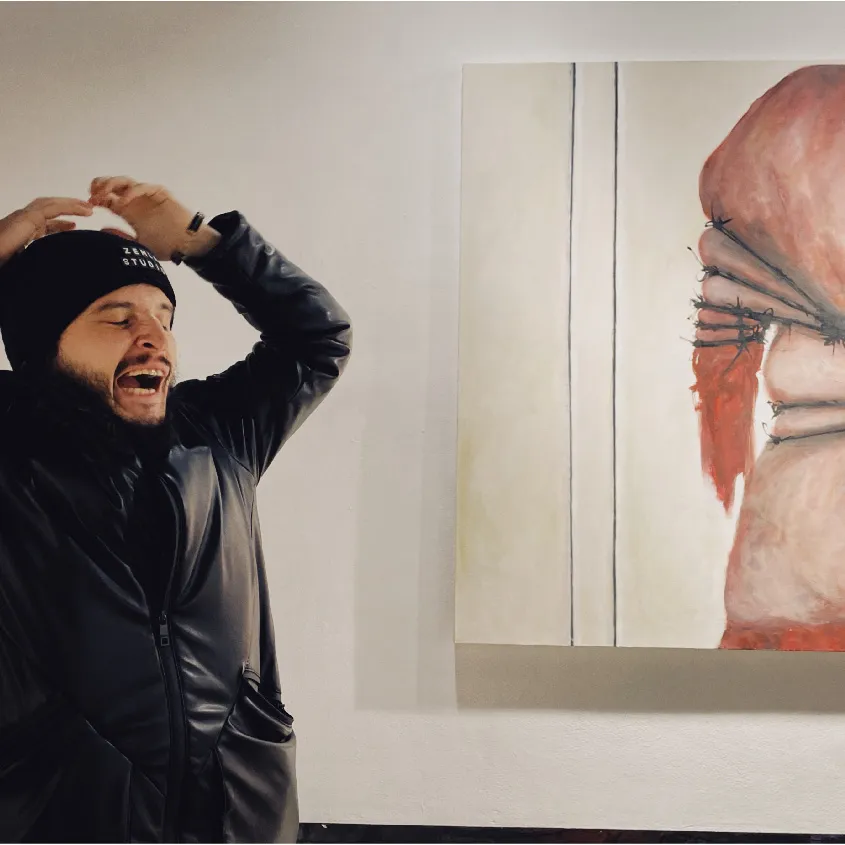
Dr. Myroslav Trofymuk
Born in Lviv. Designer, director, musician, researcher, founder of ZEMLA STUDIO. Master of classical philology and digital marketing, PhD in the history of Ukrainian literature. Member of the National Union of Journalists of Ukraine. Since 2022 he has authored the CENTRUM MUNDI audio show for Polish Radio for Ukraine, continuing the same research into the contemporary music scene in Ukraine and Poland.
Full bio →


