Introductory Remarks: The Birth of the Autonomous Space Fredra 61
There is a large couch in the back, so anyone standing should come through and settle in comfortably—there is room for everyone. I will not stall while the team sets up the projector and connects the video presentation. I simply want to say a few brief words for those joining us for the first time. For a long time, my friends and I harbored the idea of establishing a truly open space in Lviv—a point on the urban map where anyone could drop in freely and where we could host diverse cultural and countercultural gatherings. That is precisely how Fredra 61 came to life, named straightforwardly after its address: 6 Aleksander Fredro Street, Apartment 1.
We have only inhabited this venue for two weeks. Yet over these brief fourteen days, we have already managed to stage a series of compelling events: acoustic concerts, informal performances, and cinema screenings—including Katrusia’s Cinema Hall, a well-known underground film initiative curated by Katrusia. To be completely honest, I am somewhat breathless and nervous, having just dashed over straight from work. Tonight, we have an art lecture on Warsaw, exploring a landmark exhibition recently held in the Polish capital. I am delighted to hand the floor over to Trof—Myroslav Trofymuk Jr. Once the talk wraps up, I will speak again to share a much more comprehensive look at the philosophy behind Fredra 61, our core tenets, and our upcoming plans. Thank you all for gathering here tonight!
Thank you to everyone who joined us in this intimate room tonight. I have accumulated a substantial volume of visual and conceptual material, and we will attempt to navigate these rich layers together. While everyone was arriving, I set a background timelapse film running, which I curated yesterday. If you observed the screen closely, you surely noticed a singular compositional axis: across every single timelapse, dead center in the frame, stands one monolithic structure—the colossal Palace of Culture and Science in downtown Warsaw. That architectural signpost will serve as the springboard for our inquiry.
Warsaw Timelapse and the Monument to Totalitarian Hegemony
This monument is directly intertwined with the exhibition ’In the Heart of the Country’ (W sercu kraju), presented at the Museum of Modern Art in Warsaw (Muzeum Sztuki Nowoczesnej w Warszawie, MSN). In her introductory essay for the exhibition catalog, the museum’s director, Joanna Mytkowska, articulated a striking and unsettling observation: in the very heart of the country lies a gaping void. The geographical center of Poland, the urban core of Warsaw, reveals itself as an abandoned, desolate expanse—Parade Square (Plac Defilad)—where this monumental Soviet high-rise stands. The skyscraper itself personifies this profound desolation.
When you look at glossy promotional travel brochures or commercial timelapses of Warsaw, you are treated to a dazzling spectacle: the municipality illuminated the skyscraper with sophisticated floodlights, traffic streaks past in luminous ribbons, and dynamic capitalist life pulses around the core. Yet one only needs to set foot directly on Plac Defilad to experience an acute, almost visceral dissonance. It is a vast, desolate plateau of cracked asphalt and slab concrete. Unhoused people sleep on benches, marginalized figures wander about, and police cruisers routinely detain drunks. Modern glass skyscrapers housing multinational corporations and luxury hotels encircle the plaza, but their exterior sheen only accentuates the cold void inside.

Here lies a monumental historical paradox. The Palace of Culture and Science was originally officially named the ’Joseph Stalin Palace of Culture and Science’—an enforced ’gift from the Soviet people to the Polish nation,’ erected in the 1950s. Poland was the vanguard of the Eastern Bloc in shattering the communist yoke, orchestrating lustration, and integrating into Europe. Yet the indisputable visual trademark of Warsaw remains this Stalinist skyscraper. Whichever souvenir kiosk you browse—postcards, lapel pins, coffee mugs, or t-shirts—all bear the silhouette of this totalitarian pyramid. Joanna Mytkowska confronts this frozen vacuum, asserting that for the nation to heal, this desolate core must be reanimated through fundamentally new architectural paradigms and vibrant culture.
The Void in the Country’s Heart and the Battle for the Modern Art Museum
Mytkowska deliberately and masterfully plays with geographical and metaphysical concepts. She invokes the notion of ’the geographical center of Poland.’ If you verify this cartographically, Poland’s true geometric centroid is not in Warsaw at all, but in the Lodz Voivodeship, in the small town of Piatek, commemorated by a monument. Yet geopolitically, culturally, and psychogeographically, the unquestioned heart of Poland is Warsaw. Right on Plac Defilad stands a stone milepost marking kilometer zero—the geometric center of Warsaw itself, inscribed with distances to major world capitals. The curator bridges this micro-location with the collective trauma of the entire nation.
It was precisely across this wasteland, right at the feet of the Soviet colossus, that the state planned to construct its flagship cultural institution of the twenty-first century: the permanent home of the Museum of Modern Art in Warsaw. The realization of this project disintegrated into a major international architectural scandal. An open competition had drawn dozens of submissions from premier global studios. The Swiss architect Christian Kerez emerged victorious with a brilliant minimalist proposal. The project reached its advanced design phase: engineers completed 3D simulations, structural load calculations, and technical blueprints.
Suddenly, at the eleventh hour, Warsaw City Hall unilaterally terminated all contracts with Kerez, alleging that the architect demanded inflated fees and exceeded initial budgetary parameters. Last year, prominent Wroclaw architect Zbigniew Mackow visited Lviv; his own studio had submitted a proposal for that very competition. We discussed the debacle at length, and Mackow stated unequivocally that sacking Kerez was an unprecedented blow to Poland’s cultural reputation. He placed Kerez’s structural ingenuity on par with Herzog & de Meuron. The construction was aborted, the blueprint shelved, and all that remains is a 33-second digital fly-through animation. The museum was left out in the cold, lacking a roof.
Architecture of Transparency: The Emilia Pavilion and Institutional Barge Haulers
Yet as the adage goes, every cloud has a silver lining. Deprived of a purpose-built home, the museum secured a temporary residence adjacent to Plac Defilad: the postwar modernist Emilia Pavilion on Emilii Plater Street. Erected in the late 1960s within the rigorous syntax of mature constructivism and functionalism, the building made architectural waves upon completion. The journal Architektura published a feature cover story celebrating it under the banner ’The Renaissance of Steel.’ Theorists of postwar modernism classify such edifices as ’open structural systems resting on a lightweight steel skeleton.’
The defining aesthetic genius of Emilia lies in its floor-to-ceiling glass vitrines running the entire perimeter of the facade. Originally, the pavilion operated as a premier municipal furniture showroom. Its transparent envelope erased the boundary separating the public sidewalk from the interior showroom: a passerby glanced through the glass and perceived the modernist furniture arrangements organically, without coercive advertising slogans. The curators of MSN brilliantly co-opted this functionalist strategy for contemporary art: installations are mounted flush against the glass, eliminating the threshold between art and the street. An artwork begins interrogating the viewer well before they decide to step inside.
Moreover, the dramatic saga of the cancelled museum construction gave birth to brilliant artistic reflections. In 2012, acclaimed Polish artist Pawel Althamer created a monumental figurative sculpture titled ’Burlacy’ (’Barge Haulers’). It is an explicit dialogue with Ilya Repin’s canonical 1873 canvas ’Barge Haulers on the Volga.’ But in lieu of disenfranchised pre-revolutionary serfs pulling a barge against river currents, Althamer sculpted actual employees of the Museum of Modern Art—curators, director Joanna Mytkowska, installers, technicians, and docents. Their faces are rendered with unmistakable portrait fidelity. Straining against heavy ropes, they haul the stalled museum blueprint forward. It stands as an acutely satirical yet moving metaphor of self-sacrificing cultural labor dragging an institution against administrative inertia.
Technical Interlude: Underground Humor and the Irony of Censorship
It is equally symbolic that the Emilia Pavilion sits on Emilii Plater Street. Plater was a noblewoman, folklorist, and commissioned captain in the Polish-Lithuanian insurgent forces during the November Uprising of 1830–1831 against the Russian Empire. That revolt erupted when Tsar Alexander I, and subsequently Nicholas I, dismantled constitutional guarantees, outlawed patriotic student societies, and imposed suffocating censorship backed by secret police repression. History endlessly oscillates along repetitive spirals... Wait a moment, it seems our presentation setup has decided to dramatize this theme literally! The screen froze. The Wi-Fi indicates connected, but the software refuses to advance the slide.
Friends, our apologies for the brief pause! This is our first technical hiccup here; we simply had never tested the Prezi presentation tool on this particular projector rig. We will reboot the application immediately and restore the image.
It is the Warsaw municipal bureaucrats behind the Kerez scandal! They intercepted our Wi-Fi feed so Trofymuk cannot expose the truth about Plac Defilad!
Spot on! The moment our lecture touched upon imperial censorship, police crackdowns, and bureaucratic corruption, the authorities jammed our underground signal. We are officially under surveillance; city hall is panicking! But Lviv grassroots self-organization cannot be throttled so easily. The software has rebooted, the slides are back online—let us proceed!
What Art Is Today, Such Will Poland Be Tomorrow: Occupy Wall Street and Propaganda Irony
Let us return to the Emilia Pavilion itself. If one approaches the structure from the rear along Emilii Plater Street, the eye is arrested by a massive facade installation. This large-scale work by Dawid Radziszewski and Zbigniew Rogalski is titled ’Prognoza’ (’Forecast’, 2012). Rendered across an expansive white plane in commanding lettering is the bold slogan: ’Jakie sztuka dzisiaj, taka Polska jutro’ (’What art is today, such will Poland be tomorrow’).
I asked the museum curator why they chose to mount the piece on that rear flank, where the standard tourist traffic seldom wanders. She explained the purely formal spatial rationale: only that uninterrupted facade plane accommodated the full string of text without awkward breaks or truncations. Yet the conceptual density of the slogan is explosive. On one hand, it mimics the bombastic socialist realist agitprop of the communist PRL era, such as ’How we labor today determines our motherland tomorrow.’ On the other, it establishes a direct dialogue with the Occupy Wall Street movement that erupted in New York in the autumn of 2011.
The Occupy movement emerged as a thunderous rebellion against corporate impunity following the 2008 subprime financial crash. Citizens flooded Lower Manhattan and seized Zuccotti Park, demanding structural accountability. The global public recoiled when video emerged of an NYPD commanding officer casually pepper-spraying peacefully seated young women directly in the face. That footage catalyzed millions across social networks. Federal authorities panicked to such an extent that the FBI coordinated counter-surveillance, quietly classifying peaceful civil assemblies under counter-terrorism rubrics before violent evictions followed. Rogalski and Radziszewski use this juxtaposition to formulate an uncomfortable critique of institutional art: can an art museum genuinely serve as a vector of societal transformation, or does it merely commodify radical protest into harmless, decorative spectacle? Notice, too, the typography of Occupy—it practically mirrors the iconic lettering of Poland’s Solidarnosc union from 1980.
Spatial Deconstruction: Anna Zaradny’s Sonic Gesture and the Revolutionary Calendar
The moment you cross the threshold of the Emilia Pavilion, you are greeted by an acoustic intervention by the renowned experimental composer and sound artist Anna Zaradny. Hidden directly above the entryway is a miniature speaker. A calm female voice methodically decomposes the word ’museum’ into isolated phonemes and syllables: ’M... U... Z... E... U... M.’ These acoustic particles scatter into spatial dissonance, collide in apparent entropy, and gradually coalesce back into the unified word ’MUZEUM.’ Typographically in Polish, the word possesses inherent geometric symmetry, but Zaradny’s sonic treatment subjects it to radical deconstruction. She lays bare the friction between structural order and chaos, mapping the fragile equilibrium across the triangle of Artist, Institution, and City.
 NIEZALEZNOSC1:46:54CONTRASTS XXIII | BETWEEN CONCEPTUALISM AND SOUND-ART. DISCUSSION ABOUT CONTEMPORARY MUSIC IN LVIVvia: Anna Zaradny

The crowning installation of the exhibition was a semi-performative conceptual piece by acclaimed Scottish artist Ruth Ewan titled ’A Revolutionary Calendar.’ In the main entrance foyer, spanning a massive white wall, Ewan installed an expansive calendar structurally mimicking a Catholic Advent calendar. Within Polish Catholic society, the Advent calendar is an intimate domestic artifact, used by families to count down the days of fast toward the Nativity of Christ. But Ruth Ewan inverted this devotional framework with secular, anti-clerical radicalism.
Ewan excavated the French Republican Calendar of 1792. Upon seizing power, the Jacobins sought to obliterate the Gregorian framework along with its theological baggage. They instituted a decimal regime across human existence: Year I of the new era commenced on September 22, 1792—the autumnal equinox and the proclamation of the French Republic. The year was partitioned into twelve months of exactly thirty days each, with the remaining five or six days designated as revolutionary holidays honoring the working class, the sansculottides. The seven-day biblical week was abolished in favor of ten-day decades. Decimalization invaded geometry itself, recalculating right angles into 100 degrees rather than 90! Months received lyrical agrarian names: Vendemiaire (grape harvest), Brumaire (fogs), Frimaire (frosts), Nivose (snows). Instead of saints’ feast days, every day commemorated agricultural fauna, flora, or implements—the Day of the Shovel, the Day of the Chestnut, the Day of the Ox. Ewan revives this pre-industrial egalitarian cosmology as a trenchant critique of capitalist temporal regimentation.
Synchronicity of Rebellion: The Maidan, Aeronauts, and the Sockets of Ruins
While studying the exhibition, I had the privilege of conversing with MSN curator Natalia Sielewicz. She recounted a stunning episode. In early December 2013, Sielewicz met Ruth Ewan at Warsaw’s Chopin Airport. They stepped into her car, turned on the radio, and the opening broadcast announced that revolution had erupted in Kyiv and Lviv—hundreds of thousands of Ukrainians were flooding the streets in defiance of tyranny. Sielewicz confessed that chills ran down her spine: their ’Revolutionary Calendar’ installation had been commissioned twelve months earlier, when no one could have predicted the Maidan uprising. Yet the zeitgeist of insurrection was already humming in the cultural ether, rendering the artwork mystically synchronous with living history.
Adjacent to the calendar, a monumental video work by the art collective Aeronaut M.K. titled ’Commitment’ was playing. Recorded inside an auditorium of the same Soviet Palace of Culture and Science, it portrays a large assembly of Warsaw’s Vietnamese diaspora. Figures sit at podiums, unfurl banners, debate passionately, and cast votes by raising hands. Yet the soundtrack deliberately obfuscates the dialogue: are they an insurgent political committee, a workers’ union, or participants in a recreational roleplay? The artists obscure the specifics, transforming the scene into an open canvas where each viewer projects their own reading of communitas—civic solidarity. Standing in stark contrast to this collective kineticism was a suite of monochrome paintings by Rafal Bujnowski titled ’Oczodoly’ (’Eye Sockets’).
Could you clarify, please—is that genuinely traditional easel painting? Are those individual stretched canvases, or a massive continuous wall mural?
It is authentic easel painting—thick oil on stretched linen! A digital projector struggles to translate the tactile optical illusion. Bujnowski applies heavy brushstrokes along strictly measured counter-directional axes. This microscopic impasto texture catches ambient gallery light in such a way that the flat plane manifests uncanny three-dimensional depth. The subject matter depicts ’oczodoly’—the black, vacant window apertures of abandoned, unfinished concrete carcasses. This imagery strikes an agonizing chord with Ukrainian reality: take any highway out of any regional center, and you are surrounded by skeletal brick mansions and factories, commenced in speculative euphoria and abandoned to the elements. They are the blind eye sockets in the skull of unfulfilled modernization—monuments to economic folly and wasted human labor.
This canvas converses intimately with the documentary film on the Polish Solidarnosc movement that we screened here at Fredra two weeks ago. In that documentary, contemporary Polish youth confront grey-haired veterans of the underground resistance with a devastating interrogation: ’What happened to your solidarity?’ The camera cuts across contemporary Warsaw streets where purse-snatchers rob elderly women in broad daylight and atomized citizens retreat behind armored apartment doors. Just two days ago, I watched a Polish television documentary tracking a Warsaw household that subjected itself to an extreme sociological experiment: for one month, they surrendered smartphones, hypermarkets, internet access, and credit cards to replicate daily life in 1980s communist Poland—navigating rationing coupons, queues, and scarcities. At the experiment’s conclusion, the father offered a poignant verdict: ’We secured brimming supermarkets and boundless consumer goods, but somewhere along the asphalt, we forfeited a piece of our fundamental humanity and communal warmth.’
 LIVE1:38FROM WROCŁAW WITH FREDRAvia: Fredra · Aleksander Fredro
Critical Memory: From Lego Bricks to Karaoke Protests
May I ask a clarifying question? Are all these disparate artworks you describe gathered under a single overarching exhibition curated by Mytkowska, focusing specifically on the concept of the central void?
Yes, thank you for raising that! The exhibition ’In the Heart of the Country’ was an ambitious retrospective of the permanent collection that the Museum of Modern Art in Warsaw assembled across years of active acquisition. In total, it displayed approximately 150 seminal works by artists worldwide—spanning the United States, Germany, Russia, Romania, and Ukraine. While the full show addressed multiple discourses, for tonight’s lecture I specifically distilled one conceptual spine: how contemporary art interrogates totalitarian trauma, state power, insurrection, and the viability of societal transformation.
Within this terrain, one cannot bypass one of the most explosive masterpieces of late twentieth-century European art: Zbigniew Libera’s 1996 installation ’Lego. Concentration Camp.’ Libera acquired standard plastic components from the Lego company and constructed an immaculate, chilling scale model of an extermination camp: prisoner barracks, electrified barbed wire, watchtowers mounted with sentries, crematoria, and gaunt plastic skeleton figures. The work interrogates an unsettling realization: how mechanisms of state violence, regimentation, and normalized militarism are stealthily imprinted upon human consciousness from infancy via seemingly benign toys—toy rifles, soldier figurines, and police truncheons. The Lego Group initially provided the artist with free bricks for an unspecified creative project; however, upon witnessing their trademark branded across sets reading ’This work by Zbigniew Libera has been sponsored by Lego,’ corporate executives initiated lawsuits! The legal threat was abandoned only after the piece was acquired by the Jewish Museum in New York.
Did anyone in Poland ever investigate the ethnic background or nationality of the Lego CEO at that time?
A witty question indeed! I promise to look into the biographical background of Lego’s Danish executive leadership as soon as I get home. The subsequent history of the artwork is revealing: Libera produced merely three authenticated sets, each packaged in seven distinct cardboard boxes. The first is housed at the Jewish Museum in New York, the second at the Haus der Geschichte in Bonn, and the third remained with a private collector. The Museum of Modern Art in Warsaw acquired this third edition for 245,000 Polish zlotys (roughly 55,000 euros). Notably, half of that purchase was underwritten by the Society of Friends of MSN—exemplifying how civic patrons step up to finance difficult, unvarnished critical art.
Next to Libera’s sets stood an acerbic video installation by Russian artist Ivan Brazhkin titled ’Karaoke of Protest’ (2012). It compiles documentary footage of street clashes, barricades, and demonstrations from across the globe. Along the lower margin runs a karaoke-style subtitle strip displaying militant protest chants. A visitor approaches the microphone and bellows revolutionary slogans from struggles they never participated in. It acts as both a satirical gym for armchair rebels and a critique of how bourgeois leisure defangs socio-political rage into harmless entertainment. In a related vein, American artist Sharon Hayes, in her performance ’Warsaw in the Very Near Future’ (2008), walked the plazas of the Polish capital shouting historic American anti-Vietnam War slogans through a megaphone. Pedestrians halted in bewilderment: why is an English-speaking woman in contemporary Warsaw denouncing the Vietnam War? This Brechtian alienation effect jolts citizens out of domestic complacency, prompting critical reflection on historical amnesia.
Iconography of Resistance: Masked Liberty and the Ukrainian Presence in Warsaw
This vein of direct public intervention continues in the reportage graphics produced between 2009 and 2011 by Russian artist David Ter-Oganyan. These are rapid, razor-sharp sketches capturing clashes on Moscow’s Manezhnaya Square, unrest in Nagorno-Karabakh, and riot police detaining protesters. Executed like courtroom sketches where photography is strictly prohibited, the artist documents the spasms of state brutality with photographic immediacy. Beside them sits Romanian conceptualist Daniel Knorr’s intervention ’Stolen History.’ Knorr knits black wool balaclavas and pulls them over the bronze heads of canonized public monuments. This visceral gesture forces a reckoning: were these historical icons valiant freedom fighters or ruthless terrorists in the eyes of their contemporary regimes? The crescendo of the project is a colossal balaclava, custom-tailored to the proportions of the Statue of Liberty in New York Harbor.
It was immensely gratifying to discover works by two premier contemporary Ukrainian artists included in the MSN permanent collection. The first is Zhanna Kadyrova with her signature asphalt sculptures. Kadyrova literally saws out sections of municipal road pavement, bitumen, and aggregate stone. Initially, she mounted these raw rectangular slabs inside gilded frames as street landscapes; for Warsaw, she sculpted an immaculate globe—a planet Earth carved entirely from industrial asphalt. A dizzying ontological question emerges: if this asphalt globe is placed back onto a public highway, it instantly dissolves into the mundane roadbed, relinquishing its aura as high art. Simultaneously, it embodies an apocalyptic ecological emblem of a planet choked beneath concrete during unbridled industrial expansion.
The second Ukrainian piece is a video installation by Kharkiv-born artist Mykola Ridnyi titled ’Monument.’ Ridnyi filmed the dismantling of the Soviet monument commemorating the proclamation of Soviet power on Constitution Square in Kharkiv—a monument locals facetiously christened ’Five men carrying a refrigerator out of a pawn shop.’ The camera observes jackhammers and industrial cranes systematically dismembering the granite Bolshevik figures. Yet Ridnyi’s philosophical inquiry cuts deeper than superficial anti-communist triumphalism: toppling an ideological idol is effortless, but who or what will society erect upon this vacated pedestal? Will we merely replace old dogmas with new, equally coercive idols?
Lastly, to conclude our exploration of the Emilia Pavilion, let us revisit Ruth Ewan’s decimal time subversion. Mounted on the wall of the museum’s subterranean lecture theater hangs her conceptual timepiece ’We Could Have Been Anything We Wanted.’ Superficially, it appears to be a standard minimalist wall clock. Yet in place of twelve hours, the clock face is demarcated into ten decimal units, with hands moving to decimal seconds! It was comical to watch Polish lecturers mid-discourse instinctively glance at the clock, see the hand pointing at seven, and freeze in utter cognitive disorientation, mentally wrestling with how many minutes remained in their lecture. This elegant gesture exposes how thoroughly our waking thoughts, labor shifts, lunch hours, and sleep cycles are conditioned by arbitrary temporal metrics designed for industrial efficiency. Thank you for your attention! That brings our slide presentation to a close.
Fredra 61 as Autonomous Space: The Grassroots Cultural Manifesto

Thank you, Trof! While the technical team switches the laptop inputs and routes the audio into our larger speakers for the screening, I want to step up and articulate what I had to cut short earlier. Where did the impetus for Fredra 61 truly originate? Everyone living and working in Lviv recognizes the daily grind: the clock strikes six in the evening—and where does a young, energetic person go? The options are depressingly narrow: either trudge home to mindlessly scroll Facebook feeds, or head to a commercial pub or rock club and drink away your wages. The existing venues across town are either strictly commercialized—pressuring patrons to purchase overpriced beers or cover charges—or stultifying state institutions suffocated by academic elitism, where one cannot breathe freely.
We resolved to shatter that paradigm by building a venue of an entirely different nature. Fredra 61 is an autonomous forum of radical hospitality. You can walk in any evening after six o’clock, head into our communal kitchen, brew tea or coffee, bring a bottle of wine or beer from the corner shop, sink into a couch, read, converse with friends, or listen to records. We charge zero admission, enforce no door policies, and answer to no grant agencies or political benefactors. Everything surrounding you was scavenged or donated by our collective. I brought forty kilograms of walnuts from home and dumped them in the kitchen—crack them and eat at will. Someone spotted an abandoned velvet sofa on the street—we hauled it up three flights of stairs, scrubbed it clean, and placed it alongside others. Friends brought tables and floor lamps. We pooled our personal pocket money to buy this video projector, because no one wanted to part with their living-room unit, and we stitched the fabric projection screen by hand.
The sole financial engine sustaining this roof is an ordinary three-liter glass jar sitting on the kitchen table. If you appreciate the atmosphere and wish to support our rent and utility bills, drop a few hryvnias inside. If your pockets are empty, it matters not—come in, converse, and belong to the community. We intentionally reject academic protocol: you can walk in mid-lecture, pour yourself a drink, step outside for fresh air, and wander back without receiving a single scowl. Behind Fredra 61 stands a core of around twenty proactive young people from Lviv—architects like myself, painters, electronic producers, and translators—who yearn to see their city vibrate with unscripted life.
Our programming mutates nightly. On Wednesdays, Roman Kleputs hosts Classical Wednesday—informal salons exploring symphonic literature and rare vinyl recordings. On Thursdays, Katrusia packs the salon for her underground cinema hall. Last Friday, we held an uninhibited musical marathon: we projected two legendary live concerts by Bratia Hadiukiny back-to-back for four straight hours—people sprawled on floor cushions, sang along, and embraced. On Saturday, we staged an intellectual lecture followed by a late-night session on global techno history. In a few weeks, we are organizing a masterclass on rolling handmade sushi. We observe no rigid boundaries: whereas downtown rock clubs spin the same predictable blues-rock loops, Fredra plays adventurous electronics, funk, ambient textures, and experimental jazz.
Our most emblematic breakthrough occurred two Saturdays ago. Two foreign investigative journalists—one from Italy, another from France—arrived in Lviv. They urgently sought candid interviews with leaders of Ukrainian football ultras regarding their pivotal frontline role in street clashes during the unfolding revolution. Instead of huddling in a dim corner of some commercial cafe, we phoned our local ultras contacts and convened an open public press conference right here in this room! The salon was overflowing; the foreign correspondents fired sharp, unvarnished questions, and the football fans responded with raw honesty about the barricades. It was electric. So if you have spare rugs, standing lamps, armchairs, or volumes of poetry, or if you harbor an idea for an exhibition or theoretical lecture—step forward and build it! Fredra 61 belongs to everyone who animates it. Now, let us roll the film!
Finale: Is Art Truly Capable of Transforming Reality?
Returning to the core thesis of our gathering—’Revolution in Art and Artistic Revolution.’ Just last week, my close friend Marian Vorovets urged me to watch an exceptional documentary. I watched it in a single sitting and instantly realized we needed to screen it here at Fredra for as broad a circle of critical minds as possible. This documentary investigates our fundamental dilemma: who is the artist in the twenty-first century? Do cultural practitioners command genuine agency, and can contemporary art escape the sterile white cube to shatter civic apathy and steer the trajectory of living history?
For those among you who wish to delve deeper into the Polish cultural debates, I warmly recommend looking up the extensive interview with MSN curator Natalia Sielewicz published in the art journal Magazyn Szum on the 27th. In it, she unpacks profound reflections on how a contemporary museum navigates the tension between raw political insurrection and institutional survival. Now, we shall extinguish the lamps and commence the screening. Thank you all for your presence, and enjoy the film!
- Markiyan Maksymyuk [person]person · “Fredra 61”: what is it?
- Anna Zaradny [person]person · “The artist effect” or artistic déjà vu?
- Ruth Ewan [person]person · “The artist effect” or artistic déjà vu?
- Christian Kerez [person]person · “The artist effect” or artistic déjà vu?
- Mykola Ridnyi [person]person. T.A.M. Club / Centrum Mundi corpus · Venice Biennale, Days of Ukraine in London, and Ukrainian Cross-Section
- Myroslav Trofymuk Jr. [person]person · C-Day
- Revolutionary Calendar [work]work · “The artist effect” or artistic déjà vu?
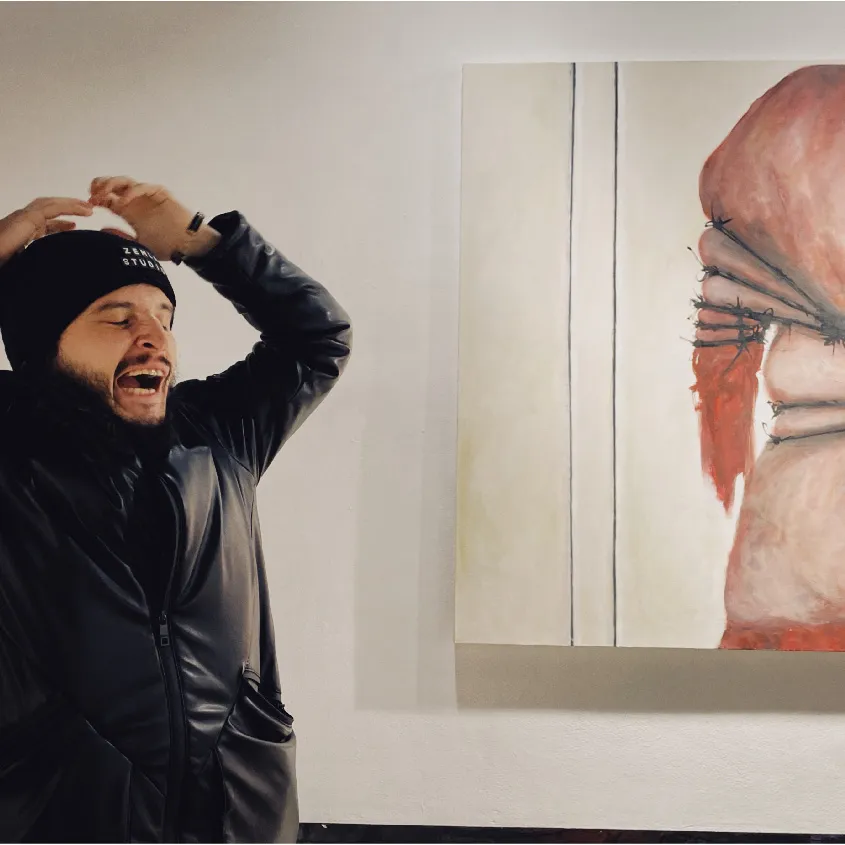
Dr. Myroslav Trofymuk
Born in Lviv. Designer, director, musician, researcher, founder of ZEMLA STUDIO. Master of classical philology and digital marketing, PhD in the history of Ukrainian literature. Member of the National Union of Journalists of Ukraine. Since 2022 he has authored the CENTRUM MUNDI audio show for Polish Radio for Ukraine, continuing the same research into the contemporary music scene in Ukraine and Poland.
Full bio →