
The Meridian Czernowitz International Poetry Festival is not just poetry and prose — it is a cocktail of cultures, a “mix” of languages, unconventional locations and the blurring of the familiar boundaries typical of literary festivals…
For all the extravagance of its form, Meridian Czernowitz has a measured, well-balanced rhythm. Thanks to the festival’s director, Iryna Vikyrchak, and its president, Sviatoslav Pomerantsev, the heart of the festival always beats steadily, while the hearts of its visitors and listeners, by contrast, race on poetic doping. The organisers never tire of stressing the festival’s German punctuality, which ensures that events do not overlap and visitors have plenty of time to get from one location to the next. Sviatoslav Pomerantsev places particular emphasis on Meridian Czernowitz as a platform for new contacts: every year the festival brings talented people together in Chernivtsi and creates fertile ground for the development of literature in Ukraine. This year the festival embarked on a literary expansion, with the offensive advancing on two fronts: the first, Central and Western Ukraine; the second, the traditional one: “On to Berlin!”

First, the poetic wave captured the capital: on 4 September, at 19.00 Kyiv time, an intercontinental SURFACE-TO-SURFACE poetry missile codenamed “Meridian Czernowitz” struck Kyiv. The pathogen of festival frenzy and rhyming fever spread at colossal speed, provoking a movement westwards.

The second target: Lviv. The smell of autumn hung in the air. The city’s familiar traffic jams were lulling its residents to sleep. In the Palace of Arts, the final preparations were under way for the 20th, anniversary edition of the Publishers’ Forum. On Monday, 9 September, at 21.01 local time, a mixed poetic landing force touched down at Lviv railway station. Several fighters of Ukrainian literature were carrying out separate and, it seems, secret operations behind the lines of book lovers and literature buffs (in the Kyiv–Chernivtsi sector, after heroically completing his shift as moderator, Dmytro Lazutkin got off the train; on his way to Lviv, Yurii Andrukhovych got off in Ivano-Frankivsk, where he presented his musical and poetic performance with the band Werwolf Sutra; Izdryk, so eagerly awaited in Chernivtsi, displayed his poetic mastery only in Lviv; and Andrii Liubka, the darling of female readers, never made it to the Forum at all, though he did turn up in Chernivtsi).

Meanwhile, the leading hero of the poetry events — not only a sharpshooting scribe but also a crack reciter of Ukrainian literature, a frontline word-gunner — was the “sapper of human souls”, Serhii Zhadan. The poet displayed brilliant skill both as a “one-man army” and in paired readings, as well as in “group” literary operations, such as the sortie codenamed “Poetry of the Dormitory Districts”, in the course of which an international “peacekeeping” unit delivered “poetic provisions” to one of the remote corners of Chernivtsi. Once Central and Western Ukraine had been “poeticised”, it was time for the plan of international invasion: “Meridian Czernowitz” headed for Berlin.

Such was the literary September of 2013. But let us go back to Kyiv. 18.30 Kyiv time: outside the building at 1/3-2 Baseina Street — the home of the PinchukArtCentre — people begin to gather. There are not as many as usual: a few journalists, some lad with a camera. For four months now the Centre has been showing an exhibition of contemporary artists from China under the fitting title “China China”. Its motto: the interrelation of the individual and the collective. Works made in the Far East turn out to be strangely relevant to us too: at the entrance to the Centre I am asked, as usual, to take out all metal objects and walk through the “arch”. I walk through. The arch stays silent. The Centre’s security, naturally, defends contemporary art with self-sacrificing zeal, and so asks for cameras and other equipment to be left at the entrance. The besuited guards have trouble finding me on the list of accredited journalists — no wonder: it seems they cannot find the list either.
18.48. After phone calls, a hunt for a manager and negotiations among the girls on the Centre’s reception desk, Meridian Czernowitz’s press secretary, Lilia Shutiak, finally manages to convince the staff that I am an accredited journalist and that my name was agreed the day before.
18.53. I show security my “press badge”. Just then an English-speaking woman is being made to put down all her belongings and walk through the “arch”. She is bewildered: she does not understand why her camera has been taken away, or what she is supposed to do with a big plastic cloakroom token. At last the list of journalists turns up. I point to my name on it. The guards confer and, taking pity on me, hand back my camera.

18.59. The room on the Centre’s third floor is packed. There are students and older people, a few journalists, camera operators, big and small photo and video cameras. I spot Yurii Makarov: peering intently, he is straining to make out what is going on inside “Movement Field”, an installation by the Chinese artist Xu Zhen. Tellingly, it is with this very work that the readings begin. In his installation Xu Zhen recreates the artificial space of a garden that looks peaceful and calm from the outside. Next to the moss and plants we see paintings and some kind of wax imprints. In fact, the garden is made of protest routes superimposed on one another: it copies the paths along which people marched to fight for their rights. The idea of the work is movement that leads to change. The concept intertwines perfectly with the idea of the Meridian Czernowitz festival, whose organisers are in fact staging a literary and cultural revolution.

The honour of opening the readings fell to Ihor Pomerantsev, who presented his twenty-minute recital as a journey — a journey through his own poetry, from his earliest work to his latest: “You will be able to follow what my poetry turns into — perhaps an old woman, or perhaps a Prague Beetle, since it is in Prague that I now live,” Ihor Pomerantsev added. And so, under the motto “Movement Field”, various aspects of movement came together: the conceptual idea of the passage of time in Ihor Pomerantsev’s poetry; the cultural development that the organisers proclaim through their festival; and, on top of that, an epigraph to the festival’s subsequent events, for which movement was the key — after all, if you think about it, the poets read their work along a stretch of more than a thousand kilometres…

The train sped on. To the rhythm of the wheels, the German-language authors built their regular geometric figures, deftly laying their lines of verse into the squares of the train’s rhythm; the Ukrainian-language poems pulsed with the measured cadences of Serhii Zhadan, Svitlana Povaliaieva and Dmytro Lazutkin, the free verse of Taras Malkovych and the lacework imagery of Marianna Kiianovska and Kateryna Babkina. Incidentally, it was Kateryna Babkina who curated the “300 Chinese Men” readings: her work made possible everything that happened at the PinchukArtCentre on 4 September. By the time you finish this article you will see that these are not empty words: a truly colossal amount of work went into it. Babkina managed to find a parallel between every artist and every poet, between installation, sculpture or painting and poem. I will commit the sin of one more grand phrase: she managed to build a cultural bridge, to open a three-hour cultural portal between China and Ukraine, discarding everything superfluous and focusing on what the two have in common.

19.36. The second location. Cao Fei, “Eyeliner” (in Ukrainian, even that rhymes). A woman’s touch is immediately apparent. “Eyeliner” is a glass pavilion slotted right into one of the Centre’s rooms. In effect, it is a clothes shop. You can wander inside, make yourself a coffee, sit down in an armchair, pick up an item of clothing and… read a story on its label — a story that perhaps tells of the garment’s owner, so that we can picture in detail who the person was who wore this or that dress. It was here, at the epicentre of all things feminine, in a kind of boutique of women’s dreams, a second-hand shop of human stories, that Svitlana Povaliaieva, Kateryna Babkina and Marianna Kiianovska read their poems. It is the classic situation: in some place where women feel at ease — a boutique, a beauty salon or a hairdresser’s — a few random women come together who have never seen one another before and, quite possibly, will never see one another again, though it is even more likely that they will become friends for life or, if not for life, then at least until one of them breaks the commandments of intimate female friendship. Waiting in the queue for the till, or drying their hair or a fresh manicure, these women talk about what weighs on their hearts: social status does not matter here, nor do political, religious or whatever other convictions; what matters to them are stories, simple situations lived through recently, a while ago or a very long time ago (usually stories of unhappy love or, conversely, of living happily ever after). They tell their own stories and other people’s — nobody worries about copyright here; what matters is the process of communication itself, the support, the emotions, sharing their innermost secrets or, conversely, hiding them behind yet another story about the neighbours or a colleague. The second location was composed in the form of just such a poetic get-together. Three women who were anything but random — the socially sharp Povaliaieva, the dreamy Babkina, the enigmatic and fanciful Kiianovska — told their “bodily stories” inside the glass pavilion, while outside the listeners, indulging in poetic voyeurism, pressed themselves against the panes, satisfying their curiosity, eavesdropping, trying to find the answer to the question: “What do women want?”

Incidentally, behind the listeners’ backs Ai Weiwei’s towering “skyscrapers” rose to the ceiling, made of five hundred and fifty (550) bicycles bearing the word “Forever”. Next to the gigantic forms of these “bike-rises”, Cao Fei’s individual stories turned into a dialogue between the personal and the collective. In Ukrainian, the title of the installation, “Forever Bicycles”, has been translated as “Bicycles Forever”, but the wordplay may in fact be more interesting than this rendering of a motto that could make a fine slogan for yet another “European Mobility Week”. For, on the one hand, the title of the work is the name of a Chinese company that makes bicycles; on the other, we can read it as yet another association with movement: the phrase “perpetual bicycles” calls to mind the well-known “perpetuum mobile” — the perpetual motion machine — since the bicycle is a means of transport identified with motion. Ai Weiwei aptly finds a parallel between the company’s real name and the idea of movement, “…building a new landscape of China out of traditional Chinese bicycles”, in the words of the exhibition’s curator, Björn Geldhof. The traditions on which the new China is being built matter to Ai Weiwei, and this work seems to say: “We remember our history, our traditions are solid; we will take everything we have and build something new on it, and this new thing will be all the more stable thanks to such a foundation.” Sadly, a Ukrainian counterpart of this work would carry a gloomier subtext: if we tried to build such structures out of “Ukraina” bicycles, then, in deference to the manufacturer, the work would have to be called “Ukraine. Made in the USSR”.

20.05. I walk through a room of figures in suits and dresses sitting in leather armchairs. Instead of heads they have huge boulders, while at their feet children play, crawling on all fours between the armchairs with enormous cardboard boxes over them, grunting like pigs. I walk on. In the next room is perhaps the most interesting work in the whole exhibition — a collective performance by Sun Yuan and Peng Yu, whose title the Centre’s staff have translated as “Seeing Is Not Enough” (although, given the work itself, the English “Seeing is not an option” would be better rendered as “When You Cannot See”). In an iron cage crammed and hung with real weapons sit eleven men, with Kalashnikovs lying on the table in front of them. Every now and then the men stand up and tie black rags over their eyes; one of them, apparently the leader, bangs his hand on the table, and they begin to strip and reassemble their AKs blind. The whole thing is repeated in cycles several times; after each cycle, each man passes his rifle on to the next. Their actions are linked — each man’s task matters to the whole process, since one man’s mistake will affect the work of the next, and in the end the entire system may collapse. When the cycles are over, they sit down again and lay their AKs beside them.

The performance is a vivid reminder of how pressing the problem of armed conflict remains. At the same time, it is also an apt illustration of how a mechanism, a system — ultimately, a state — functions properly. The collective rests on the individual. The system is built on its individual participants, and it requires everyone to act in concert. The leader — the one at the top of the system, who gives the orders — bears the greatest responsibility. But at the same time he depends on the rest: he has to listen to every participant so as not to give the signal too early; only when the clatter dies down can they carry on. The negative emphasis of this work is stronger than the positive: in the end, it is just a handful of people locked in a cage, blindly and mindlessly repeating the same action, carrying out commands without thinking about the orders. The powerful emotional charge that Sun Yuan and Peng Yu’s performance unleashes on its audience could be “tamed” only by Serhii Zhadan, who, with his poetry of slogans, his ironic post-Soviet sketches and his ballads about the Ukraine of the nineties, fires off bursts of verse from the stage and hits young Ukrainian hearts dead centre, summoning the spirits of rockabilly and psychedelia and conjuring up punkish little devils. When his poetic-political calls ring out from the stage, Jim Morrison, Robert Plant and Bob Dylan watch him in amazement from their little rock-and-roll cloud, while somewhere in a parallel reality David Duchovny’s character Hank Moody, drinking himself into despair yet again, curses his own lack of talent. Zhadan has been talking about the grey daily grind of Mother Ukraine for a good ten minutes when suddenly a girl comes up to me and asks in Russian whether I know the poet’s name. “Zhadan… Serhii Zhadan!” I reply. To be sure, the girl taps something into her mobile.

20.49. Another hour to go and three more locations ahead. The eleven figures put on their jackets and leave the hall, leaving their AKs in the cage. The audience returns to the room with the “stone-headed beau monde” in leather armchairs. People make themselves comfortable among the sculptures, sitting right on the floor. Oleh Skrypka walks into the hall, greets Serhii Zhadan and has a quiet word with him. The next location is another work by the same Sun Yuan and Peng Yu, entitled “Teenager Teenager”. The figures sitting in the armchairs symbolise the older generation: people who have achieved something in life but whose minds are already formed and set in stone. These mannequins observe what is going on around them but are incapable of communicating; meanwhile, at their feet something more interesting is happening, something that is in fact the very object of their observation: children in cardboard boxes, playing and communicating. The children’s view of the outside world is not yet formed: they see only a tiny part of it — whatever they can glimpse through the slits in the box. A well-chosen image for illuminating the conflict of generations. That night, however, both groups saw more than usual. They saw and heard poetry — the poetry of the German-language authors Hans Thill and Ann Cotten. Once again a clash between two seemingly different generations is inevitable, but conflict is avoided through dialogue — in this case, a poetic dialogue. Eventually this dialogue grew into a poetic triangle: the authors communicated with each other and, thanks to Serhii Zhadan, with the audience too: it was he who read out Andrukhovych’s translations of Hans Thill’s poems and his own translations of Ann Cotten’s work.

21.21.21. The next location. In a huge hall with uprooted tree roots on the floor, there seem to be more people — or perhaps it only seems so to me: the illusion is created by a gallery of 1,001 portraits along the walls. To the right stand Iryna Vikyrchak and Sviatoslav Pomerantsev, deep in lively conversation with Christof Weil, the German ambassador. Two works by Ai Weiwei installed in this hall, “Fairytale” and “Rooted Upon”, echo each other with a similar idea. “Fairytale” consists of a thousand and one portraits of people on the walls, intended to draw attention to the relationship between the individual and the collective: a thousand individuals form a mass, while one individual remains one. In 2007 Ai Weiwei invited these people to the contemporary art exhibition documenta 12 in the German city of Kassel; all of them were boundlessly happy to have the chance to see Europe and one of the top events in the contemporary art world, yet their surroundings were utterly alien and incomprehensible to them — and it was in these circumstances that he documented them in photographs. The tree roots, uprooted in various corners of China and brought by the artist into the exhibition halls, symbolise lost souls torn from their familiar environment: a hint at being cut off from tradition, at losing touch with the history and context of one’s country.

It was in the middle of this dead garden — or rather, in the middle of a hint of a garden — that the longest readings by German-language authors took place: Michael Donhauser, Marion Poschmann, Erich A. Richter and others. The oppressive atmosphere of the unknown, like a cosmic gloom and cold, alive and yet dead at the same time, was heightened by the darkness in which the authors read. This location became the perfect backdrop for the poems of the Israeli poet Amir Or, in which one hears an echo — and at times a full-throated cry — of the events of the last century that were so tragic for the Jews. The theme is very close to Amir Or’s heart, as his grandmother and grandfather perished in the Holocaust.


22.04. The last location. In the spotlight are two authors, Oles Ilchenko and the poet Iryna Vikyrchak, with a reading entitled “The Way Above All” inside “Spirit Above All”, a work by the young artist Zhao Yao. The three-tier work consists of photo wallpaper showing various monasteries in Tibet. The main elements of the exhibit are abstract paintings of geometric figures, in which the artist goes on playing with form even at the level of the shape of the works themselves, stepping “outside the frame” of the traditional rectangle. The third tier is the most interesting, because it fills the form of the paintings with content: Zhao Yao takes his paintings, loads them into the boot of a car and drives them 4,000 kilometres to Tibet, where a monk blesses them. Along the way the artist photographs his journey and later puts the photos into an album. Now anyone can leaf through these albums: special prayer mats lie on the floor, and next to them the albums that tell the story of the paintings. Interestingly, the path the paintings travel echoes the biblical Way of the Cross, and the photo albums could be a modern counterpart of the Book of Books in pictures.

As I mentioned at the outset, this was only the beginning. The last location of the Kyiv readings became the starting point for the fourth Meridian Czernowitz poetry festival — a festival that is constantly on the move and developing, and is therefore growing, maturing, getting wiser and gaining experience. What followed was a frenzied literary September, and next year, you can be sure, the organisers will have something even grander and more poetic in store for us.
Photos: Myroslav Trofymuk Jr
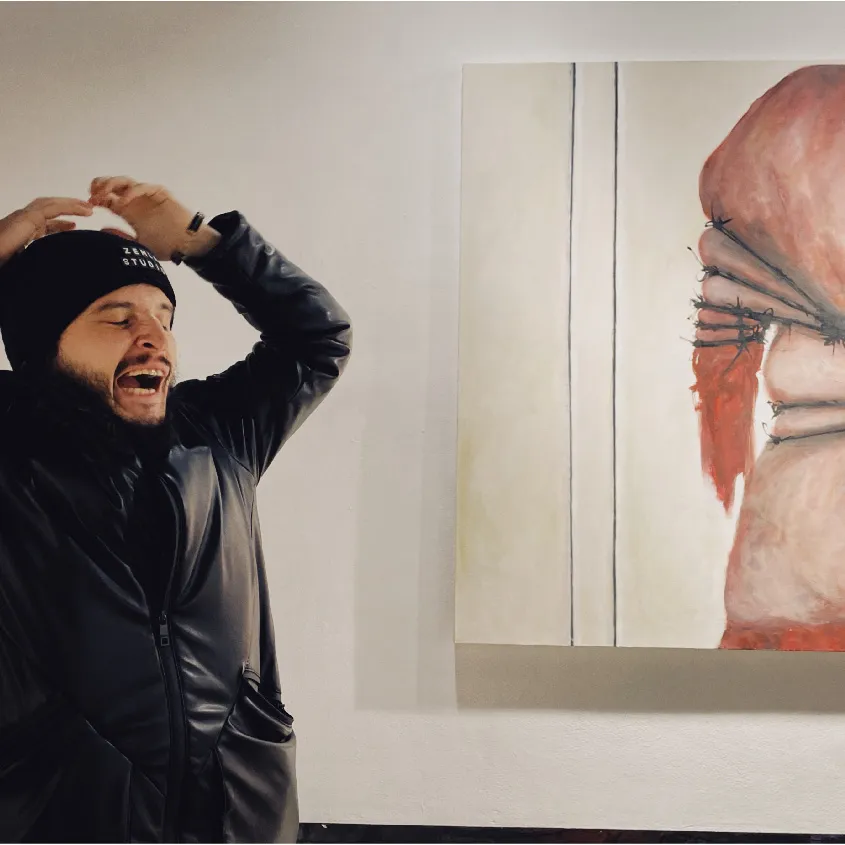
Dr. Myroslav Trofymuk
Born in Lviv. Designer, director, musician, researcher, founder of ZEMLA STUDIO. Master of classical philology and digital marketing, PhD in the history of Ukrainian literature. Member of the National Union of Journalists of Ukraine. Since 2022 he has authored the CENTRUM MUNDI audio show for Polish Radio for Ukraine, continuing the same research into the contemporary music scene in Ukraine and Poland.
Full bio →

