
I’ve heard that in Kyiv there is a building that isn’t on any street. And there are ghost streets that start from nowhere or end abruptly… Lviv, meanwhile, has a venue that virtually extends one of its streets by a whole 60 numbers. The art space Fredra 61 — its name coined off the cuff — baffles people at first: they spend ages looking for it and keep asking the way. But come to Fredra once and you will be back more than once. Behind the intriguing name lies something entirely prosaic: 6 Fredra Street, flat 1. All the magic seems to have gone — but a few charms remain. An interesting detail: the founders nurtured the idea for this platform in Warsaw, and quite by chance the vacant premises they found in Lviv turned out to be on the street named after Aleksander Fredro, the Polish poet and comic playwright whose life is closely bound up with Lviv’s place names. He was a “bridge” between Polish and Ukrainian culture and also campaigned actively for the construction of Lviv’s railway — so even in his lifetime he fostered contacts between people, cities and countries (not to mention his descendants: Aleksander Fredro’s grandson was none other than Metropolitan Andrei Sheptytskyi!). So it is only natural that people should still come together under his name today, for the sake of conversation.
Tell me, is there something you feel Lviv is missing? The guys who created Fredra 61 felt there was. “We felt the lack of an open platform where you could come without buying expensive cognac or coffee, feel at ease, not pay to get in, and still see something interesting, express yourself, meet people who want the same thing and have a chat,” is how Markiian Maksymiuk, one of the initiators and founders, sums up the concept of the venue. “We wanted the format to be as varied as possible. From the very classical — that’s Classical Wednesdays, run by Roman Kleputs (short talks about composers and selected concerts) — through talks about art and meetings with all kinds of interesting people who have something to say, all the way to parties with contemporary electronic techno. We’re mainly aiming at socially aware young people who value their free time.”
In their own words
Myroslav Trofymuk: Who dreamt all this up and made it happen?
Markiian Maksymiuk: People often ask who made this project. A few people came up with it, but now lots and lots and lots of new people from all walks of life are getting involved and saying they want to put on their own events here. Fredra now counts several dozen people who help out and get things done. So you could say that Fredra is made by the people of Lviv themselves.
Roman Kleputs: It was Market’s idea. He came to Lviv from Kyiv and kept saying that something had to be done here, but nothing much was actually happening. Later Mutini came back from Sweden and got kicked out of home — we won’t go into the details of that incident (laughs). Within half an hour he’d found this flat on social media. He called us, knowing nothing at all about Market’s idea, and told us he’d found a really cool flat in the centre, but the rent was steep and he wanted us to live here with him…
M.M.: He was here with Chad, a friend of ours. I remember how Chad described it: he told me the flat was sort of central and sort of trashy. I imagined that “sort of central” probably meant somewhere way out on Zelena Street, and “sort of trashy” meant a total wreck… But when I saw what kind of Centre it was, and what kind of “Trash”, and how much that “Trash” appealed to me, I was immediately fired up — something had to be done here!
M.T.: So how did the idea come about, after all? What prompted you to create something “like this”? You spent some time in Kyiv — maybe you saw something similar there?
M.M.: There was a similar initiative in Kyiv, but it went belly up because it ended up turning into a “den”. I asked the guys why they’d stopped doing something special, and realised it was an example of how not to do things. We try to hold the line. Last Saturday showed it can be done. The party started at 20.00 and finished at 23.00.
Taras Luzhetskyi (better known in Lviv as DJ Terry Mutini): It was the peak and everyone was really “going off”, but at 23.00 nobody had to be chased out. The DJ brought the set down to zero and everyone understood it was time to head home.
M.T.: So what are your plans for the future?
M.M.: We’ve only been here two months. In those two months loads of things have happened here. A great many people have heard about the project. In such a short time it has made a huge splash — by Lviv standards, anyway. KTs (Kateryna Brydun, art director of Fredra 61) was telling me that a friend of hers who lives in Dubai wrote to her a few days ago and asked, in passing, whether she knew anything about “Fredra”, some new venue in Lviv. I think that if they know about us even in Dubai, this project is definitely not going to die. Lots of people want to get in here, but not everyone does — the place isn’t very big, after all. It only holds 30–50 people. We don’t know what will happen to these premises, because they’re not ours: our lease runs until the end of June. Maybe it’ll be extended, maybe not — as of today, nobody knows. We’ll probably look for another place. We want premises of our own, on a permanent basis. We’ve managed to make this work, we’re keeping the bar high, we’re keeping a balance between culture and leisure, and that’s why I believe in Fredra’s future.

M.T.: Tell me about the club side of Fredra. What kind of music will be played here? Only techno, or will we be able to hear other styles too?
T.L.: Not necessarily techno as a genre. More like techno in the broad sense. It could be deep, house or broken beats. There are no particular stylistic boundaries.
M.M.: Techno is a very broad concept. We try to promote music that’s good and relevant today. If someone plays tech house and mixes it with jazz, more power to them. For me the notion of relevant music has crystallised, but each of us understands “relevance” in our own way.
T.L.: Different things get different people “pumped”. There’s music with sharp edges — you can hear a lot of it in Lviv right now. We, on the other hand, want to work in a “rounded” format, if you can put it that way. The music played here kind of envelops you. It’s music you can chat to, have a cocktail to; it doesn’t make you jump around. These aren’t parties like the ones in nightclubs.
M.M.: When things escalated in Crimea, we couldn’t settle. There had been no events for a week, and it felt as if you couldn’t throw a party, because there was a war on — but then we suddenly remembered what a guy once told us: “I know what you’re up to here. You’re doing product placement. You’re placing a product. And that product is ‘conversation’.” And it’s true: we give people a chance to talk to each other. Every event encourages conversation in a particular direction — art, music, or discussing important social issues. And on Saturdays there’s relevant music playing, but it doesn’t take up all the space around you; it leaves room for conversation, which you don’t get in clubs. In clubs it’s impossible to talk. That’s why these Saturday parties aren’t “discos” — they’re parties in a cultural format, however that may sound. We’re making a cultural revolution here. The last time we came back from the Maidan, it was with the thought that what we do here would be of more use.
M.T.: Are there any restrictions on the projects held here? How will you choose events if there are more people wanting to put them on than there are days in the year?
M.M.: There are no particular restrictions. If I see that an event isn’t very relevant — say, no more interesting than the ones already happening here — or the concept is vague, I suggest people think it all through, write it up and send it in. But usually, as experience shows, people talk a lot and only a handful actually do anything. Nobody has sent in a written proposal like that yet.

The list of events presented at Fredra is truly impressive in its range. Some might remark that everything here is chaotic, but chaos, as we know, is considered the highest degree of order. Over almost three months there have been countless meetings with interesting people who talked about aspects of their work that others might find interesting. During the revolution, the author of these lines talked about the revolutionary aspect of the collection of the Museum of Modern Art in Warsaw, screened several films important for understanding revolutionary and post-revolutionary processes in Poland, and also spoke about who the artist of today is. Oleh Fedorkiv presented his journey to India, and Andrii Shymanskyi gave a talk on the history of Crimea. There were meetings with Father Oleh Fedorenko, a progressive priest of the Ukrainian Greek Catholic Church and director of the registration centre for homeless people at Lviv City Council. Sister Veronika, who studied law in Lviv and became a nun after graduating from Lviv University, talked about her journey through life. Quite recently there was a fascinating meeting with Ivan Nesterenko (known in Lviv as Zelenyi Tatko, or “Green Daddy”), who talked about “the life of Lviv’s rubbish” and whether it has any prospect of “living on a little after death”. Besides these talks, usually held on Tuesdays, several regular projects have taken up residence at Fredra and have been able to flourish fully in precisely these conditions. Fredra regularly hosts “Board Game Evenings”, curated by Rostyk Hnatyk, as well as the already mentioned “Classical Wednesdays with Roman Kleputs”. Speaking about his “Wednesdays”, Roman himself stresses that he conceived these meetings to introduce people to the very phenomenon of classical music; he chooses composers at random, without following any chronological order, and picks striking works and key composers to whet people’s appetite for classical music. Besides classical music, Fredra also hosts contemporary live music: there are acoustic concerts by bands from Lviv and beyond, some well known and some less so (visitors have already heard SUNS and Cherry Band).
One such project, Katrusyn Kinozal (“Katrusia’s Screening Room”), which has already grown into something of a brand in Lviv, is described by its founder, Kateryna Brydun: “I’ve been running Katrusyn Kinozal for several years, and it’s usually open-air film screenings when it’s warm. But when it’s cold outside, I had to look for an alternative — bars or cafés. Yet pubs aren’t suitable for events like this, because the whole idea of these gatherings is to watch films in a cosy, friendly, almost homely atmosphere. Fredra 61 turned out to be ideal for them.”
Incidentally, Kateryna Brydun (or KTs, as she is known among friends) automatically became Fredra 61’s art director. “At first the place was empty,” says Markiian. “KTs said she’d bring us a cool ultraviolet lamp. Thanks to her, Fredra got its first projector, its screen and its first sofas and chairs. And when she said, ‘I’ll bring you a piano too,’ I thanked her very nicely and realised she simply had to be called art director, because that’s what she had been since the very beginning of Fredra 61. She takes care of the decor, advises on how to hang the posters, and we all listen to her opinion.”

Living in symbiosis with Fredra 61 is the HOMEPLAYING project (roughly, “home jamming”), which is in fact the same age as the venue itself. HOMEPLAYING is an attempt to give a public airing to home-made electronic music that people make for themselves and “for the hard drive” (as they once wrote “for the drawer”). The project exists independently of Fredra: seasoned musicians or complete beginners can get together and play without any stylistic restrictions. All these performances, concerts and improvisations are recorded, and afterwards everyone can hear themselves from the outside and show the result to their friends. At Fredra, the concerts have a more clearly defined thematic backbone, but visitors are invited to bring their own instruments, and anyone can join in. That is why these events are interesting and unpredictable not only for the audience but for the musicians themselves. I remember that at the first concert, the idea for which came from Sofiia Filipchuk, we were joined by Roman Feshchak, Danylo Petrushenko and Yulia Shved. At the second concert, held to mark World Poetry Day, Marichka Chichkova, one of the singers in the band Olenky, sang with us; Stanislav Kyryllov also joins the performances from time to time. In time, the project hopes to widen its circle of joint performances with other friends — the Vox Electronika festival of electroacoustic music, and musicians from Kyiv and Ternopil; visits by improvising musicians from Warsaw are also planned.
In April Fredra announced yet another format: gallery exhibitions. In truth, though, two unannounced exhibitions have already taken place here, both by Sofiia Filipchuk: a selection of cheerful collages on the theme of Sofiia’s childhood with her sister, and an attempt to look at the “little green men” from a different angle — in her characteristically kind and luminous style, she depicted them as aliens. Currently on show at Fredra is an officially announced exhibition of paintings by Myroslava Bachkur entitled “Rubizh” (“Frontier”).
Whatever the descriptions, comments and reports, it is clear that words cannot convey the atmosphere of this new and original venue. Best of all is to come to Fredra 61 and see it all with your own eyes.
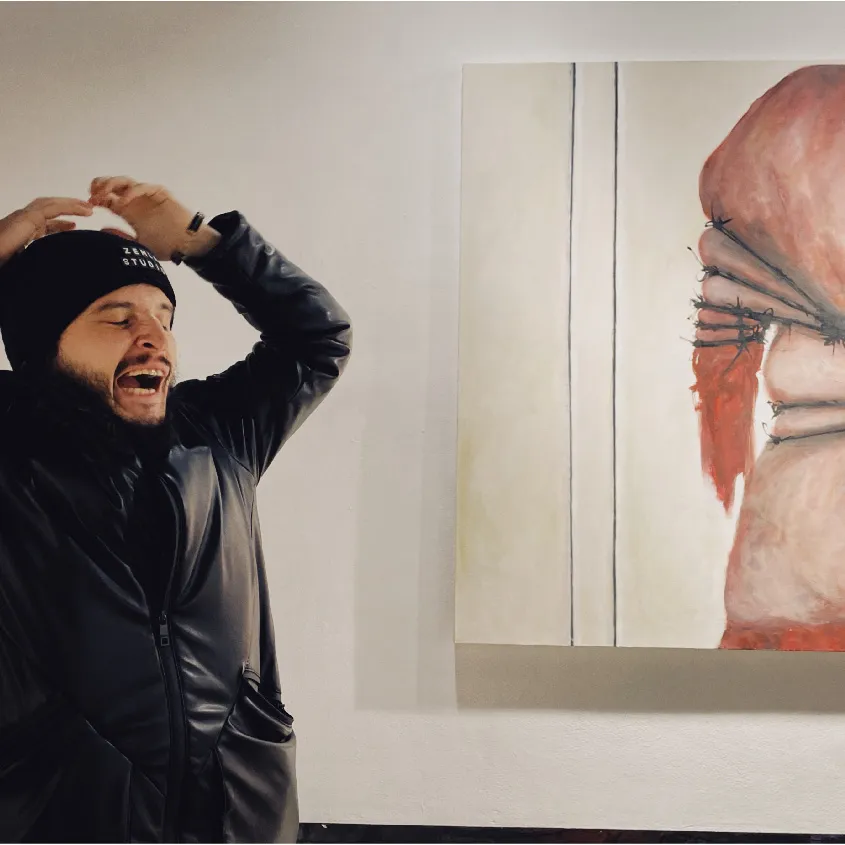
Dr. Myroslav Trofymuk
Born in Lviv. Designer, director, musician, researcher, founder of ZEMLA STUDIO. Master of classical philology and digital marketing, PhD in the history of Ukrainian literature. Member of the National Union of Journalists of Ukraine. Since 2022 he has authored the CENTRUM MUNDI audio show for Polish Radio for Ukraine, continuing the same research into the contemporary music scene in Ukraine and Poland.
Full bio →

