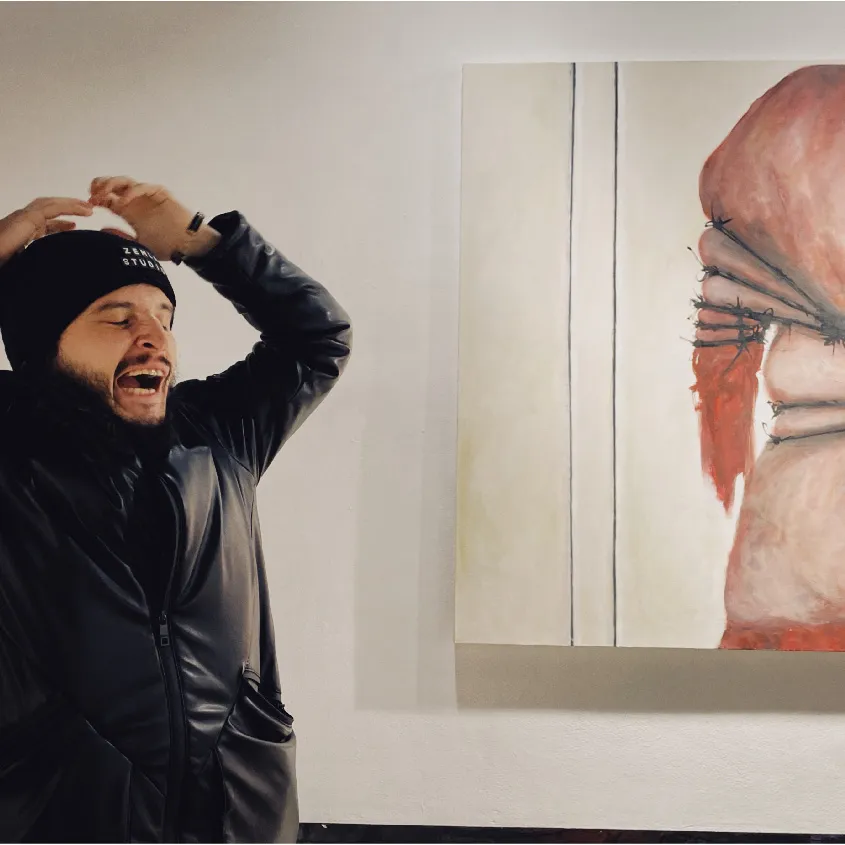
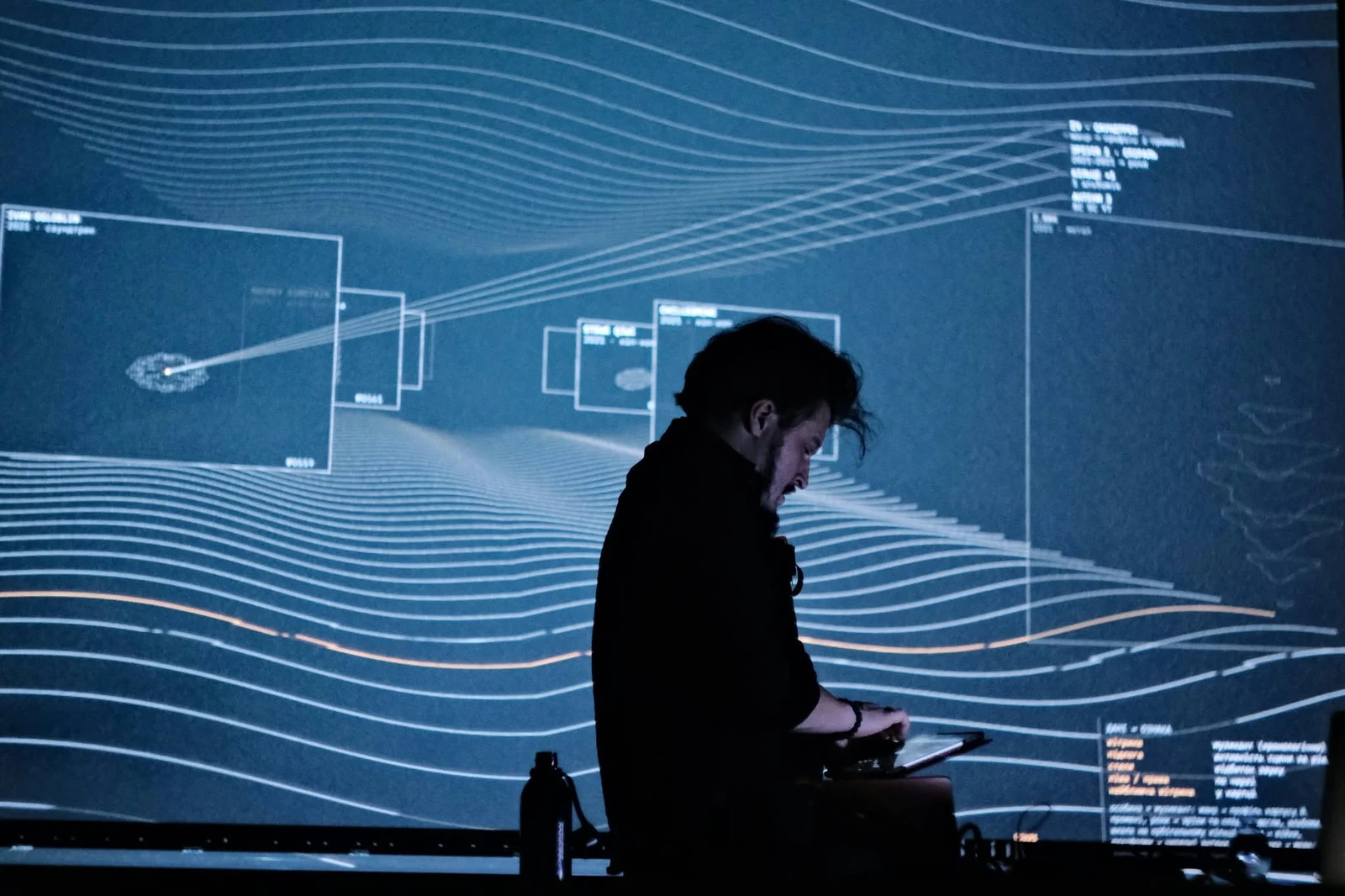
On the penultimate day of Kraków’s 34th Audio Art Festival—one day before the finale in Nowa Huta—Electroacoustic Music Studio (SME) director Marek Chołoniewski and media artist/musician Myroslav Trofymuk (AYKTRONER) convene inside The Krzysztof Penderecki Academy of Music in Kraków (Akademia Muzyczna im. Krzysztofa Pendereckiego w Krakowie) for an unscheduled lecture-dialogue on curved spacetime, RASTER // ATLAS, the generative plugins CONTRAPUNKT and HALFSTEPER, and institutional ethics.
34
edition of Kraków’s Audio Art Festival, running since 1993
50,000
musicians in GENOME catalogue (~4,000 visualized live across 15 scenes)
14,000+
cross-links in Zemla Studio Knowledge Base & ~400 indexed tracks
197
student sound pieces (90% participation) in Seans spirytystyczny
Streaming Into Zero: Room A8, a Five-Złoty Cable & Global Mix
Opening over a Góralki wafer, coffee, a bread roll, and a nagging lumbar spasm, the academy mezzanine sits locked to an in-room audience of zero while Zoom accidentally tunnels through a blocked SME URL straight onto the festival homepage—sparking Chołoniewski’s reflection on Einstein’s curved spacetime, the Möbius strip, and memory as life’s anchor.
 LIVE54:44Plejrek 84 – 26.04.2017 - SMEvia: Electroacoustic Music Studio · Marek Choloniewski · Academy of Music
RASTER // ATLAS & Zemla Studio’s Three Instruments at Audio Art
Myroslav Trofymuk explains how the GENOME archive, the 14,000-link Knowledge Base mesh, and work with Lorenzo Brusci (MUSI-CO) converged in three linked instruments now filed under Technology · Apps & games:
 LIVE45:16IMERSJA 317 - noart / Marta Nawrot / MariaŚmiszek / Nastia Vorobiova /Jagoda Wójtowicz - Solvayvia: Lorenzo Brusci · Academy of Music in Kraków · Marek Choloniewski
RASTER // ATLAS
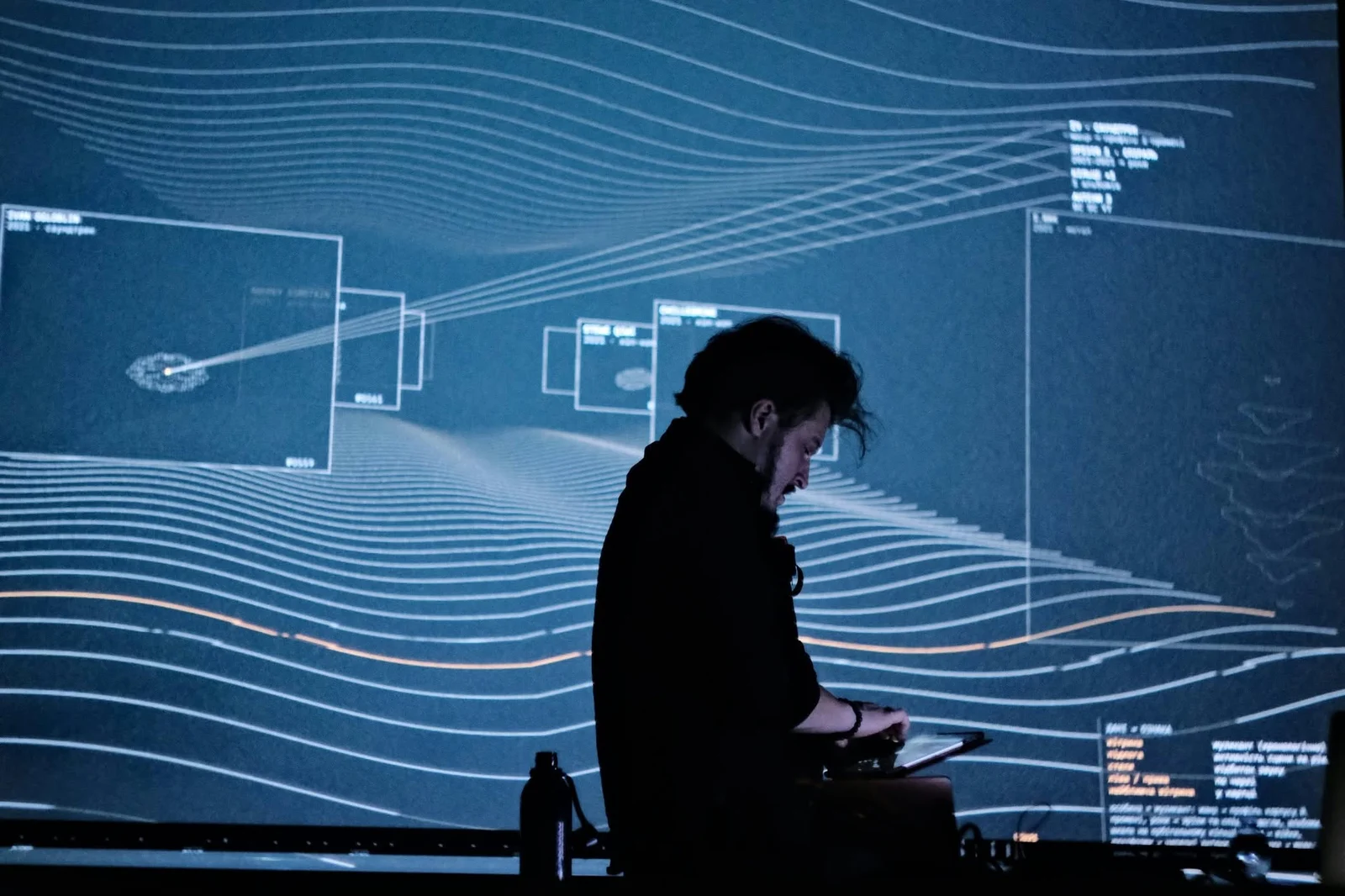
Transforms 4,428 GENOME artist records into living parametric organisms across 15 Rutt/Etra scenes steered wirelessly from an iPad over Wi-Fi.
CONTRAPUNKT
Composes 8-chord modal progressions with smooth voice leading across 12 candidates, splitting bass and Barbieri Seq with a wrong-note guard.
HALFSTEPER
Halfstep & glitch DnB drum generator where the kick holds steady while eight lanes evolve via live controls and dictionary learning.
“I speak of those whom I might call the mighty of this world. They are not mighty—for they certainly hold no dominion over our souls.”
Five Galleries at Pałac Potockich & The Ethics of Trust
Closing the afternoon, Chołoniewski walks through the five silent-until-entered lower galleries open at Pałac Potockich (Rynek Główny 20) and contrasts municipal festival reporting with academic inertia at both the Penderecki Academy of Music and the Matejko Academy of Fine Arts—culminating in 90% student participation and a former student’s comic reply: “TATO NIE BIJ!”
| Room | Work & Artists | Interaction |
|---|---|---|
| ROOM 01 | ECHO² · panGenerator (Jakub Koźniewski, Krzysztof Cybulski) | 20 illuminated kinetic speakers triggered via microphone input. |
| ROOM 02 | Seans spirytystyczny · ASP & AMKP Students (197 tracks) | Omitted manual except touching the mannequin; 90% student participation. |
| ROOM 03a | The Oracle · Kacper Ziemianin | Silent until pressed; speaks only on direct trigger. |
| ROOM 03b | The Archive (A. Józefczyk) → Point Line Piano (J. Kapuściński) → Śniedź | Rotating gallery from VR piano to 6:00 PM concert (A. Klimczak & A. Beksiak). |
| ROOM 04 | [nie]Fenomenalny · Michał Cygnar | Rear room accessed through Room 3; closed during afternoon soundchecks. |
Site Photo Archive & Live Concert Carousel (24 Frames)
Live concert photography of RASTER // ATLAS by Przemysław Niemczewski, archival Kraków Electroacoustic Music Studio (SME) photographs from the site corpus, and key slides from the instrument deck:
Complete Unabridged Session Transcript (Pages 1–26)
Complete, unedited bilingual edition covering every page of the live session transcript recorded inside The Krzysztof Penderecki Academy of Music in Kraków:
p. 01 · Prologue & Global Mix
…against the backdrop of our world. And of course once again the dictum holds that “there is method in this madness.” I’m also very glad you’ve already eaten your sweet—truly glad. So what hovers right above Myroslav’s head is an anti-aircraft defense system. You can even see us eating a Góralki wafer on stream.
I’m delighted I managed to spin up a broadcast, even though nobody knows about it. And nobody knows where it goes either, because it’s flowing to the old studio webpage [SME], which was blocked. So today we find ourselves in a fascinating fold of reality: generating yet another batch of virtual worlds, basically non-existent. Even though we deploy technology fairly precisely, the destination turns out hidden, inaccessible, vanishing, and so forth.
We don’t even have a way to verify whether the stream is genuinely running. Wait—let me take a risk and type the old studio URL. It redirects to the main website of the Krzysztof Penderecki Academy of Music in Kraków, so it definitely isn’t there… Hold on, if I type that virtual… Oh! Global Mix just popped up on my screen! I had zero intention of landing on Global Mix right now. Honestly, this is unbelievable: on page four sits everything from the old site that nobody even knows still exists or not.
pp. 02–03 · Opening & Room A8 HDMI Setup
[p. 02] Yet here “truth of the times, truth of the screen” applies—an old formula. “The truth shall set us free” is the next key proposition. Meanwhile this back spasm of mine is, as you can hear, all too real! Let me open by saying that even though I am invisible in the frame of a stream that is also invisible, for a lecture that wasn’t supposed to happen—so we are essentially fulfilling expectations and sticking to the plan—seated before me is Myroslav Trofymuk (AYKTRONER), whom I warmly welcome to this final Audio Art session, inaccessible yet not virtual. It is intensely real: I’m sipping coffee, tasting it, even tasting the roll I just ate.
Hard to say whether this reality curves or straightens out. As you noticed, the entrance to the Academy is open, whereas the mezzanine is locked, because officially these lectures no longer exist—and my session in particular wasn’t supposed to happen. Ultimately, here we are together. Myroslav is organized to an enviable degree.
Hold on, there’s another quirk that sometimes pops up… Looking at it now. It lights up—meaning if it receives no signal from here, it won’t project there. Only one trick left: test on my own laptop, where I’ve already displayed things using the same method. With my lower back throbbing upward, give it a second—open display settings and see if it detects anything at all. I don’t give up easily.
[p. 03] Next option is plugging straight into the projector, though unfortunately I lack a long HDMI cable right now. I do have the key to Room A8, so I could check whether a longer HDMI lies in there. Does it detect it? When plugging and unplugging fails, the one trick is reversing the cable—put that plug here and this plug there, because sometimes a single pin misses contact. Otherwise we run your presentation off my laptop—at which point I have no idea what happens to Zoom feeding YouTube and streaming onto the old site. Still, there is method in this madness, so I would take the risk.
Crucially, the rig is tethered to real reality by just one cable into this old iPhone whose battery is dying—a long cable bought for five złoty at Carrefour, super flexible and solid. Doesn’t see it? Hand it back then—now you stay visible in the frame and do the switching yourself. I won’t even ring Janek; according to the plan none of this exists, so rather than stressing him in the morning I’ll tell him next week.
pp. 04–05 · Violet Poster, Florence, Amara.org & Broadcast Paradox
[p. 04] Intriguing, isn’t it? Yesterday at 6:00 PM I opened with the old violet poster that had an error on it—some people noticed immediately, others didn’t, since it was the draft layout, and then as we started I flashed the new one briefly and jumped to another sandbox. I have no doubt this world is endlessly fascinating; I can be very concrete when data converges cleanly, yet reality dissolves wherever boundaries stay undefined. Incidentally, had your rig failed, I have a recording of my piece Cymatic Brain in Florence—especially fitting with Italy as a motif… Ah, the broadcast is already moving; cached, yet shifting cleanly. I threw it on the page autonomously, and afterward we’ll hand everything to Jacek Opiełka to edit properly.
[p. 05] By my lights, audio should auto-login—though I wouldn’t bet my head on it—same as yesterday. The real question is how long such a stream remains persuasive, not pretending it comes from the brain—because it genuinely comes from the brain! Still, we live in profound doubt. Inside a faked world saturated with visuality and endless substitutes of something else, it grows hard to tell what is authentic from what is fabricated—especially with technology involved, which brings to mind: “a humble firm, yet honest and thoroughly professional.”
[Background glitch triggers Polish Amara.org test audio: “Subtitles created by the Amara.org community… Thanks for watching!”] Leave it running as a backing track—at least we have sound! That’s hilarious.
So ladies and gentlemen: since the lecture that was not meant to exist exists anyway—even as we try to lose it so it remains unreachable—imagine my pleasant surprise opening the festival homepage and discovering this lecture is already playing there while we wait here in order not to deliver it. We are doing everything to prevent it from happening, and it’s already live.
p. 06 · Zero Audience, Einstein, Möbius Strip & RASTER // ATLAS
And so you, ladies and gentlemen—specifically, an audience numbering zero—stand witness to this event. An event wholly faithful to the philosophical premise of the Audio Art Festival in Kraków. “They won’t catch us!” We travel along a rather defined line, a kinetic trajectory through spacetime. As I like to argue, since Einstein tells us spacetime is curved, curving continuously loops it right back to its origin.
Allegedly, past the horizon where that bend vanishes from sight, it twists over itself—forming a Möbius strip. Of course, we can neither see nor prove that. Paraphrasing my sister, memories and imagination constitute the most essential elements of our lives: we refer back to lived memory as our anchor, while projecting into a future we cannot predict—conducting small manipulations on that future.
Across most world philosophies, existence binds first to presence inside this point of the now—though certain frameworks reject the present outright, defining it solely as a shifting seam flowing between past and future in spacetime. Consider this an overture to a lecture meant not to happen that is happening nonetheless.
It is called Raster Atlas—do I read that right? And I see it right there on the screen: the very instrument I operated yesterday. Remarkable that you brought up memory—that is the whole point.
pp. 07–08 · Nomadism, Infinity & Why Art Sensitizes Rather Than Proves
[p. 07] Introducing our guest—an accomplished artist, AYKTRONER [Myroslav Trofymuk], who has been part of our orbit for a long time: originally from Lviv, living in Warsaw as well as Sicily and assorted places—a genuine nomad who fits this spacetime vision of unpredictable, uncharted trajectories.
Someone tried to convince me yesterday that infinity cannot be imagined. Infinity is actually the easiest thing: close your eyes. I might even argue—risky and unprovable though it sounds—that we inhabit infinity differently in sleep than while awake: an unfathomable ocean-floor abyss shifting between subconscious and what I sometimes term superconscious states, felt most sharply when you jolt awake at night returning from that other space.
Usually I point out that our two main senses—ears and eyes—operate within narrow frequency limits, offering immediate, tangible proof that reality extends beyond our empirical perception. Telescopes and microscopes have long stretched our scale upward and downward.
[p. 08] Yet I remain unsettled by the leap into warm solid matter. Enter molecular space and it turns out mostly hollow: quanta and atoms held apart by emptiness, perplexing to reconcile with a solid table beneath your hand—even remembering crystal lattices grant extraordinary structural strength.
I am no physicist or cosmologist—let me put that disclaimer upfront. When we turn to technology, our artistic goal differs fundamentally from science. Science seeks to discover phenomena and rigorously prove the physical laws governing them. Art uses technology to sensitize and unlock uncharted spaces—and often that opening suffices. We need not prove anything exists; we touch it to craft a deeply individual vision and pass that vision on.
Something remarkable unfolds the instant art becomes participatory—as in Jarek Kapuściński’s VR installation, where putting on the headset lets us play his instrument as co-authors of the work. The same holds for Seans spirytystyczny and Echo 2 by panGenerator (Jakub Koźniewski and Krzysztof Cybulski).
pp. 09–10 · Egalitarian Instruments, Missiles, Hejnał & Launch of RASTER // ATLAS
[p. 09 — Marek Chołoniewski:] Those installations wait for us, activating only when someone enters. Philosophically, it proposes an instrument we all play together. Equality enters: it is egalitarian, not elitist. Elitist because it’s contemporary art? Quite the opposite. When a crowd gathered at the opening and formed a secret circle holding hands, it felt ritualistic and tribal rather than sterilely artistic—unlike artists who erect defenses pretending to belong to some national elite. That illusion breaks down fast.
Missiles keep flying, drones keep flying—a starker reality where we live less. Some madman preparing for years to descend upon Kraków… One point in space suddenly bends the course of history. I can only compare it to the Tatar arrow lodging in the Kraków trumpeter’s throat: though the exact moment slips away, we commemorate it every hour as an audible mantra dedicated to the victim of barbarism touching Kraków.
[p. 10] I mention this calmly precisely because—as everyone knows—this lecture doesn’t exist. So with my lower back spasming, I am experiencing doubly or triply the final—actually penultimate—festival day before tomorrow’s grande finale in Nowa Huta.
Having settled on multiple closings, recall day one had three openings: noon lecture by Martin Küchen, 6:00 PM opening of five installations at Pałac Potockich, and 8:00 PM solo concerts—three separate openings. Yesterday brought the official-unofficial catered closing; tonight at Pałac Potockich will be quieter before inviting everyone to tomorrow’s finale.
[p. 10 — Myroslav Trofymuk:] Picking up quickly from what you said: RASTER // ATLAS is indeed built around spacetime—time especially—continuing my Gaude Polonia fellowship work, which was always about connecting the dots. Just last week I gathered every strand onto the Zemla Studio website. As the numbers show, there are currently 14,000 links—meaning semantic connections between facts and people across Polish and Ukrainian lectures, Gaude Polonia interviews, Centrum Mundi episodes on Polish Radio, and projects in Lviv.
pp. 11–12 · GENOM, 400 Tracks, AI Build & Three-Window Control
[p. 11 — Myroslav Trofymuk:] Everything recorded across YouTube connects into a neural mesh—tracing via people and themes how Polish and Ukrainian experimental scenes converse across axes of innovation, tradition, nature, and technology. For this Audio Art, I decided to visualize the Ukrainian music catalogue [GENOME]: around 50,000 musicians total, with roughly 4,000 displayed onstage yesterday. The engine constructs organisms from each record’s fields—source platform, core genre, album count—forming identifiable creatures emerging along a 15-scene timeline.
I plan to deepen that interaction beyond chronology alone. One scene maps song lyrics directly: besides the artist database, I compiled roughly 400 tracks and lyric entries [p. 12] to explore thematic patterns and naming conventions. The entire instrument was built using AI, and I’m proud of linking three synchronized windows: projection output, computer preview, and an iPad controlling everything wirelessly over Wi-Fi while walking around the venue—as seen last night.
[p. 12 — Marek Chołoniewski:] Technicians pacing rooms has indeed become event orthodoxy. I remember Mackie’s very first iPad-docked mixer: they overlooked built-in Wi-Fi, forcing you to wire an external router by cable—a headache only Behringer’s X32 later fixed internally. Yet I also carry sad memories of techs strutting proudly around halls clutching an iPad while half the sound rig isn’t working.
pp. 13–14 · Wireless Falls, Kotoński, Pierre Jodlowski & The Sensor Paradox
[p. 13] He clutches an iPad and brags about his iPad—and I reply: well, good thing you’re even wearing clothes… Same with wireless hype. Once my handheld mic softly hit the floor onstage, my natural reflex was: “Oh, wireless!” On a cable, it wouldn’t have dropped!
[Myroslav notes club mic audio-reactivity misfired unnoticed yesterday.] We could hush it up, yet a lecture is precisely where you unpack those glitches. Włodzimierz Kotoński spoke candidly about that here; Pierre Jodlowski emphasized the final artistic result matters most, while strange tricks go on underneath interactive setups—vital during setup and pedagogy, invisible onstage.
[p. 14] I recall my own sensor-and-lamp performance at the Festival of Polish Music in Wrocław’s Teatr Polski: everyone congratulated me on how skillfully I danced to the playback track. When I protested I was triggering it live via sensors, a good friend pondered and said: “Well, it doesn’t matter.” And there’s wisdom in not battling to explain away magic. Yet Pierre Jodlowski, master of these crafts, literally pulled back the curtain to expose the innards and a hidden pedal under the table. We crave systems that are peer-to-peer, rigorously modeled, transparent, AND magical all at once—an outright contradiction.
pp. 15–16 · CONTRA PUNKT, HALF STEPER, MUSI-CO & Solvay Stream Twist
[pp. 14–15 — Myroslav Trofymuk:] Alongside visual coding, I used two plugins built myself: a harmonic sequence plugin [CONTRA PUNKT] splitting voice leading cleanly across registers so progressions cohere, with an option to extract structural scaffolds from existing songs and deliberately diverge from them; and a percussion generator [HALF STEPER] rooted in halfstep, drum’n’bass, and hybrid boundary zones.
Half the tracks had an IDM edge using a crooked MIDI generator whose “broken” scattered output becomes raw gold once dragged into Ableton Live and refined by hand. One rule keeps it grounded: the kick holds steady as an anchor while tiny hi-hats and micro-details drift subtly through the track via knobs—reminiscent of hardware Digitakt randomizers and LFOs. For the first time, it simply gave pure joy [frajda] instead of endless menu-diving. I can gladly share the presentation decks too.
[p. 16] Part of this connects to our work starting with Lorenzo Brusci at MUSI-CO, who builds AI-driven sequential systems inviting musicians to craft personalized instruments rooted in their own practice, already collected in an extensive showcase on the MUSI-CO site.
[p. 16 — Marek Chołoniewski:] Well, that wraps the lecture that happened after all! Just got an astonished message from our festival media coordinator Iza—baffled how and why a lecture that wasn’t supposed to exist is playing right on the main festival homepage and refusing to stop! Recording on two devices, routing to a blocked SME site, it mysteriously popped onto the homepage—hocus-pocus, old devil! My guess is legacy Zoom/Facebook settings left over from our Solvay concerts hijacked it automatically. I’ll thank Janek later—though he probably has no clue why either!
pp. 17–18 · “Yes,” Bubbles of Power & 123 Relations Tree
[p. 17 — Marek Chołoniewski:] Ladies and gentlemen, since the non-existent lecture occurred after all, it is time for questions that shouldn’t arise. Following the rule strictly: Myroslav, I ask you a question that does not exist—answer it!
[Myroslav Trofymuk:] Okay… answering the question: yes.
[Marek Chołoniewski:] What a positive answer—he could have said “no” and invited trouble, yet by sheer intuition and self-preservation he said “yes.” We tell children not to say “yes” too carelessly, imagining “no” is safer—yet in truth neither guarantees safety inside a faked world where terrible things unfold before our eyes and rulers exercise the bandit’s right to spin unbelievable lies.
[p. 18] I speak of those we call the mighty of this world. They are not mighty—they hold zero dominion over our souls. Trapped inside dangerous bubbles bouncing at summits, all their reshuffling yields the same recurring answer—war—as if everything swells until violence looks like a solution, though history proves it multiplies catastrophe solely to enrich arms makers needing old tanks destroyed so newer ones get ordered. That people die there gets shrugged off—and casualty tallies get dismissed as fake. Time to shut the laptop lid… Meanwhile on screen sits your Knowledge Base network: “123 relations tree”—which reminds me to keep daily festival listings crystal clear.
pp. 19–21 · Potocki Palace Five Galleries & Festival Typography Rules
[p. 19] Today Śniedź is the sole evening concert at 6:00 PM, while five lower galleries run continuously for eight hours at Pałac Potockich. Room 3 hosted The Archive [Andrzej Józefczyk], followed by Jarosław Kapuściński’s Point Line Piano, and clears from 2:00 PM for Śniedź’s soundcheck; Room 4 [Michał Cygnar’s [nie]Fenomenalny], accessed through Room 3, closes during rehearsal. Meanwhile the first three rooms left of the entrance—Echo 2 [20 glowing speakers + mic], Seans spirytystyczny, and Kacper Ziemianin’s The Oracle—stay silent until someone enters or presses a trigger. For Seans, I intentionally left no manual beyond touching the mannequin [p. 20] so visitors and students who contributed pieces find and play their own sounds.
[p. 20] Please visit Rynek Główny 20: lower galleries stay open till 7:00 PM—installations till 6:00 PM, followed 6:00–7:00 PM by Śniedź [Aleksandra Klimczak & Antoni Beksiak]. Notably, Śniedź and .06 [Dot Zerosix] are duo/band pseudonyms, whereas since 1993 Audio Art’s core typographic rule puts Project Title → City → Author first, honoring the territorial journey from a village in France or remote residency.
[p. 21] Artists live perpetually in transit across studios and residencies, and works emerge from those stops. Lectures reverse that rule: Person comes first [such as Tania Cortés Becerra & Oscar Bahamonde] followed by lecture title, fitting academic review chains—from studio director through composition chair and faculty administration—even when two- to three-week paperwork entropy jams the system, contrasting sharply with Audio Art’s brisk municipal grant reporting.
pp. 22–23 · Academies, Respect for Labor, Horst Rickels & Logos Duo
[p. 22] With municipal grants it’s snip-snap, signed and settled; inside sprawling universities—both the Krzysztof Penderecki Academy of Music and the Jan Matejko Academy of Fine Arts alike—everything hinges on individual attitudes. When passive obstruction hides behind “I’m very sorry,” I ask: “Why are you sorry?” I pleaded with rectors for a minimum baseline of mutual trust and respect for human labor so we stop kicking each other’s ankles and fuse academic ethos with our 34-year festival heritage.
[p. 23] One stops working with obstructive individuals, not with institutions. By contrast, when elders like Horst Rickels or Logos Duo are genuinely exhausted—unable to fly here yet summoning the energy to stage a special live home concert just for us—I deeply respect their fatigue. What frustrates me is neglecting straightforward daily obligations. Meanwhile our students came through with 197 sounds—90% participation across both classes and Intermedia—for Seans spirytystyczny.
pp. 24–26 · Classroom Interruption, “It’s Ours!” & “TATO NIE BIJ!”
[p. 24] That consensus culminates in real art. Once an administrator barged into a guest session inside my lecture asking: “Wait, how exactly does your job work if somebody else is lecturing during your lecture?” Anyone listening can judge for themselves—organizing it together is a blessing for students! I don’t shout or revolt—I step back quietly, though it stings when people doing nothing sit more comfortably than those building something.
[p. 25] Hardest of all is when students ask if something happened. Yet the moment we step in front of an engaged crowd, everything else fades. Someone once threw at me: “After all, it’s your fest, Mirek!” My answer never changes: “No—it is ours!” Even organizational hurdles and stray arrows flying out of nowhere are woven into that shared network.
[p. 26] Just now a former student texted that his festival installation stopped working. My reply was blunt: “You are the author, and you are responsible for it.” Seconds later he texted back: “TATO NIE BIJ!” [“DAD, DON’T HIT ME!”]
We’re logging off Zoom, ladies and gentlemen! Hopefully everyone heard all this—though likely not the ones who most needed to hear it. Warm farewells—do zobaczenia… See you at evening, see you at 6 o’clock. That would be the most precise. Meanwhile, all installations remain open throughout the day.
- Marek Chołoniewski p. 01 · Prologue & Global Mix [person]person
- Pierre Jodlowski [person]person. T.A.M. Club / Centrum Mundi corpus · Jonathan Harvey — Spectralism and Musica Electronica Nova
- Lorenzo Brusci [person]person. IT. T.A.M. Club / Centrum Mundi corpus · Centrum Mundi — CXIV — UKRAINIAN MUSIC ENGINEERING: Oleksii Hrachov
- Krzysztof Penderecki [person]composer, conductor (Poland). KORINNIA map (5 conversations) · T70 The studio that changed sound: Polish… · Jonathan Harvey — Spectralism and Musica Electronica Nova
- Audio Art Festival [festival]festival. Linked with: Muzyka Centrum, Kraków. KORINNIA map (2 conversations) · Marek Chołoniewski: SME, Forty Years of Muzyka Centrum, and the Sonic…
- Electroacoustic Music Studio [institution]institution · Marek Chołoniewski: SME, Forty Years of Muzyka Centrum, and the Sonic…
- Akademia Muzyczna im. Krzysztofa Pendereckiego w Krakowie [institution]institution. T.A.M. Club / Centrum Mundi corpus · Centrum Mundi — N025 — Artur Malecki: Perfectionism, the Subconscious…