A catalogue that wants to be seen
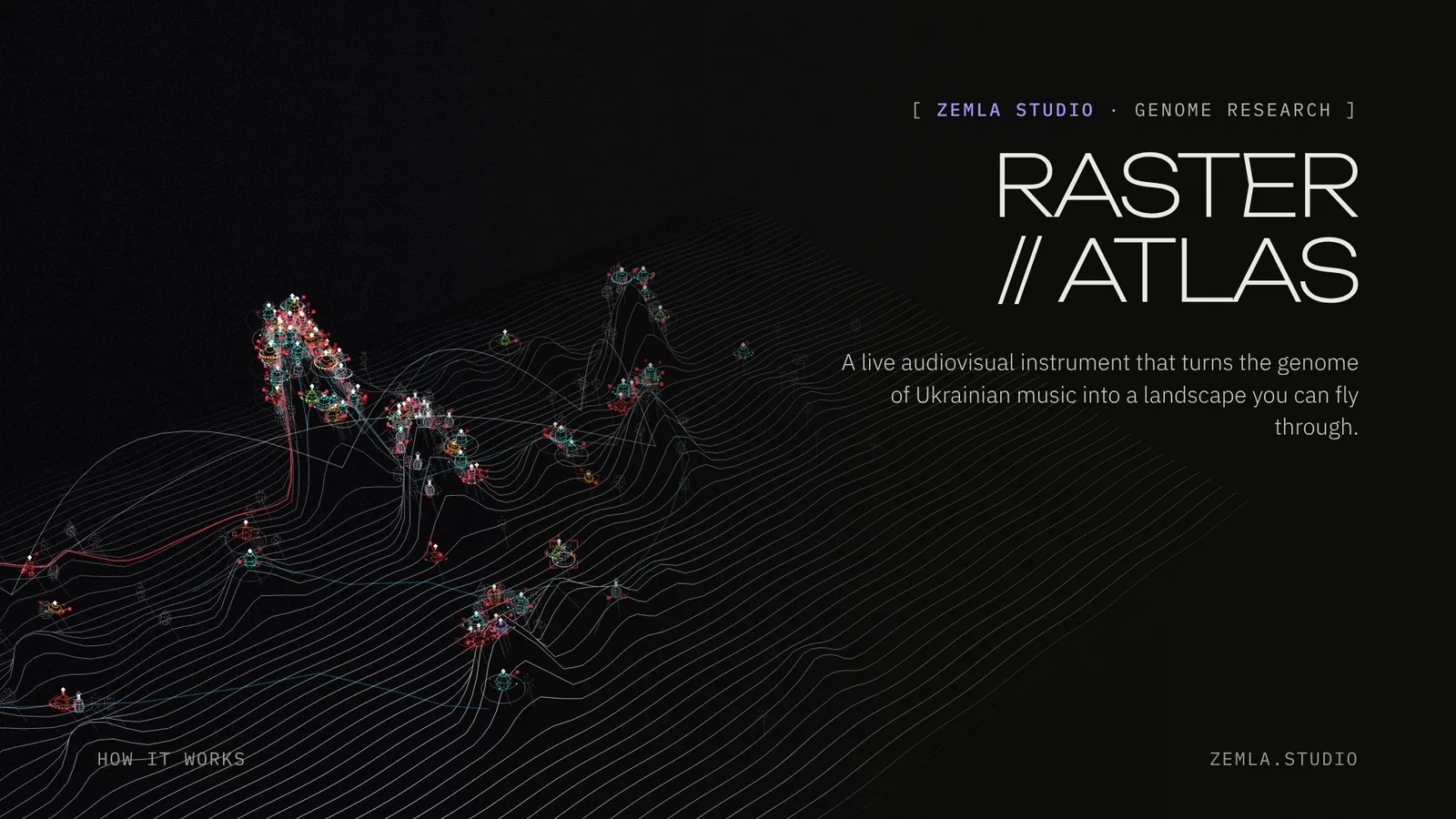
GENOME is Zemla Studio’s database of Ukrainian music, from the 1960s to now: artists, DJs, labels and compilations, with their years, releases, cities and links. It is normally read the way a database is read: with a search box, filters and tables. RASTER // ATLAS asks a different question. What would this catalogue look like if it were alive, and if you could walk an audience through it in one evening?
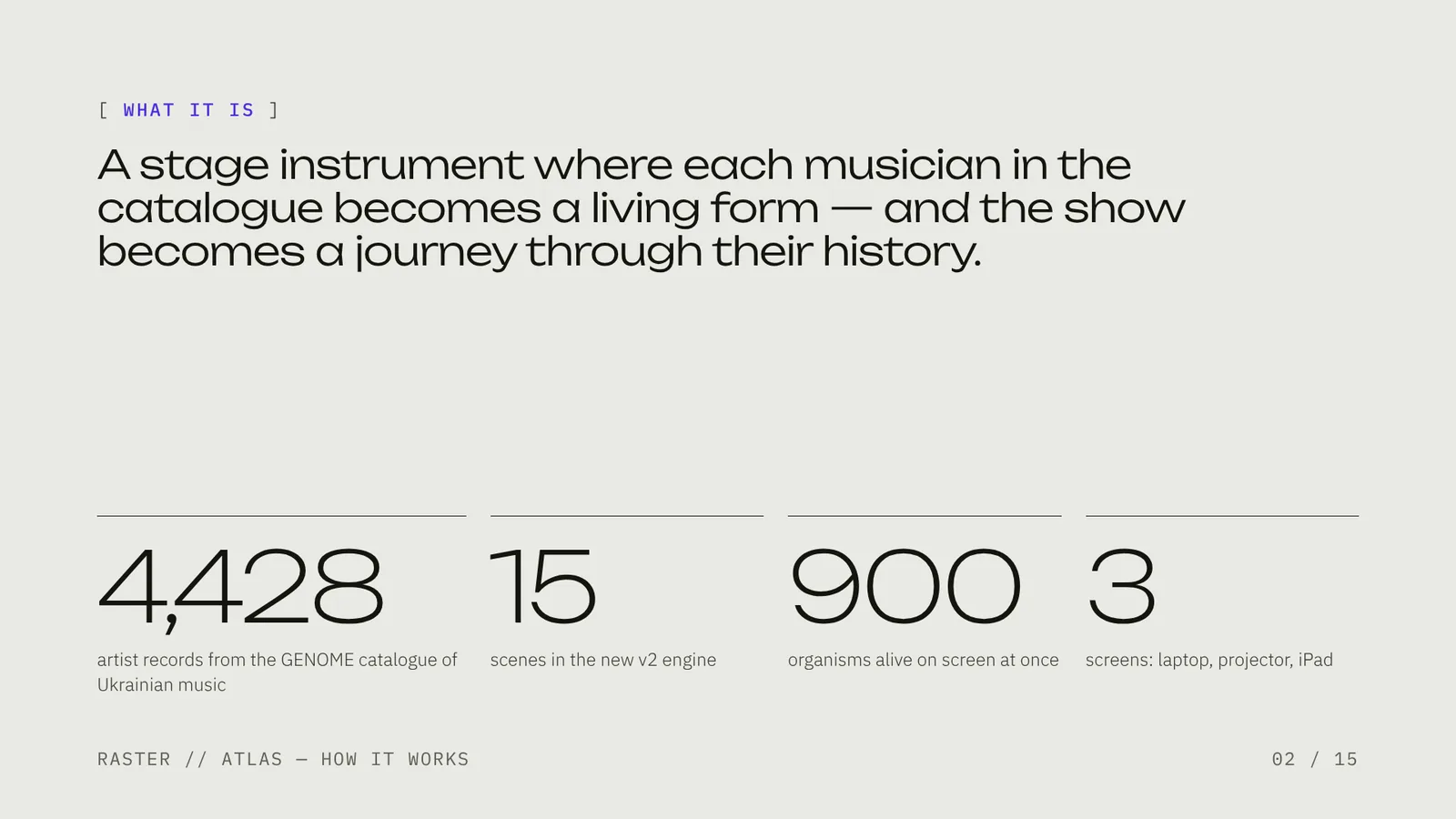
The answer is a stage instrument. Each of the 4,428 artist records becomes an organism with a body of its own. The show moves through the years in which those musicians appeared. A performer steers it live, from a laptop and an iPad, while the projector shows the result.
Every musician is an organism. Every data field is a trait. The show is a journey through time.
Those three rules hold the whole system together. The rest of this article shows how each one is built.
What goes in
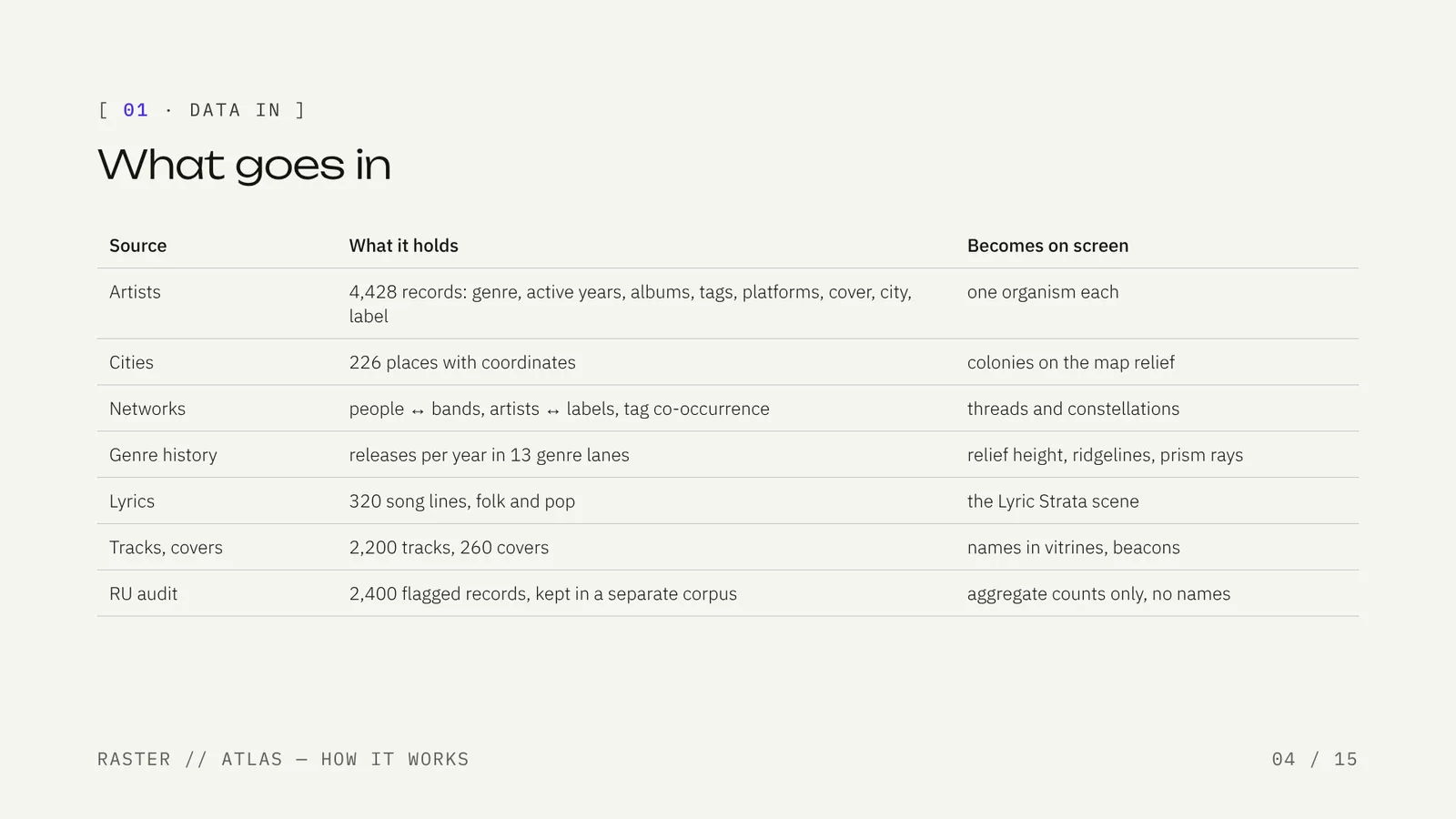
Everything is loaded from static files when the program starts, so the show needs no internet on stage. The main body of data is the artist catalogue: genre, active years, albums, tags, platforms, cover art, city and label for every record. Around it sit 226 cities with coordinates, the networks that link people to bands and artists to labels, release counts per year in 13 genre lanes, 320 song lines, 2,200 tracks and 260 covers.
One part of the data is handled differently on purpose. About 2,400 records flagged for Russian markers never enter the main atlas. They live in a separate corpus, and the RU Audit scene shows only aggregate counts from it. No names appear on screen.
One organism per musician
The organism is pseudo-volumetric. Its body is a stack of contour slices, like a CT scan, drawn with ordinary 2D lines. It reads as a three-dimensional object without needing a 3D engine to draw it.
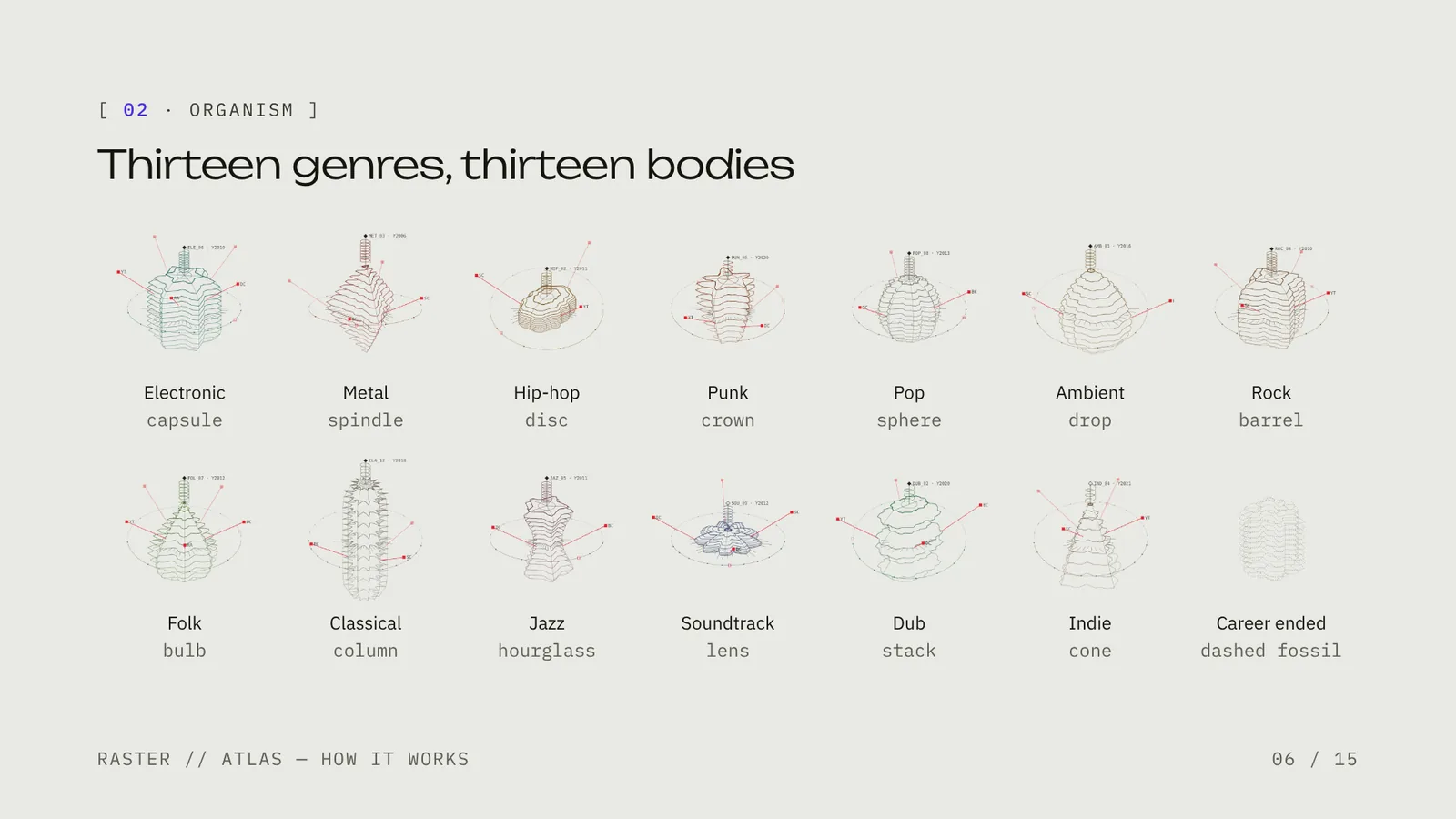
Genre chooses the body. Thirteen genres give thirteen profiles: the electronic capsule, the metal spindle, the hip-hop disc, the jazz hourglass, the dub stack and so on. Everything else comes from the artist’s own record. Active years become body slices and turns of the mast helix. Albums become ticks on the orbit ring. Tags grow as cilia around the equator, and platforms appear as red antennae labelled BC, SC, YT, RA and DC. Cover art lights a beacon on top of the mast. Names written in Cyrillic get doubled meridians. When a career ends, the body turns into a dashed fossil.
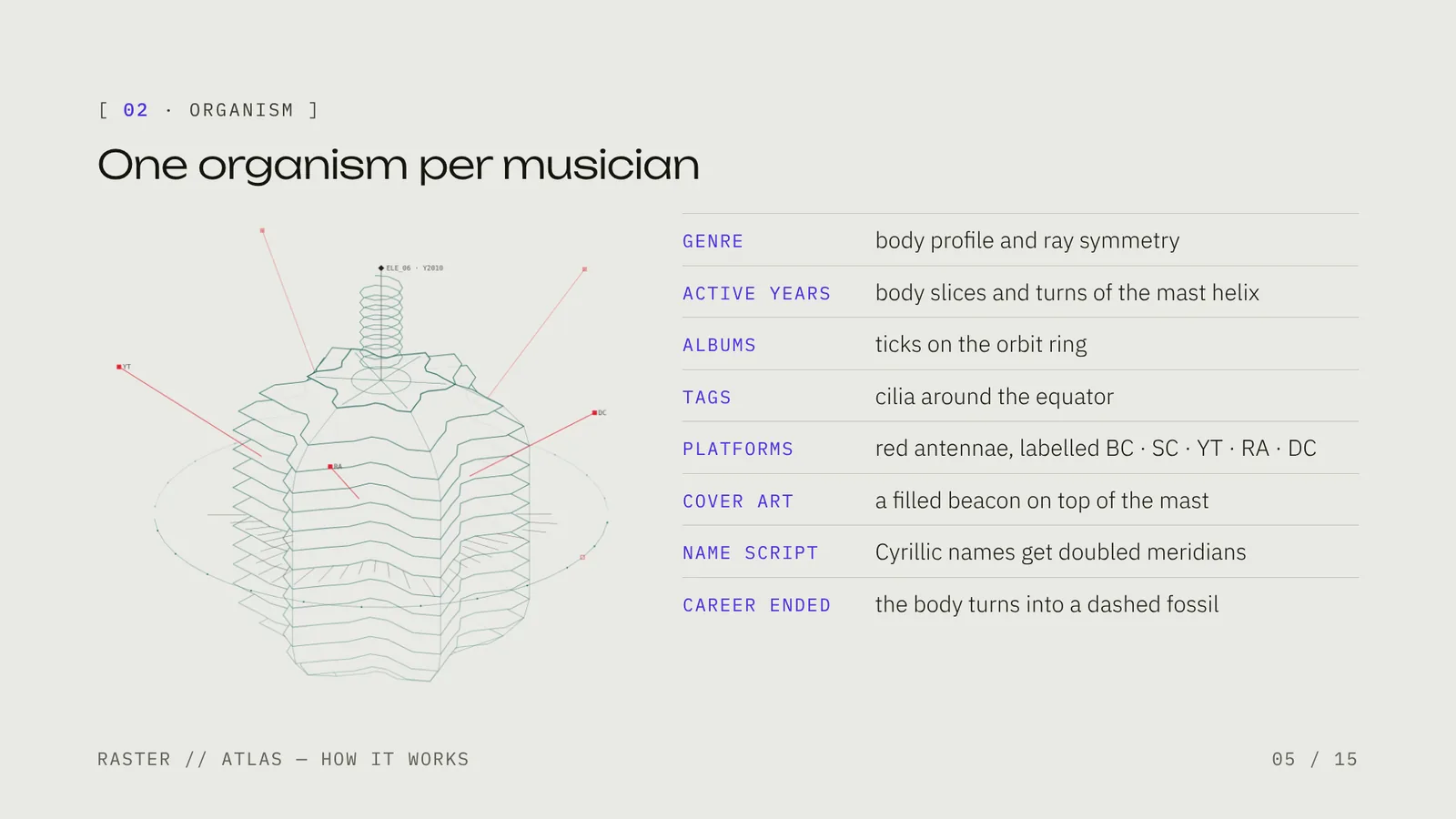
Up close an organism shows every one of these details. From far away it collapses to a dot. That level of detail by distance is what keeps hundreds of organisms affordable on screen at once.
How the show moves
MOVE · 01
Time is the road
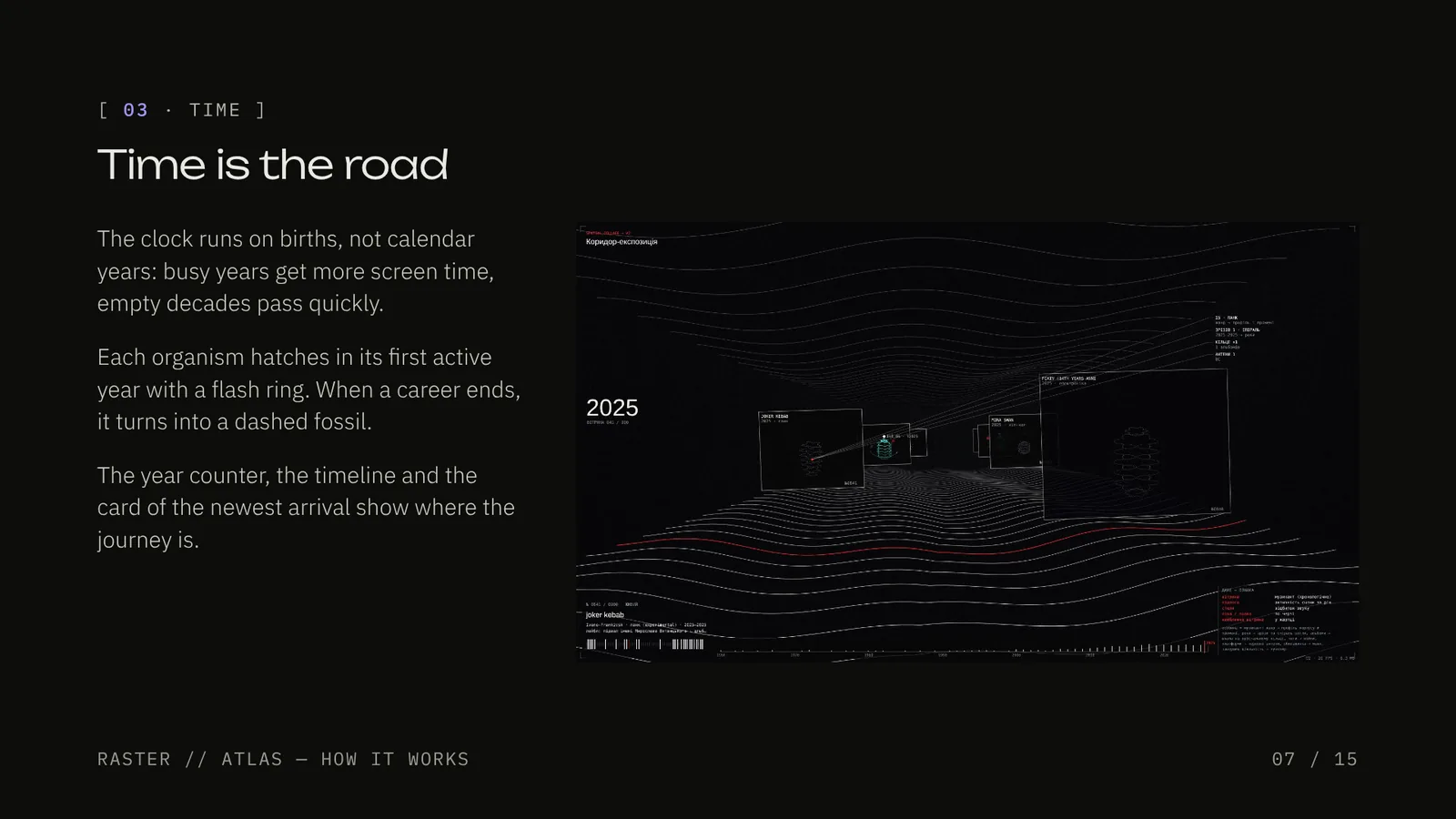
The clock runs on births, not calendar years. Busy years get more screen time and empty decades pass quickly. Each organism hatches in its first active year with a flash ring. A year counter, a timeline and a card for the newest arrival show where the journey is. A tap on “Next” on the iPad pushes it forward by a few arrivals.
MOVE · 02
A scan-line relief under every scene
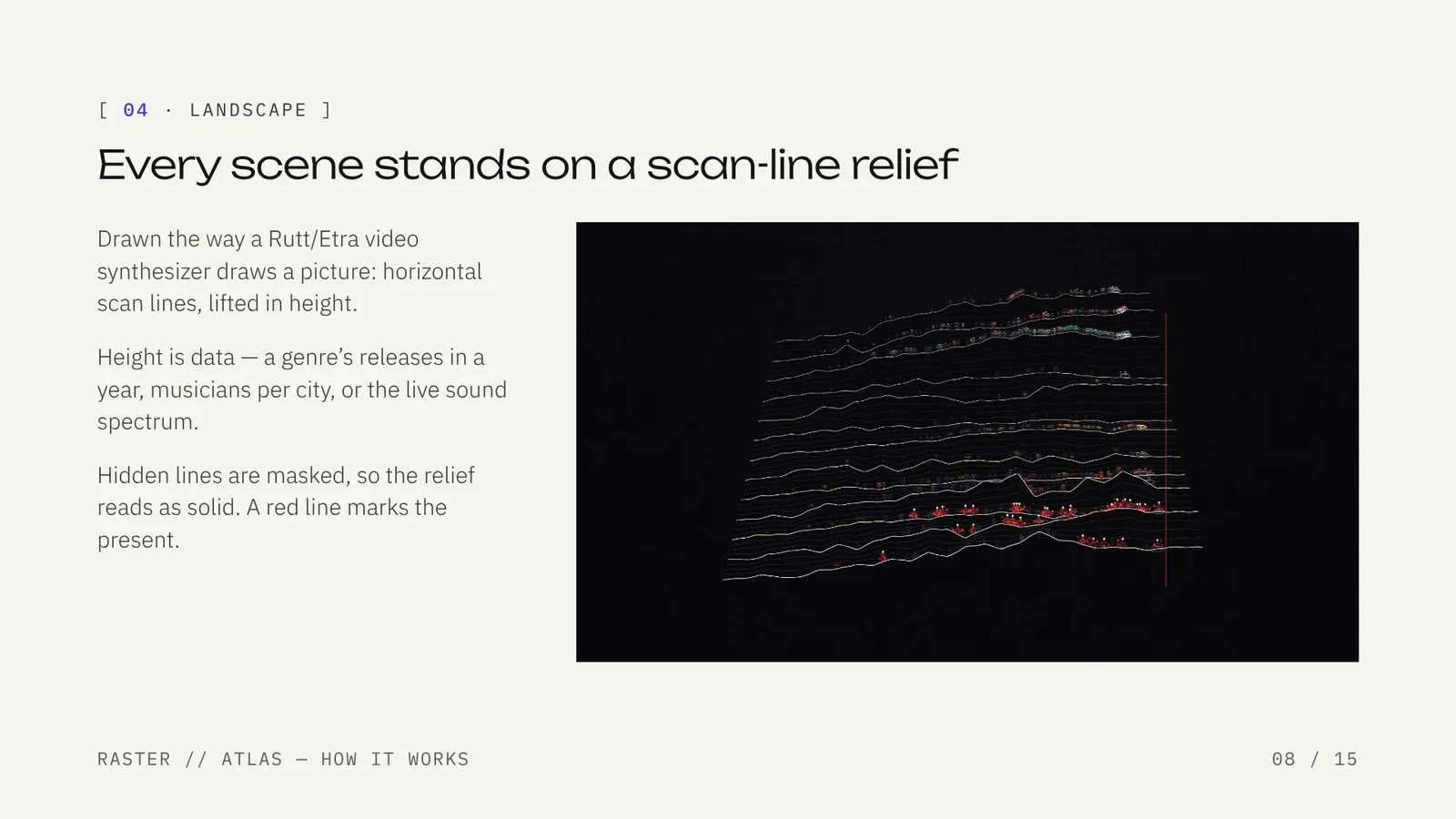
The ground is drawn the way a Rutt/Etra video synthesizer draws a picture: horizontal scan lines, lifted in height. Height is always data: a genre’s releases in a year, musicians per city, or the live sound spectrum. Hidden lines are masked so the relief reads as solid, and a red line marks the present.
MOVE · 03
A drone, not a tripod
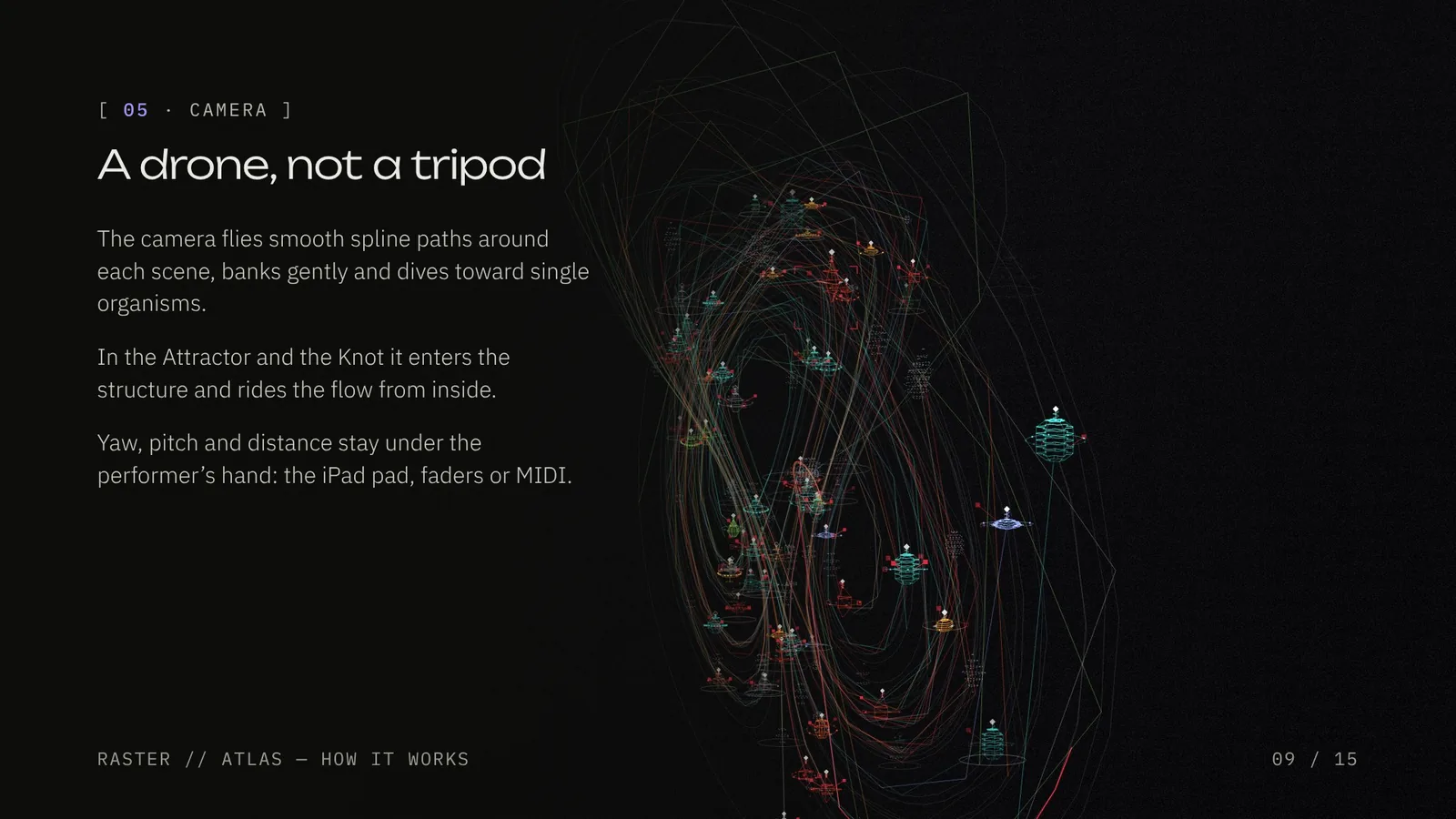
The camera flies smooth spline paths around each scene, banks gently and dives toward single organisms. The waypoints drift slowly, so the motion never repeats exactly but never jerks. In the Attractor and the Knot it enters the structure and rides the flow from inside. Yaw, pitch and distance stay under the performer’s hand: the iPad pad, faders or MIDI.
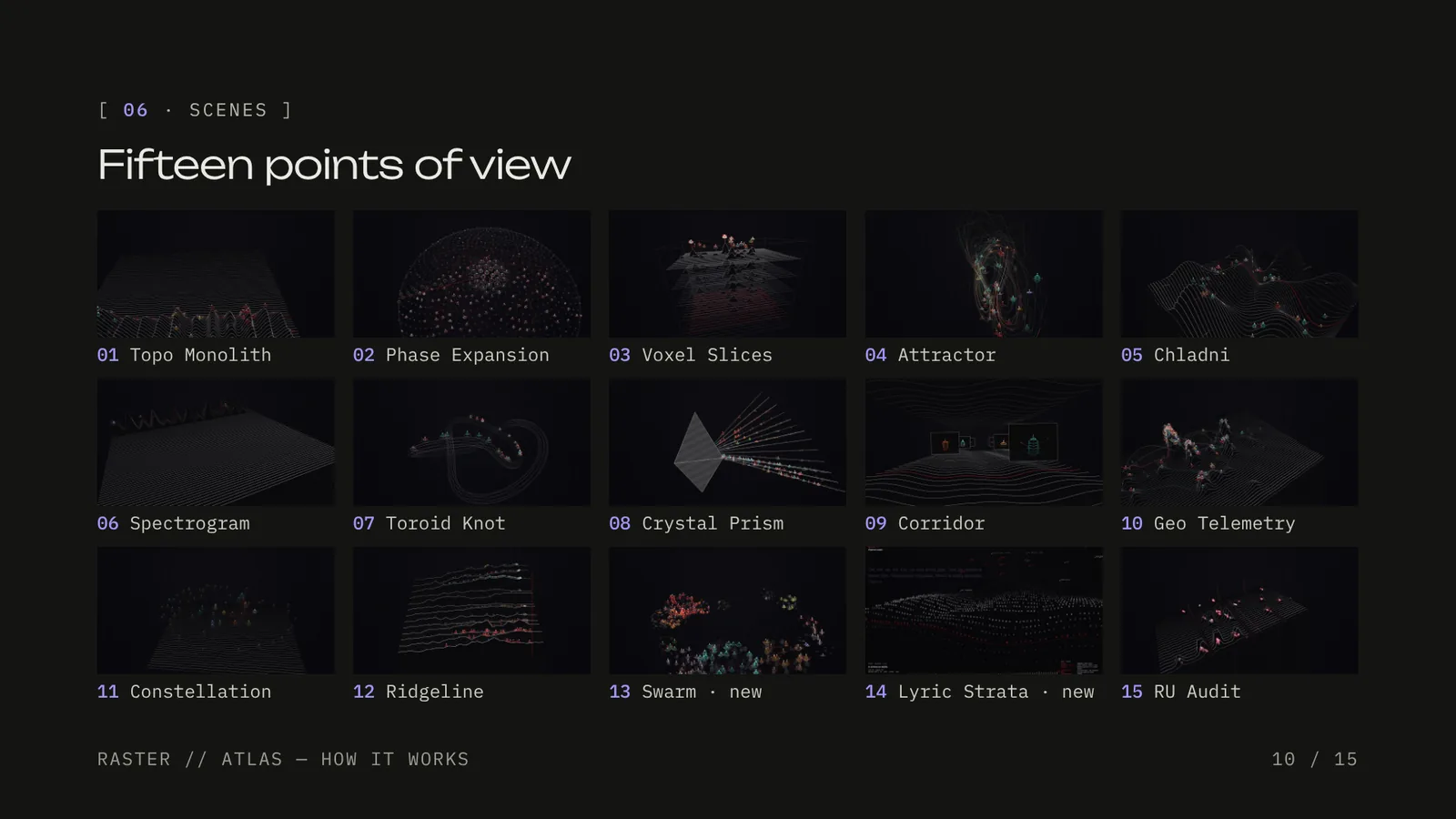
Fifteen points of view
The v2 engine has fifteen scenes: Topo Monolith, Phase Expansion, Voxel Slices, Attractor, Chladni, Spectrogram, Toroid Knot, Crystal Prism, Vitrine Corridor, Geo Telemetry, Constellation, Ridgeline, two new ones (Swarm Biome and Lyric Strata) and RU Audit. All of them read the same organisms and the same clock. Switching a scene changes the point of view, not the story.
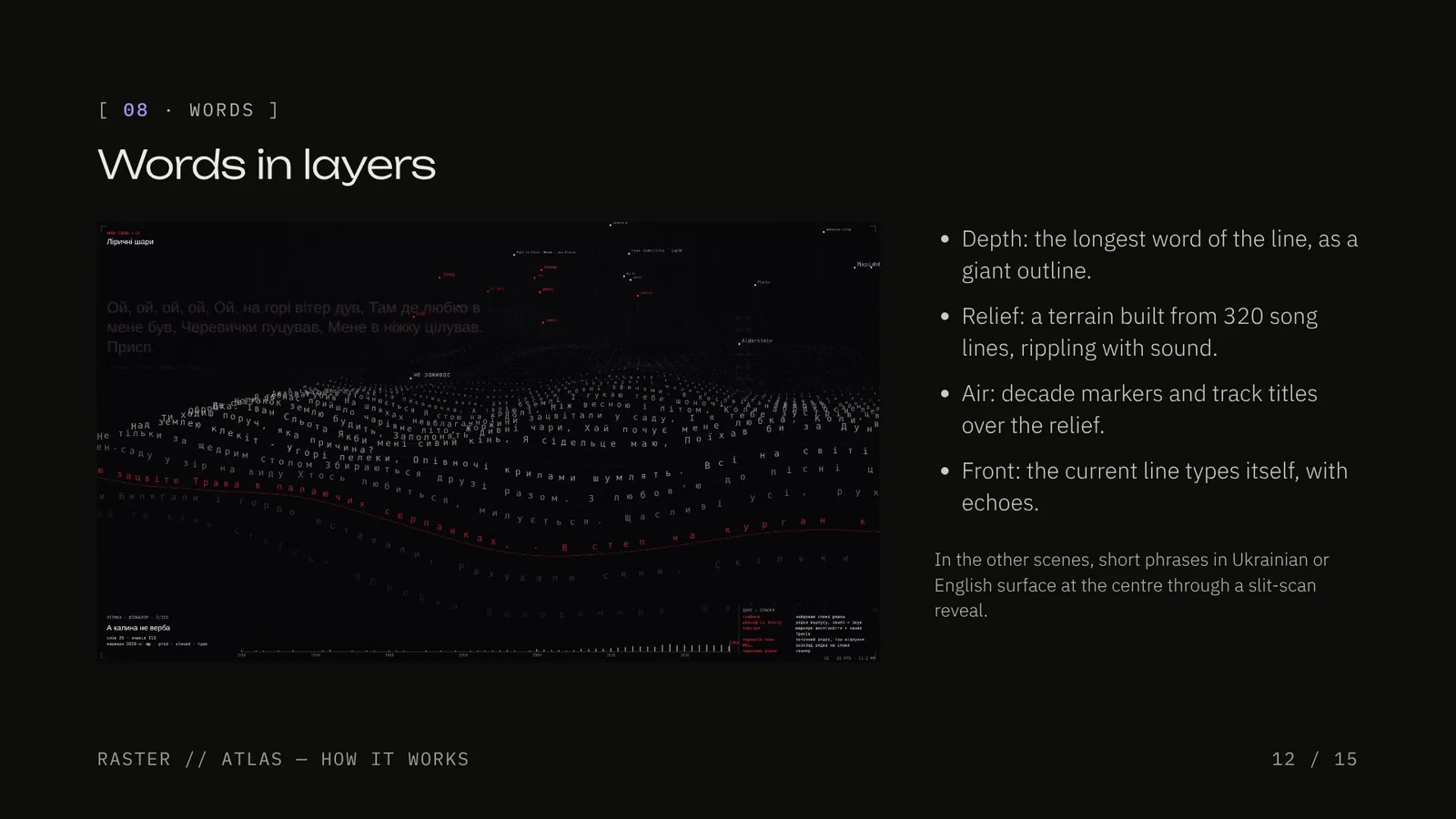
Lyric Strata is the scene made only for song texts, and it works in layers. In the depth, the longest word of the current line stands as a giant outline. Below it, a terrain built from 320 song lines ripples with the sound. Decade markers and track titles float in the air above the relief, and in front the current line types itself, with echoes. In the other scenes, short phrases in Ukrainian or English surface at the centre through a slit-scan reveal, by default about every 30 seconds or whenever the performer hits the “Phrase” pad.
Sound drives the surface
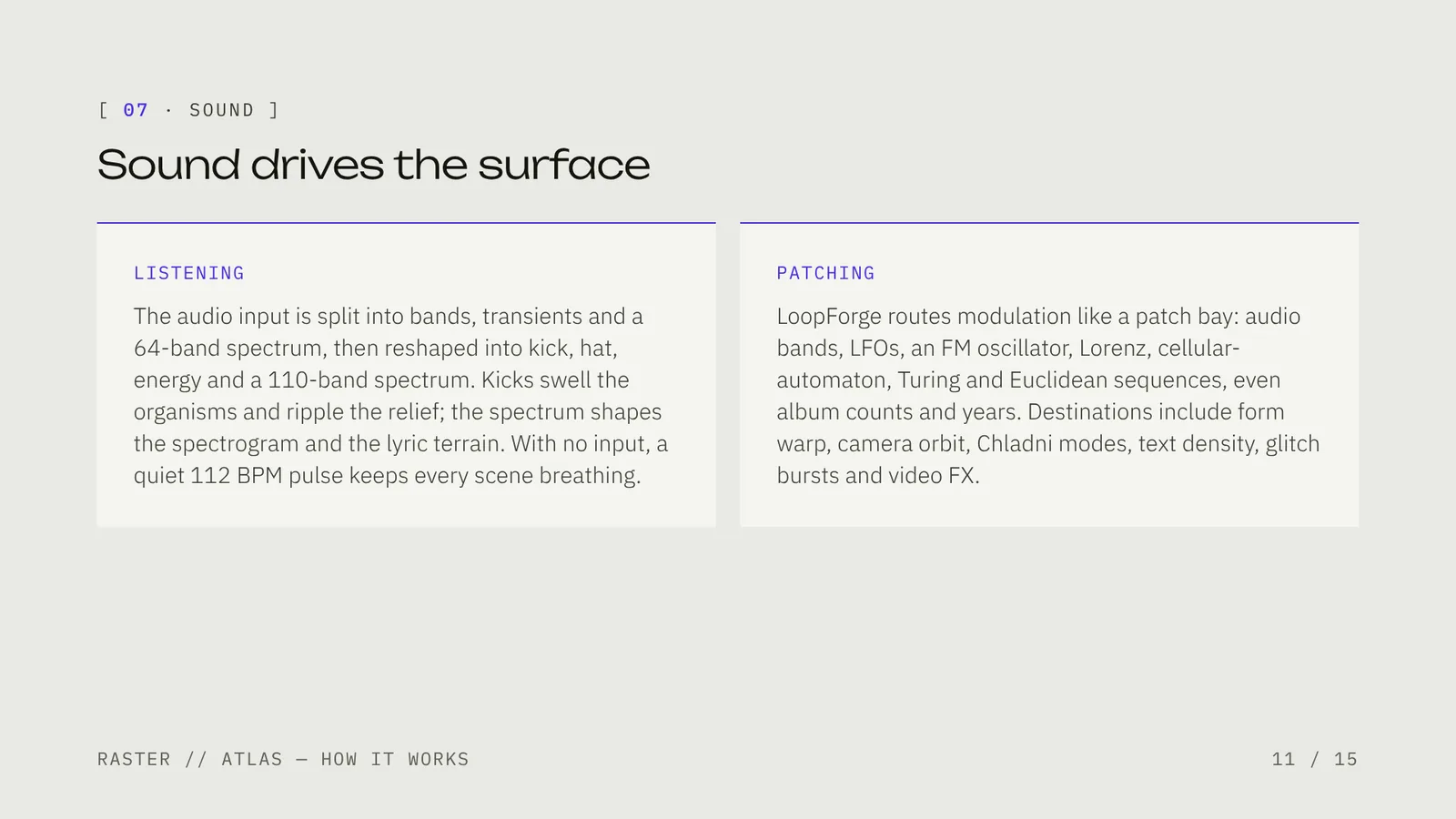
The laptop listens to its audio input. The signal is split into bands, transients and a 64-band spectrum, then reshaped into kick, hat, energy and a 110-band spectrum. Kicks swell the organisms and send ripples through the relief, and the spectrum shapes the Spectrogram scene and the lyric terrain. With no input at all, a quiet 112 BPM pulse keeps every scene breathing.
On top of that sits LoopForge, a modulation matrix that works like a patch bay. Its sources are audio bands, LFOs, an FM oscillator, a Lorenz system, cellular-automaton, Turing and Euclidean sequences, and even album counts and years from the data. Its destinations include form warp, camera orbit, Chladni modes, text density, glitch bursts and video effects.
Three screens, one show
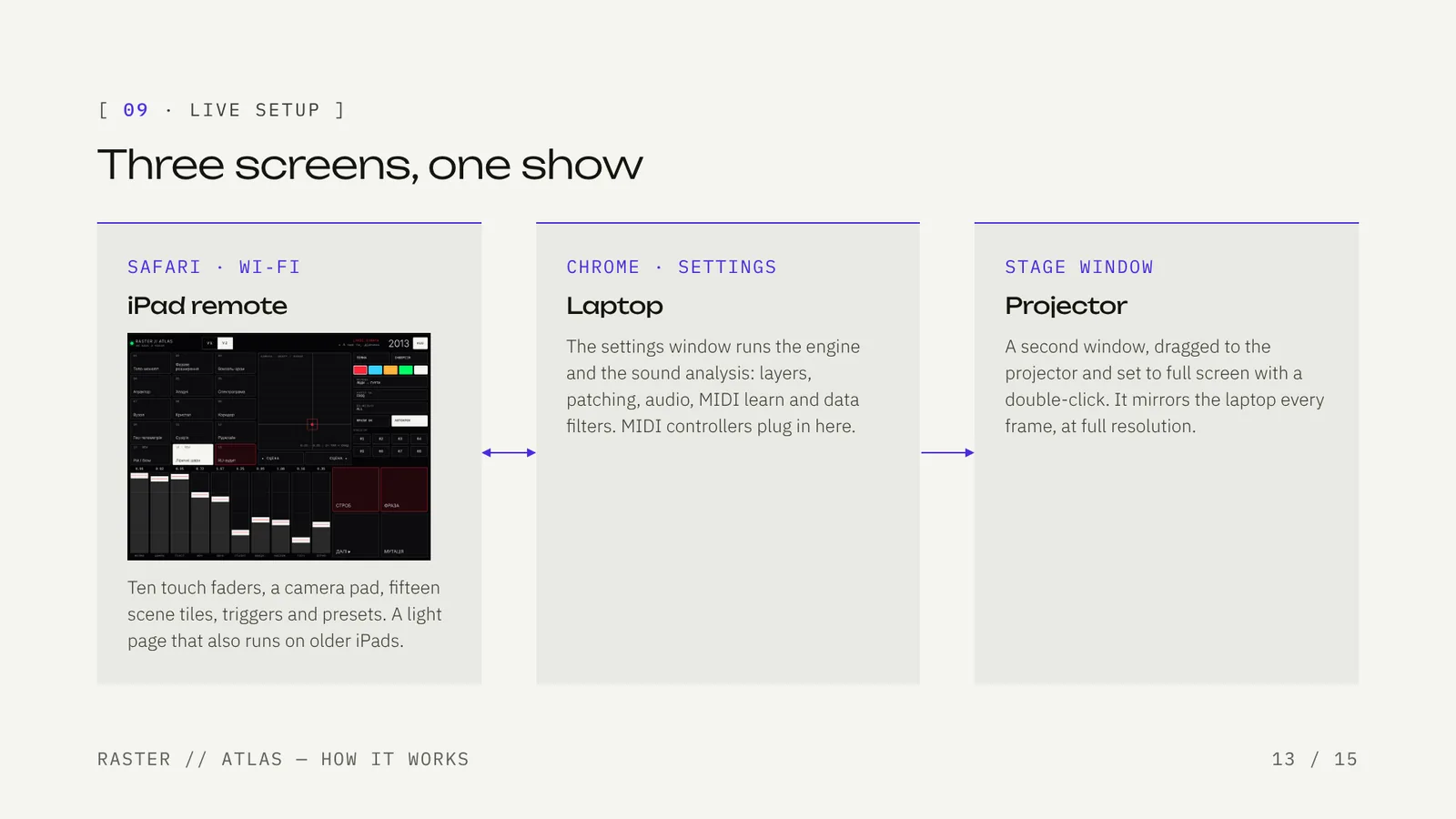
On stage the instrument uses three screens. The laptop runs the settings window in Chrome, where the engine and the sound analysis live: layers, patching, audio, MIDI learn and data filters. MIDI controllers plug in here. A second browser window is dragged to the projector and set to full screen. It mirrors the laptop every frame, at full resolution, and needs no controls of its own.
The iPad is the performer’s remote. It connects over the local network (the same Wi‑Fi, a phone hotspot or a small travel router) and offers ten touch faders, a camera pad, fifteen scene tiles, triggers and presets. The remote is a deliberately light page, so it also runs in the old Safari of older iPads.
Built for an ordinary laptop
2015
MacBook Pro 13″ with Intel Iris 6100: the machine it is tuned on
900
organisms on screen at once
15
scenes in the v2 engine
0
internet needed on stage
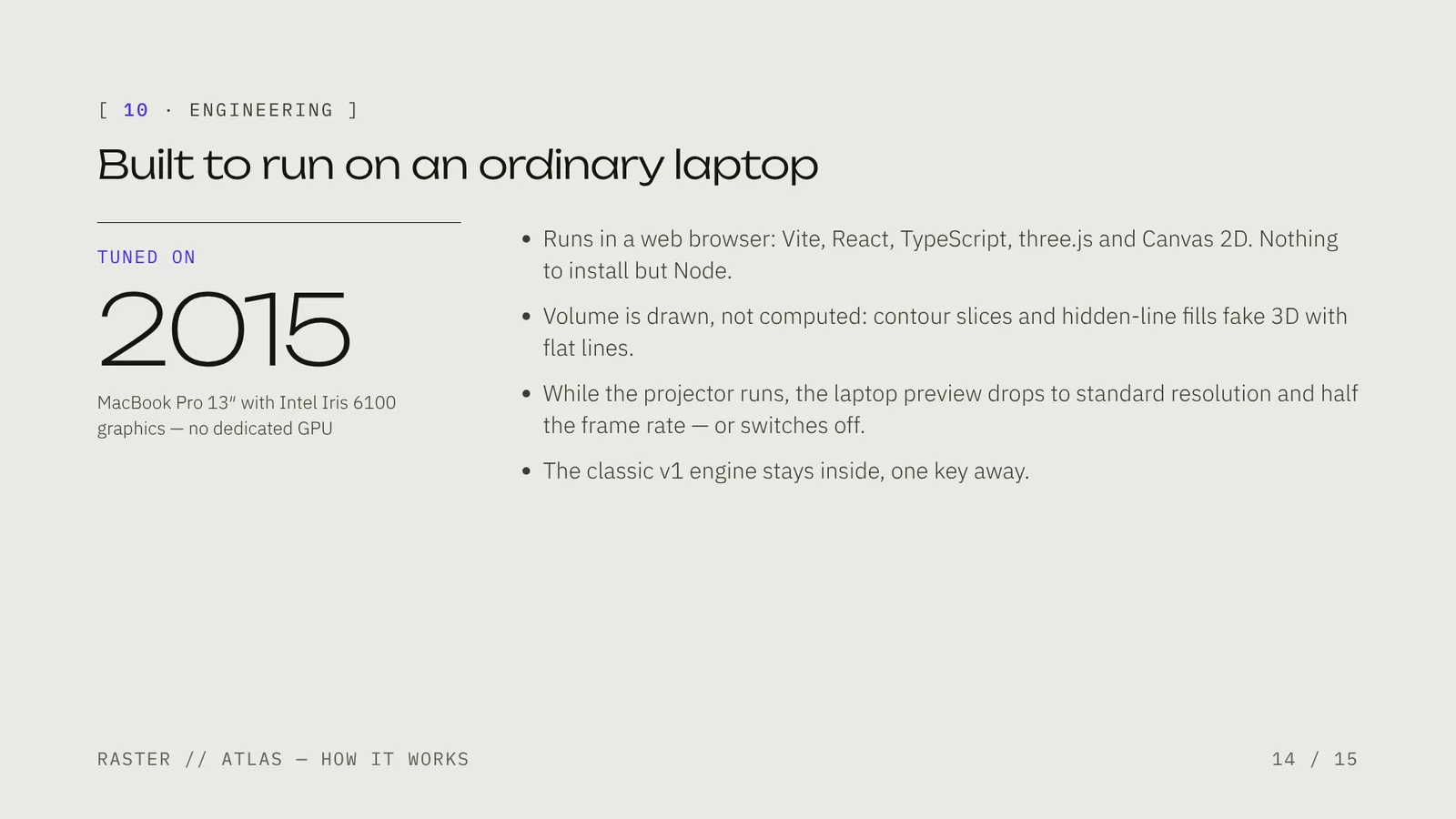
RASTER // ATLAS was tuned on a 2015 MacBook Pro with integrated Intel graphics and no dedicated GPU. It runs in a web browser and needs nothing installed but Node. Volume is drawn, not computed: contour slices and hidden-line fills fake depth with flat lines, and repeated strokes are batched together.
While the projector window is open, the laptop preview drops to standard resolution and half the frame rate, or switches off completely. The savings come from the preview and from drawing less, never from lowering the resolution on stage. The classic v1 engine is still inside, one key away.
RASTER // ATLAS is one way of putting GENOME on stage. The catalogue stays the source of truth, and the instrument is a way to read it with an audience in the room.
The deck
All 15 slides of “RASTER // ATLAS — how it works”. Click a slide to enlarge it; use the arrow keys to move through the deck.
01Cover — RASTER // ATLAS02What it is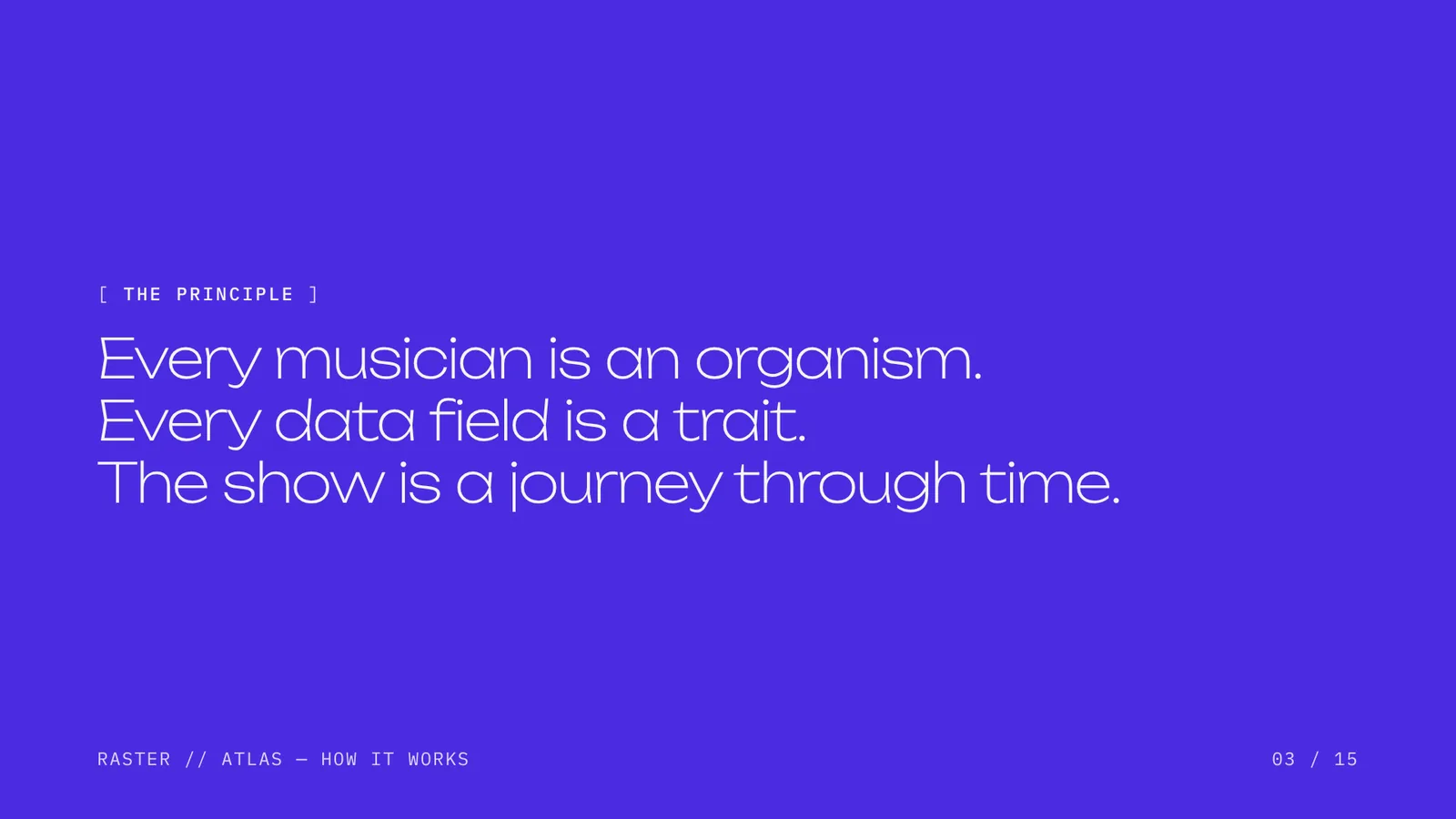 03The principle04What goes in05One organism per musician06Thirteen genres, thirteen bodies07Time is the road08Every scene stands on a scan-line relief09A drone, not a tripod10Fifteen points of view11Sound drives the surface12Words in layers13Three screens, one show14Built to run on an ordinary laptop
 15Art, science and technology, put to work on a story
Facts, concepts & context
- GENOME[database]Zemla Studio’s catalogue of Ukrainian artists, DJs, labels and compilations, 1960s → now. The single data source of the instrument.
- Rutt/Etra[instrument / technology]Analogue video synthesizer whose lifted scan lines give every scene its relief.
- LoopForge[module]The modulation patch bay inside RASTER // ATLAS: audio, LFOs, chaotic systems and data routed to form, camera and text.
- Lyric Strata[scene]The v2 scene built only for song texts: outline, terrain, air and a self-typing front line.
- three.js · Canvas 2D[technology]The browser drawing layers; volume is drawn with flat lines rather than computed in 3D.
- Zemla Studio[studio]Experimental design studio from Lviv: art, science and technology, put to work on a story.
- Atlas [place]place. T.A.M. Club / Centrum Mundi corpus · The Lecture That Wasn’t Supposed to Happen: RASTER // ATLAS, Paradoxes…
- LFO [instrument / technology]instrument / technology. T.A.M. Club / Centrum Mundi corpus · Centrum Mundi — CIX — UKRAINIAN MUSIC ENGINEERING: Kostyantyn Poveda
- Zemla Studio [label / press]label / press. T.A.M. Club / Centrum Mundi corpus · The Lecture That Wasn’t Supposed to Happen: RASTER // ATLAS, Paradoxes…
- The Ground [work]work. T.A.M. Club / Centrum Mundi corpus · Centrum Mundi — N029 — Botanica: Organic Ambient, Field Recording, and…
- The Clock [work]work. T.A.M. Club / Centrum Mundi corpus · Christian Marclay, Vinyl Collage and The Clock Masterpiece
- slide [instrument / technology]instrument / technology. T.A.M. Club / Centrum Mundi corpus · CONTRAPUNKT: a VST3 plugin that composes the harmony instead of looping…
- MacBook [instrument / technology]instrument / technology. T.A.M. Club / Centrum Mundi corpus · Yuriy Yaremchuk on Free Improvisation and ХАТНЄГРАННЯ