
Music at the Film Centre
In my previous article on the music programme of the Congress of Culture, I insistently drew attention to the hints of the fast-approaching Publishers’ Forum that permeated the performances on the IQ stage. And since Lviv is a city whose destiny is to unite — whether we are talking about the coexistence of the many ethnic groups that have settled in successfully along the narrow little streets of our city, or about the crossroads of trade routes, or about the usual interplay in the sphere of culture — one could predict that something might grow at the intersection of big and small cultural events. Something new, yet so obvious; something expected, yet ignored until now; something accidental, yet carefully thought through. The Publishers’ Forum is no exception.
Let me start from afar. The benign chaos after the Maidan, like the Big Bang, shifted the tectonic plates of Ukrainian society. Suddenly, grassroots initiatives, start-ups, art groups, labels, brands, online radio stations (and other fashionable words) began springing up everywhere. And those that had existed before finally started to speak up for themselves and to develop, and at last they were heard. The art scene began to stir and multiply in geometric progression, to spread out, to roam, to expand the scale of its activities. The critic Oleksandr Kovalchuk sees various threats to Ukrainian music in all this. In one of his latest articles, “Skovoroda vid baldy” (“Skovoroda Off the Top of One’s Head”), he writes: “On the wave of the Euromaidan, a wave of exaltation rose around new Ukrainian music, whose quantity (and it is good that it is appearing) will never turn into quality.” One can and should disagree with Kovalchuk, but one cannot ignore him. Because he is one of those Lviv “weathervanes” you have to watch to know which way the wind is blowing. In my view, these small and larger stirrings and rousings that we now have in Ukraine are the first cultural flashes hinting at the light at the end of the tunnel. At first it will hurt our eyes, but very soon the body will adapt, and we shall “see a wonderful world!”.

Until recently, entertainment Lviv developed haphazardly and very one-sidedly. This process surrounds us every day: the ways of spending one’s time are frankly limited to commercial venues offering an entirely ordinary and essentially uniform product — from eateries to cinemas, to say nothing of music venues. You can count on the fingers of one hand the places that host and support unconventional projects, and on the fingers of the other the people who help new things develop in Lviv. The turning point in how “leisure” was seen came with the Fredra.61 initiative. An ordinary flat in the centre of Lviv, done up by a few friends with their own hands, became an open platform for presenting the work of grassroots initiatives and individual artists. What mattered was not what the space looked like, with its Soviet pseudo-arty whitewash and lack of room, when there weren’t enough chairs for everyone and at some events people had to stand in the kitchen or the corridor. What mattered was that Fredra.61 showed Lviv.ians — not tourists — “another way” into the city. How relevant this way is can be seen from the fact that similar slogans, albeit with mistakes, began popping up on election billboards.

Following in the footsteps of Fredra.61 — and partly because it was taking a temporary break and the weather was warm — other places and other kinds of events began to appear in Lviv. One of them was this summer’s MOKH party (mokh means ‘moss’): a fully fledged open-air event inside the city. The advantage of such an event is obvious: you don’t have to travel tens or hundreds of kilometres out of town, live in a tent or spend money on logistics. You go to work in the morning, in the evening you end up at an open-air party, forgetting you are in the city, and a few hours later you are falling asleep in your own warm bed at home. I have been to such parties in Warsaw from time to time. They have their own advantages there, of course, one of which is the river, but the open-airs take place not only on its banks but in all sorts of little woods too.

A party that only a limited circle of people managed to get into — Sky-High — was another good practice this summer. For one night the organisers turned the hill of the High Castle into a nightclub. Admittedly, you first had to make an effort to clamber up to the top, but once there you realise that the textbook ritual of greeting the sunrise on the High Castle has never been as fitting and successful as it is today.

Another successful way of taking music out onto the street, as part of the Fête de la Musique in Lviv, was ELEKTROTERASA. This project, part of the First International Forum of Independent Initiatives HOMEPLAYING, became a musical platform where Polish and Ukrainian initiatives and musicians could get to know each other. The event took place on Franka Street next to the old building of the Polish Consulate, which had a certain symbolic colouring, since a good half of the guests had come from Poland. As part of the event, Lviv’s first mini-fair of independent labels was held. The Polish and Ukrainian guests brought music released on cassettes, CDs, memory cards… — music issued in limited quantities, so the media are usually designed by hand.

And just a few days ago, in a strange and godforsaken place — the Budivelnyk Sports Palace — a KOMAKHA costume party took place (komakha means ‘insect’), to which guests had to come dressed as insects. The setting and decorations were to match. The emergence of these events and the crowds they draw show that Lviv’s more switched-on residents have had their fill of commercial “discos” in the centre. For the sake of an interesting, new atmosphere they are ready to move a few kilometres away from the comfortable Market Square and radically change the format.
Here we come to the main point. Recently (on 20 March) a brand-new Film Centre opened in Lviv. It is not just a cinema; it is a place where, besides films, all sorts of interesting and very strange things can and do happen. As was announced at the start, besides auteur and intellectual cinema it would be a platform for all kinds of activities by Lviv’s initiative groups: workshops, concerts and so on….. So it is no surprise that during the Forum, with Fredra.61 on holiday, something like the Publishers’ Forum party could take place in only one place, and that place is called the “Lviv Film Center”.
The Film Centre’s remote location — the former Sokil cinema — can hardly be called busy. I personally put the rather low attendance, compared with commercial cinemas, down to Lviv’s “bottleneck” — transport. You would think that Sokil stands at the junction of a whole bunch of minibus routes, and a tram sails past every so often too. Nevertheless, the oppressive burden of getting to and from a dormitory suburb in the evening hangs over you whenever you dare to dream of events outside the Centre. So full houses at the Film Centre’s daily screenings are, alas, a rarity.

The Publishers’ Forum party, the “BookWorm party”, to my happy surprise, proved an exception to all these rules and outdid the whole of musical Lviv by every standard. A completely different musical content reigned at the Film Centre on 11 September: DJs and sound artists from Kyiv and Lviv whom you don’t (often) hear in Lviv, not least because of the commercial bias of Lviv clubs; a dance floor in the Film Centre’s auditorium and a chill-out zone outside, where a selection of good music played from Andrii Bondarenko’s anti-radio “Luhalbanda” and DJ Nikitone from Rivne; plus food and drink from Lviv’s progressive venues. Outside, everything was set up almost as at the MOKH party: people sat among the trees on soft pouffes, watched video poetry from the CYCLOP festival, chatted, tucked in and hung out; but what was going on inside the Film Centre was an entirely new format for Lviv. The most obvious, yet most striking and unexpected, element was the visuals on the big cinema screen. Indeed, what advantage does a cinema auditorium have over a club, if not the equipment for gigantic visuals?

Personally, I liked the spirit of freedom that reigned in the main auditorium. You could feel it even in the presence of the seats. Some may think the seats out of place at a party, but I like them, because they embody the possibility of choice: you’ve had a dance, now you can sit down and enjoy the audiovisual show while watching the musicians at work. Even cooler, there were two screens. One of them, the smaller one, hung above the DJs, so the options were endless: whichever side you stood on, not a single nuance escaped your attention. The climax of this extraordinary party was greeting the dawn on the roof of the cinema building. Besides all the freedoms already listed, this part was wrapped in musical freedom too, since anyone present could, if they wished, put on their own favourite music and share a slice of their own musical taste.
The “BookWorm party” happened thanks to the collaboration of Denys Kovalevskyi (without whose help, by the way, ELEKTROTERASA would never have become a TERRACE), Dmytro Novikov and Veronika Homeniuk, whom I asked about the organisers’ impressions of the event: “Dmytro and I, as the organisers of the music part, didn’t know how many people come to the Film Centre for night-time events. So we were entirely satisfied with the number of guests who came. We got a lot of positive feedback about the venue and the auditorium, so we hope to continue soon. Perhaps it will be screening premieres and so on, and we, as party organisers, will be able to hold our own events there alongside. The auditorium’s biggest advantage is the screen. It lets people take in the visuals better, so in future we may put the emphasis precisely on the visual side of the parties.”

As for the music, the variety of styles was surprising too. Die-hard drum’n’bass fans could partake of light, melodic dance electronica from John Object, who, incidentally, was playing in Lviv for the second time, after ELEKTROTERASA. John, whose real name is Tymur, is an extraordinarily interesting, fresh and unaffected face on the underground scene. I am sure we will hear about him more than once. After melodic electronica you could plunge into the thickets of breakcore and dubstep and finally end up in a peaceful chill-out atmosphere. Since the party was part of the Forum, texts were bound to feature. One of the curiosities of the evening was mixes of poems read aloud and recorded in advance. The recordings were made either in the cinema foyer, or people sent in ready-made extracts. According to the organisers there were no restrictions at all; everyone decided for themselves what to record. So we had a range from Vinhranovskyi to Vysotsky, and some original poetry too. From time to time these poems surfaced here and there in the music-filled space, resonating with the visuals by Slava Poliantsev and Zoz.
Anna Khvyl of the poetry club “radical beauty” — whose name you may have heard in connection with another innovative Lviv space on which fate, in the person of the people of Lviv, sadly took no pity (I am hinting at the social café “U sisidiv”, ‘At the Neighbours’’) — shared her experience of recording poetry: “We recorded a poem by the Swedish poet Tomas Tranströmer, ‘Memories Look at Me’. My friend and I learned it together on a winter walk, when it was very cold at home and we decided that if we had to freeze anyway, it was somehow more cheerful outdoors. We walked through the snowy slush learning lines about a June morning, memories and greenery.”
To make my impressions more reliable and well rounded, I decided to ask one of the DJs what he made of this interaction and the new party format. And since it turned out that one of the invited guests was Lviv’s own 1suponatime, who used to play at Fredra too, my choice was obvious: “As for the poetry, I’ll speak only for myself, as I’m not sure how the other DJs chose their poems. The organisers invited guests to send them audio recordings of their favourite poems. There was also a chance to come to the Film Centre one day and read a poem to be recorded. Then the DJs were to listen through everything sent in and recorded and pick something at their own discretion. Funnily enough, I couldn’t choose anything for myself, because I wanted to prepare a special mix for the party that would convey a certain mood and tell the listeners some kind of story. And most of the poetry collected was read in a voice that didn’t suit my music, or didn’t match what I had inside me in content or mood. Among it all there were even a few lyrical poems by young Russian-speaking women poets, already set to music from Requiem for a Dream, or something along those lines. Tom O’Bedlam came to my rescue: he has recorded a great deal of depressive poetry in his deep, calm voice. Of all the poems available I picked three: ‘Alone With Everybody’ by Charles Bukowski, ‘Bosnia Tune’ by Joseph Brodsky and ‘The Tiger’ by William Blake. In my mix you could hear them somewhat altered and distorted by effects. In Ukrainian, I also used Lina Kostenko’s poem ‘Kryla’ (‘Wings’) read by Bohdan Stupka. It fitted in nicely too, but I did it mainly to tease friends who kept asking what poems I was going to play.

I loved the format. There were no constraints from the organisers; each participant could play whatever they liked. When all the DJs had settled on their styles, Veronika and I sketched out an hour-by-hour line-up, just so we could start with something lighter and finish with something heavier. Quite unusual musicians for the Lviv scene came together, so the result was a rather interesting musical salad. That has its downsides, of course. I think the drum’n’bass fans liked it least. It was there, but they didn’t stay long enough for it. The organisers went to great lengths with the decoration of the auditorium, the lighting and the sound. When I turned up for my soundcheck, I was so surprised by the scale of the work that had gone into it that I immediately started texting all my friends to come in the evening and see it all with their own eyes. Many guests were surprised, because they had expected a half-dark party in a shabby cinema with one strobe light and ten people on the dance floor.
It wasn’t just a party with a smoking area outside, as is often the case. You could call the ‘Book Worm Party’ a one-day mini-festival.”
That last sentence, it seems, sums it up best. All that remains for me is to express the hope that new formats will appear in Lviv, old ones will develop, and the banality of leisure that loiters around the historic part of the city will leave Lviv for good.
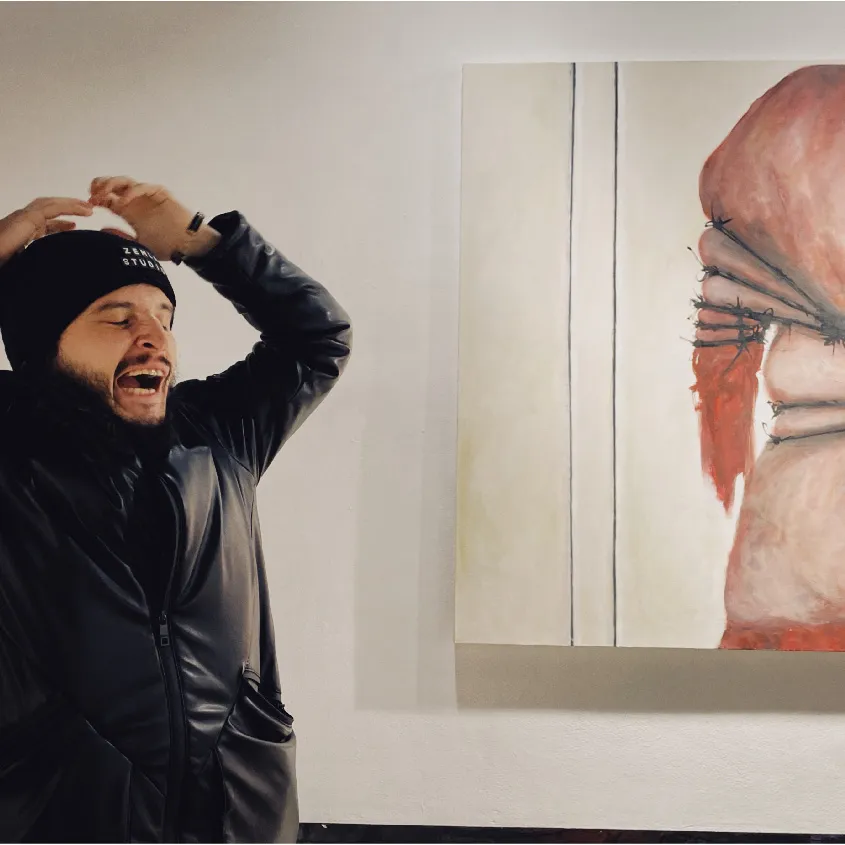
Dr. Myroslav Trofymuk
Born in Lviv. Designer, director, musician, researcher, founder of ZEMLA STUDIO. Master of classical philology and digital marketing, PhD in the history of Ukrainian literature. Member of the National Union of Journalists of Ukraine. Since 2022 he has authored the CENTRUM MUNDI audio show for Polish Radio for Ukraine, continuing the same research into the contemporary music scene in Ukraine and Poland.
Full bio →

