Wojtek Kwapisinski is a Warsaw improvisor, composer, and music theorist performing on prepared soprano saxophone. Co-organizer of the capital’s improvised concert series Impro Miting and Dzialanie Muzyczne, founder of the Element label. Trained in philology and special education, he deliberately performs live without using a computer.
This brief conversation, styled as an interview, was recorded in Lviv following the events of the international electroacoustic music festival Vox Electronica 2014.

What were your impressions of this festival?
Nothing but good. Very good, very rich. I was received here with great warmth and human care. In terms of overall impressions, I did not suffer at all. Speaking concretely: the event itself and the festival were deeply engaging for me. The concerts, the chance to converse with artists, the lectures — all of it was enriching.
For instance, compared to other festivals I have attended, I felt much better here. Those lacked this… intimate atmosphere. It is not about some extraordinary intimacy, but simply genuine contact between people. Perhaps it is partly because I know you, but I think not only that. It comes down to human relationships.
Vox Electronica is a Lviv electroacoustic music festival founded in 2013 by the NURT artistic association with composer Ostap Manulyak. The program combines concerts, lectures, and workshops, deliberately keeping a chamber scale.
LIVE39:02ХАТНЄГРАННЯ 99 - eclectic syncretism - LIVE AT VOX ELECTRONICA 2019via: Krzysztof Knittel · Vox Electronica
At most festivals I attended, everything felt far more formal: you have a task to perform, play a gig here, sign in there, move along. Here, you participate in the entire process and absorb the environment — musical, spatial, urban. So it was truly great.
I had never attended a festival with this kind of serious, dedicated orientation. I have been to jazz-adjacent and improvised events, but they were largely commercial. In Poland, unfortunately, most events drift in that direction — not necessarily in a bad way, but focused on catering to broad crowds as entertainment. Discussion panels often hit a wall too — they happen, but resemble public performances rather than genuine dialogues. That was absent here, which is fantastic. I hope it continues along this path.

On one hand, one could say: the festival is small, few attendees, somewhat desolate. But I would argue the opposite — that is a positive. Not that a small crowd is inherently good, but it defines the atmosphere. When a hundred people arrive, energies blend and the dynamic shifts entirely. Perhaps I should not overstate it — seasoned veterans feel comfortable anywhere. But for me, this was a distinctly different experience from Poland. In Warsaw, many events feel… empty. Perhaps it is the scene, perhaps circumstance — I would not generalize. When someone like Krzysztof Knittel speaks, his vast experience speaks for itself. I am speaking primarily of atmosphere. Substantively, it was a rich encounter, allowing me to observe how people in Lviv approach music — with less superficiality.
 LIVE47:56ХАТНЄГРАННЯ 99 - LIVE AT VOX ELECTRONICA 2019 - part 3via: Krzysztof Knittel · Vox Electronica
Krzysztof Knittel is a Polish composer and improvisor. Associated with the Polish Radio Experimental Studio (SEPR) since the 1970s, co-founder of KEW, Tit, and Freight Train. Merges chamber and electronic music with emerging technologies.
A Vocabulary for Sound and the Limits of Intermediality
I noticed an interesting phenomenon: during presentations, composers spoke about their sources of inspiration — events, personal emotions. That made me reflect, because in Warsaw that is frequently absent. I get the impression that both there and here, we lack an adequate vocabulary to discuss sound. There are attempts, but… I ponder this myself; I even considered enrolling in composition studies to observe how it is taught.
One gets the sense that critical reflection on music stalled about a decade ago. Sonic vocabularies are contemporary, technical means similar across Poland, Ukraine, or America. Yet these are surface variations. There was a presentation, for example — I do not recall the name — someone working with their hands in an audiovisual format. It was intriguing, yet the music itself did not captivate me. For me, intermediality is secondary. It is not the core of music. It can be compelling and well executed, but that is not the essential point. I preferred listening to the piece itself rather than watching visual layers.

Is that why you avoid computers in your performances?
No, absolutely not. Each artist selects their own tools. I hold no prejudice against computers; I care solely about the final aesthetic result. Looking at twentieth-century music history — even pioneers like Karlheinz Stockhausen, Luigi Nono, or Iannis Xenakis — one sometimes feels certain contemporary efforts take a step backward. The computer in itself is fascinating, both for sonic production and informational exchange. I simply choose not to rely on it during live performance. In the studio, however, I use it routinely: recording, mixing, mastering.
Karlheinz Stockhausen, Luigi Nono, and Iannis Xenakis were seminal figures of twentieth-century post-war avant-garde, pioneering electronic, serial, spatial, and stochastic music by integrating technical innovation with philosophical and social critique.

What did you feel was missing?
Deeper reflection. Not merely how something is constructed, but why it is made and what it represents. Alla Zagaykevych’s lecture was solid, but introductory and somewhat academic. I miss substantive dialogue on meaning — what music signifies to the creator and why specific mediums are chosen.
I also spent time at Pawel Janicki’s workshop. It was heavily technical, yet the core concept was compelling: generative grammar and translating commands into sound. His performance was intriguing, though I harbored reservations about interpreting that visual score. It was difficult to determine whether image drove sound or sound governed image. Nonetheless, the translatability across sensory modalities was captivating.
Pawel Janicki is a Polish media artist, composer, and programmer affiliated with WRO Art Center in Wroclaw. Explores interactive algorithmic systems, generative scores, and the interplay of audio and visual streams.
I discussed other projects with Pawel too — dispatching audio data packets, testing networks bordering on surveillance tactics. That intersects directly with contemporary communication and data transmission. Perhaps it is not my personal aesthetic focus, but it offers a valid translation. The fundamental question remains: what constitutes music as information? To whom is it addressed? And does it exist before someone actively listens to it?
Overall, it was very rewarding. I enjoyed it thoroughly.

- Paweł Janicki [person]composer, curator, producer (Poland). KORINNIA map (1 conversation) · Autumn New Music Festivals — Contrasts, Tetramatyka, and Cinar Timur
- Luigi Nono [person]composer (Italy). KORINNIA map (1 conversation) · Jacques Attali 'Noise' and Stochastic Music of Iannis Xenakis
- Wojciech Kwapisiński [person]Warsaw improviser and composer playing prepared soprano saxophone, co-organiser of the Impro Miting concert series. · Синергія фестивалю Vox Electronica 2014
- Krzysztof Knittel [person](b. 1947). composer, pedagogue (Poland). Linked with: Warsaw Autumn, Warsaw. KORINNIA map (3 conversations) · Marek Chołoniewski: SME, Forty Years of Muzyka Centrum, and the Sonic…
- Iannis Xenakis [person]composer, engineer (France). KORINNIA map (1 conversation) · Jacques Attali 'Noise' and Stochastic Music of Iannis Xenakis
- Karlheinz Stockhausen [person]composer (Germany). KORINNIA map (6 conversations) · Bruno Maderna and Stockhausen's 'Licht' Opera Cycle
- Alla Zagaykevych [person]person (Ukraine). Linked with: Kyiv, Paris. KORINNIA map (10 conversations) · Синергія фестивалю Vox Electronica 2014
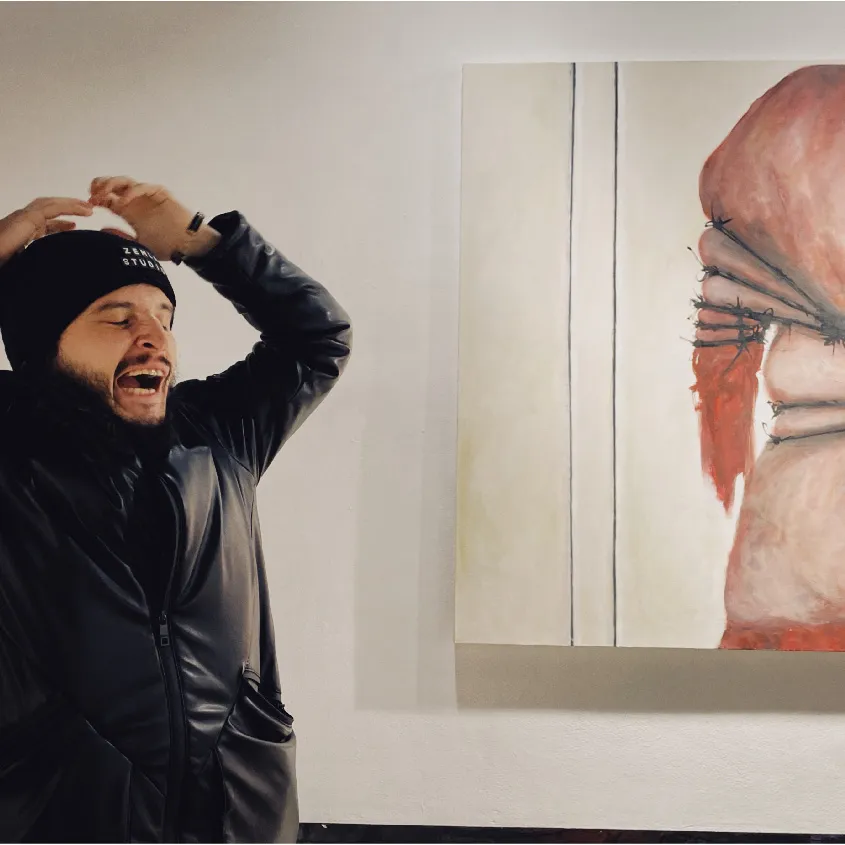
Dr. Myroslav Trofymuk
Born in Lviv. Designer, director, musician, researcher, founder of ZEMLA STUDIO. Master of classical philology and digital marketing, PhD in the history of Ukrainian literature. Member of the National Union of Journalists of Ukraine. Since 2022 he has authored the CENTRUM MUNDI audio show for Polish Radio for Ukraine, continuing the same research into the contemporary music scene in Ukraine and Poland.
Full bio →