
THE MUSICAL LABYRINTH OF AUTUMN LVIV (3)
Lviv used to be the capital of drum’n’bass; these days it could more fairly be called the capital of cover bands. Yet there is a music intertwined with the image of Lviv the way techno is with Detroit or Berlin — and that is jazz. But here we have a paradox: wander round Lviv’s bars and concert halls of an evening and you will very rarely hear jazz. Nevertheless, the myth of Lviv as the city of coffee, jazz and — as some joke — cobblestones lives on in the minds of residents and tourists alike. And it turns out that it is not only Lviv people, and not even only Ukrainians, who sense the jazz spirit of Lviv. After all, the Poles who organise the Art Meetings festival in Lviv have for the fourth time chosen the improvised incarnation for the Lviv edition of their festival.

“What’s Art Meetings?” you may ask. And I won’t be surprised if you do, because really: what kind of festival takes place in Lviv for the fourth time and yet hardly anyone knows about it? A ghost festival. A fata morgana… As for me, I first learned that this festival existed a year ago, when I was putting together a timeline of Ukrainian festivals. I came across information about it on the internet at the time, but the festival’s page suggested that the event had been, as it put it, a one-off. Later the name cropped up in conversations with the music scene in Poland, but nobody ever mentioned it here, in Lviv.
This year all of Lviv’s cultural life in September revolved around the Eastern Partnership Culture Congress. So it is no exception that the Art Meetings festival also began its journey this year as part of the Congress programme. Then came “Transfusion” — a project involving four musicians who performed improvised music referring to the sounds of the human body. “Transfusion” is a project founded by Andrzej Bauer, based at Polish Radio Programme 2 — the so-called “Dwójka” — and the Władysław Szpilman Studio. “Transfusion” brings together improvised encounters between various musicians, regardless of their musical interests or playing technique. In Lviv, besides Bauer, the project featured Igor Pudło — in his solo guise, Igor Boxx — Cezary Duchnowski and the festival’s curator, Piotr Damasiewicz.
As for Damasiewicz, throughout the festival he appeared on stage more often as a performer than as a curator. Notably as part of the project “What Does Lviv Smell Of?”, together with the Norwegians Søren Knudsen, saxophonist André Roligheten and flautist Bjørnar Habbestad, and the drummer William Sovik from Sweden. Knudsen is a composer, programmer and new-media artist. Among other things he works with so-called soundscapes, that is, he creates masses of sound, particular sonic environments. At the concert he used an ordinary microphone and a special set-up of sound effects on a computer to turn the incoming signal from that microphone into a musical instrument. The project “What Does Lviv Smell Of?” is a long-running collaboration with the Lviv poet Ostap Slyvynskyi. The musicians came to Lviv, walked round the city, observed Lviv and… sniffed it. Then each of them wrote down one word, which the poet was later to turn into a text. This year’s project caught on to the Publishers’ Forum by one nostril — as a continuation of last year’s music-and-visual project of the same name. Back then, a film about our city was also shot as part of the festival.

Damasiewicz could also be heard in the “Elements” concert, the penultimate concert on the festival’s final day. Joining him on the stage of Dzyga were the aforementioned William Sovik and Maciej Garbowski, double bassist and co-founder of the trio RGGi. If “What Does Lviv Smell Of?” was extraordinarily tender and sensuous — the music hypnotised you and gently moulded you, like plasticine, to the stiff templates of Ostap Slyvynskyi’s poetry — then “Elements” was more traditional improvisation, if improvisation can be described that way: somehow more canonical in its unconventionality.
A somewhat more radical unconventionality came from the Czech-Slovak duo of Petr Vrba and Miro Tóth. In their set you could hear echoes — not even echoes, but the hum, roar and shriek of the avant-garde of Russolo’s day. Besides their wind instruments, the performers used the full range of their own voices; Miro Tóth in particular would break off from the clarinet and use his own mouth as a fully fledged instrument. In this concert you could hear most of the groups of sounds listed by Russolo, from rustling to rumbling — and all of it on wind instruments alone. The sonic canvas reminded us of the avant-gardists’ fascination with industry: the din of factories, the roar of machines, the whistle of trains.
To be honest, loud and dynamic improvisation, unless it is noise, is a rarity in Lviv, and even in Poland I have not often come across improvisation that by every sign could be described as punk improv. The first time I heard anything like it was in fact at the Art Meetings festival, and those in the know will guess that I am talking about Fire! If underground rock clubs are your natural habitat, your everyday casual wear is leather trousers and sleeveless denim jackets, and for you the spectrum of music begins with Deep Purple and ends with Slipknot, but you suddenly feel like going to a jazz bar and partaking of improvised music — or your friends love improv and you need a compromise — then the only solution is Fire! Of course, if instead of friends it is your girlfriend, the plan is doomed: things can go one of two ways. Either she dumps you once she realises where you have brought her after weeks/days/hours of dreaming about jazz improvisation, or she dumps you for the mighty Swedish lad Mats Gustafsson. There is no third option, as they say. What best describes this band is not so much its name as the exclamation mark at the end!

In my pieces I have a habit of saving for last what impresses me most. And what impresses me most is something that has no equivalent, or that is hard to describe in familiar terms or fit into a standard frame. At this year’s Art Meetings festival that was “Tiny Instruments” (Małe instrumenty). “Tiny Instruments” is not a band, it is a fairyland. Imagine a whole stage crammed with original miniature musical instruments: a little guitar, a piano you can carry in two hands, assorted synthesisers… And on these instruments five musicians play the most varied music: from Chopin to cheerful children’s tunes or atmospheric pieces. Can you picture it? Well, in reality it is even better. Better still, the musicians play not only the bought instruments collected by the project’s founder, Paweł Romańczuk, but also ones they make themselves. They can make anything out of whatever is to hand — from a cello to percussion — and, if need be, kit out an entire orchestra that has forgotten its instruments. That is exactly what they were doing at the festival.
The musicians run a project called “Samoróbka”: workshops at which they teach people to make such instruments; they have even published an illustrated book describing in detail how to make an instrument from things to hand. Instrument-making workshops were held in Lviv too, at the Solomiia Krushelnytska music school. All in all, the project is very many-sided, since besides music it also does publishing. So they brought a mass of books and CDs to Lviv, and even little barrel organs — yes, real barrel organs, which come with CDs of pieces played on barrel organs. That is all from me; only Paweł Romańczuk can tell you more about his project.

— It all began in 2006 with listening to experimental music, which, you know, broadens your horizons not only in writing contemporary instrumental or new music, but also music “at the intersections”, which lets you use all sorts of unusual sound sources. That always interested me, and I started by looking for instruments and sound sources, and then for musicians, because playing such instruments is not always easy. They are rather unusual; sometimes people think it’s just a toy and don’t want to take playing them seriously. And the ones who liked it weren’t always professionals; the line-up changed over the years, but all the same we managed to carry out several projects…
— Are all the musicians in the current line-up professionals? — At the moment only one person has no musical training; all the others do. The formula is this: I write the music and look for someone who could perform it, and professional musicians naturally stand the best chance. Actually, I do this on my own; it’s my individual project. I always wanted to find someone as interested in it as I am, but I didn’t manage to — so I look for people who would like to collaborate.
— Besides the music, there is an instrument workshop. Tell us about it.
— The very idea of small instruments lies in the search for unusual sounds, and therefore in the search for technical solutions and for ways of extending their sonic properties. So instrument-building, which goes hand in hand with the music, comes into it to a greater or lesser degree.

— But surely you need some engineering knowledge, or just craft skills?
— If you play an instrument (I’m speaking for myself), at some point you start to understand how they — instruments — work; you get curious, you look into it. Instruments often make a strange sound, and you start wondering why and trying different solutions. You start doing it out of curiosity, and later it builds up into technical knowledge.
— Do you remember which instrument it all started with?
— Oh, no… we’ve built some 50 different instruments with our own hands, and altogether we must have around 500 at our disposal…
— And what can you tell us about the workshops? How did the children react?
— If, through various kinds of educational activity, I get the chance to draw someone interested in music further towards this kind of music, so that in future they start listening to it or even playing it, then I try to do that. I think workshops like these make sense, especially nowadays, when we have very few opportunities to make something with our own hands and when we come into contact with real instruments less and less, in a world where sounds reach us from the digital realm. Young people understand less and less where the sound that later becomes a sample actually comes from. And it matters to me that young people gain that knowledge, which is why we run these workshops quite often. Your local young people were really engaged: they didn’t want our sessions to end, they always wanted to stay longer and make something more.

From one set of workshops to another. If, from the audience’s point of view, the “Tiny Instruments” events were the most interesting, then for improvising musicians the most interesting event of September might have been the workshop “The Art of Improvisation” with Damasiewicz and Knudsen. I write “might have been” because I did not see most of Lviv’s improvisers there; it seems that those present were mostly students of the Jazz School. I have taken part in workshops like this in Poland, and every time, although they revolve around similar principles, they give you unforgettable practice, faith in your own abilities and an invaluable advantage — an understanding of the nuances of improvisation. And most importantly, they teach you to play carefully and to listen, because in improvisation it is often a case of “measure twice, cut once” (though sometimes it can be the other way round). But it is precisely workshops that help you understand which applies when.
PS. Having written all this, I suddenly realised that what matters about the Art Meetings festival is the “meetings” themselves. Perhaps that is its essence. It is like a chance encounter: it happens to everyone, but you never know exactly when or where you will run into someone in the street. What matters is to stumble on this festival spontaneously in your Facebook feed — as happened to me — while drinking and snacking at Dzyga, as a music-school pupil or a musician, a journalist or anyone else. Art Meetings is like a lovely spontaneous encounter that leaves you with good memories for the rest of the day.
PPS. On 20–21 November the second part of the international Art Meetings festival kicks off in Kyiv.
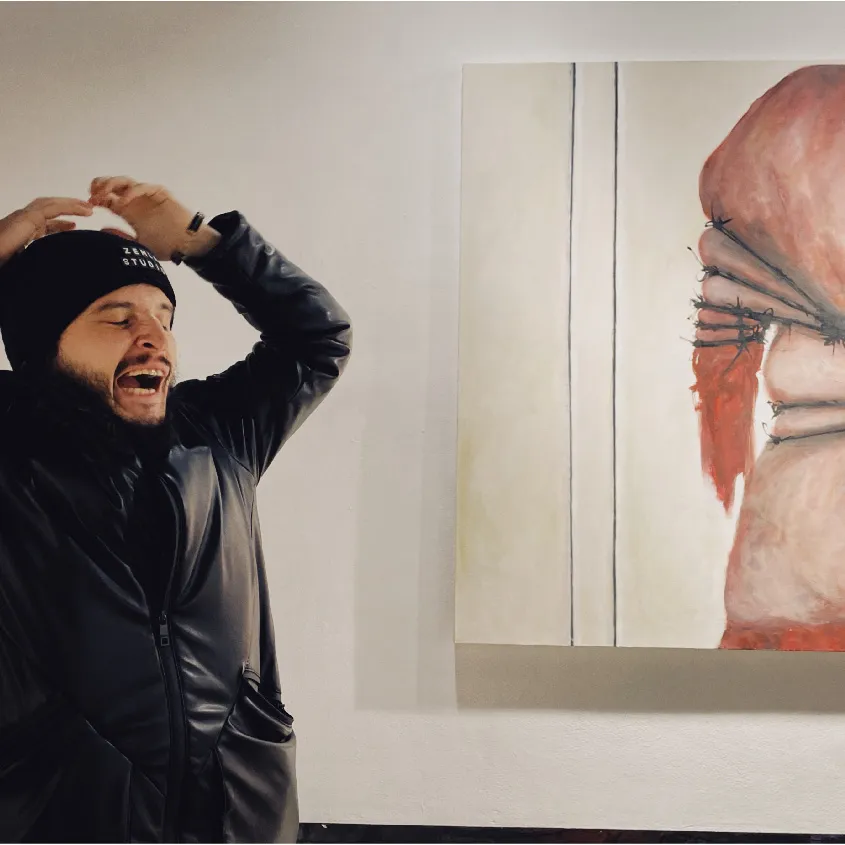
Dr. Myroslav Trofymuk
Born in Lviv. Designer, director, musician, researcher, founder of ZEMLA STUDIO. Master of classical philology and digital marketing, PhD in the history of Ukrainian literature. Member of the National Union of Journalists of Ukraine. Since 2022 he has authored the CENTRUM MUNDI audio show for Polish Radio for Ukraine, continuing the same research into the contemporary music scene in Ukraine and Poland.
Full bio →

