
Chapter one: Interaction
“And all the others
simply cannot be listed,
For there were also gorillas, generals,
cut-throats, soaks,
ragamuffins, Danaans,
Nanai, lard-eaters, Arabs,
Carpathian outlaws, Russkies,
midwives, lesbians,
skriabins, bilyks, little gnomes,
yeremiis, povaliis, mavkas,
monkeys, bats, strange, black
cats, chest toads, alchemists,
prostitutes, Tatars,
bubabists, Ukrainians and dead
roosters.”

At the beginning of September, Lviv hosted the Eastern Partnership Culture Congress for the first time. It is already the third congress, but this year, unlike the previous two, which took place in Lublin, Lviv had the honour of bringing together everyone who lives culture, writes about culture, creates cultural products and supports culture between East and West, whatever that may mean. (It seems there were far more “Easts” this year than usual, but that is only my guess.) Despite an extraordinarily packed programme of lectures and debates, the Congress also left room for personal art projects, and for being filled with — or filling it with — quality music. So I would like to tell you about those who did the filling. It looks as though the organisers managed to bring the most interesting Ukrainian music projects together on one stage.
I’ll start with the project “Etno Kovcheg.ua”, which was, in a sense, a trailer for the Forum, a musical hint that the Forum was near (or, again, that is only my guess). Along with Jalapita, the Ark took aboard Ukrainian poets, men and women, who sang accompanied by the wonderful vocals of Sofiia Paliukh, Liudmyla Zborovska and Yuliia Pivtorak. Of all the scheduled participants, only Ivan Malkovych was unable to perform (his song was sung by Ostap Slyvynskyi, well known for his poetry-and-music projects; more on him below).

Towards the evening of the first day, the Telniuk Sisters took the stage. Although it was cold, and despite the usual pan-Lviv glitches in projects, festivals and events, the Sisters drew their devoted audience. The number of couples in love in front of the stage grew noticeably, time seemed to slow down, and the listeners sank into the languid trance of Oksana Zabuzhko’s poetry set to song — a trance only the Telniuk Sisters know how to induce with their voices. At the end, the hardiest received a real gift: the duo performed several songs from their new programme set to Shevchenko’s poetry. I am convinced that Shevchenko’s works were bound to appear in the Sisters’ repertoire. If anyone, apart from the extremely successful but radically masculine take of Komu Vnyz, is capable of fully adapting our Kobzar for the modern ear, it is unquestionably the Telniuk Sisters. Incidentally, the “Our Shevchenko” project, created in collaboration with Valentyn Silvestrov and accompanied by the National Symphony Orchestra of Ukraine, will be presented on 15 October in Kyiv, in the assembly hall of the Institute of International Relations of Taras Shevchenko National University of Kyiv. It is a charity project; the money raised will go to the 46th Special Forces Battalion.

Musically, the first day of the Congress ended with Mykhailo Barbara’s “Monologue about the Most Important Thing”, to the psychedelic electroacoustic accompaniment of Yurko Yefremov and the no less psychedelic visuals of Mykhailo Shylnov. Barbara is always a welcome guest in Lviv. He is received with particular tenderness by those whose hearts still ache after the exodus of Mertvyi Piven (Dead Rooster) from the Fluhery festival’s “Prokydannia”. Knowing this, sensing all that incredible longing which resonates especially in autumnal Lviv, He decided to “turn water into wine”, longing into joy, and the all-Ukrainian farce into a stream of consciousness — a topical almost-one-man show. The texts by Yurii Andrukhovych in Barbara’s mouth were recognisable, and those that weren’t belonged to Marzena Sadocha. Barbara is a master of speaking while singing and singing while speaking, and of bringing things to life simply by being on stage. That is why Barbara’s “Dead Rooster” was the liveliest dead rooster, and his topical monologue about the most important thing was the most important thing that could have happened to topical Lviv on 4 September 2015.

The only thing capable of working even stronger shamanic magic on stage than Barbara is perhaps Zhadan... as performed by Mariana Sadovska and the Mark Tokar Octet. Four female voices and four double basses: on these eight pillars rests Zhadan’s word, which now thunders above the clouds, now creeps in a whisper into the very heart. I had previously experienced something of equal expressive power to the Octet when I first heard Dakh Daughters at the beginning of last year. I can rejoice not only for myself but for all of Ukrainian music. Because such a rate of discovery — every year a new project that can neither be fitted into any existing genre framework nor given a place on the shelf next to others, since it needs not just a shelf of its own but a whole cupboard — gives every reason for pride.
Since we have got on to Tokar, I want to break the sequence and jump ahead to Olesia Zdorovetska & Mark Tokar Project. Lviv audiences (not all of them, of course, but the most interesting and curious ones) could already hear their project “MO” at last year’s Vox Electronica festival at Dzyga. If the collaboration with Mariana Sadovska is about atmospheric sound, with Olesia Zdorovetska everything is much stranger. Here it is impossible, and pointless, to say or expect anything. It is more like a mountain river: you never know whether it will take a fancy to dry up or to flood villages, snapping centuries-old trees in its path. At Vox Electronica this “explosive” mixture was joined by Alla Zahaikevych, who electrified this musical substance even further — but then, recordings of that concert can be found online, so words are superfluous here.
Let me move on to the project I deliberately saved for dessert: “Interaction” by the Nostri Temporis ensemble. It struck me as significant that among the variety of projects there was one called “Interaction”: as if it embodied, in concrete form, the different facets of interaction present in all the others. To find out more about it, I decided to talk to the director of the Nostri Temporis ensemble, Bohdan Sehin. In the course of our conversation it turned out that all the coincidences and accidents that had taken shape in my head had an even deeper meaning and, in some mystical way, were not entirely — or not at all — accidental...
Bohdan Sehin: — Interaction is communication between the composer and the video artist, between the composer and the ensemble, the conductor and the performers, between musicians and artists from different countries, an interaction of visions and sounds, as it says on the Congress website. And Interaction is also feedback on all of the Nostri Temporis ensemble’s projects. The ensemble first worked with video in 2011, when composers gave us finished pieces with their own accompanying video. Our second serious project was Transit 2, which took place in Lviv; for it, composers wrote their pieces specially, in collaboration with video artists. The current realisation of the “Interaction” project was built on the results of “Transit”, except perhaps for Oleksii Shmurak’s piece “The Doll’s Illness”, which was written for the first audiovisual project, the one from 2011 I have already mentioned. But this format is somewhat dated for us. Technology is advancing, which means the process of interaction can happen quite differently, in a far more natural way. In these new projects we are tied to synchronisation — the scores have time lines written into them, corresponding to the video line — and every musician, together with the conductor, follows the clock so as to hit the frames. In future we plan to look for new technical possibilities for realising our projects. — Do you mean possibly using sensors? — That’s another subject. Karol Nepelski and Paulina Załubska do that kind of thing. Karol, for example, uses sensors attached to his body — they pick up the sounds of his organs, and then Paulina processes that sound. Then again, in 2012 Gregor Mayrhofer, a German composer, wrote a piece for us, and that was no longer just video but VJing — he set up a microphone, and a program processed the sound and generated the video sequence. To give another example, I went to a project in Moscow that used live video clips and loops. Screens were arranged around the audience in the shape of the letter П, and this video mash-up was projected onto them. We did something similar at the first Izoliatsiia in Donetsk: we were filmed live, and the video operators used those loops as visuals during the concert. Still, what fascinates me is not so much video as mapping. We used mapping at the second Izoliatsiia in Donetsk, and lately the Kurbas Theatre has been putting on concerts with mapping. There are lots of ideas, but for now we are holding on to them until better times.
The Nostri Temporis ensemble is always looking for such ways of interacting, and always finding them. Lviv audiences will remember “Preparations”, the ensemble’s joint project with Ostap Slyvynskyi at this year’s Donkult. The idea of the performance was to make visible the simplest actions embedded in the poetry of writers who lived through the war in the Balkans. Recorded readings of the poets’ texts and memories were accompanied by music played by the ensemble, while Ostap Slyvynskyi performed the simple actions, the preparations a man usually makes before going off to war: he has to choose which things to take with him and which to leave behind; he has to be rational. “Preparations” is an attempt to live through the moment when one set of familiar, everyday rituals has to be replaced by new ones. By the way, anyone who missed the performance in June has a chance — having first torn themselves away from their everyday rituals — to see “Preparations” at the Contrasts festival in Lviv next month.
And everything in this article would be banally simple were it not for strange coincidences and non-accidental accidents. In my conversation with Bohdan Sehin, mention came up of another 2011 project, created in collaboration with two more Ukrainian poets, which Ukrainian journalists seem to have passed over: the audiobook “Taras Prokhasko and Serhii Zhadan Read Czesław Miłosz”. That seems to be everything. Now I can sleep soundly... except that a good motivational paragraph is still needed to finish. Or two?
So what do we have? The texts of Mariana Sadovska and the Mark Tokar Octet are no less topical than Barbara’s, and the songs are just as folk as those in the “Etno Kovcheg.ua” project. And if you close your eyes, it may even seem that the light breath of the Telniuk Sisters is present in their voices — just listen closely... Poets here, poets there. Somewhere above it all float Ostap Slyvynskyi and Serhii Zhadan with their musical-poetic omnipresence, and Volodymyr Bedzvin too... “Interaction” all round.
The single DNA that unites all these projects, all this music — one conspicuous chromosome, like an invisible mother-curator running through every note, every sound, every word and every thought of every performer and every listener — is probably the very solution, the discovery we were all seeking throughout the Culture Congress. That mission of culture in a time of crisis, that Ariadne’s thread we must hold on to tightly so that it finally leads us out of the labyrinth of our personal fears, prejudices and despair, in which we are mined and Minotaured.
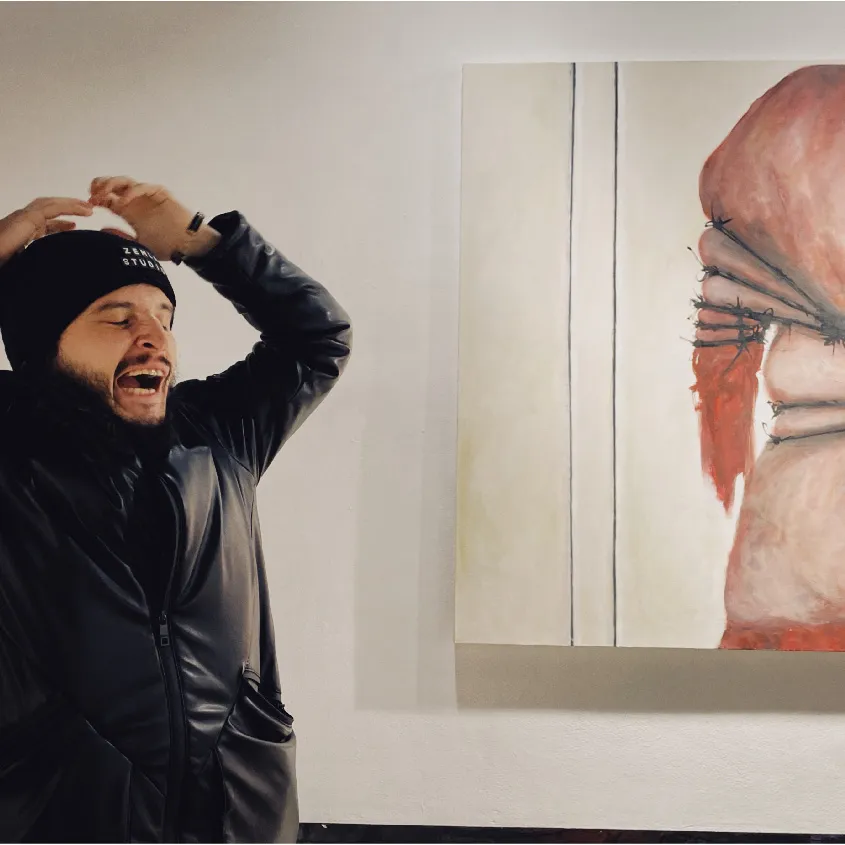
Dr. Myroslav Trofymuk
Born in Lviv. Designer, director, musician, researcher, founder of ZEMLA STUDIO. Master of classical philology and digital marketing, PhD in the history of Ukrainian literature. Member of the National Union of Journalists of Ukraine. Since 2022 he has authored the CENTRUM MUNDI audio show for Polish Radio for Ukraine, continuing the same research into the contemporary music scene in Ukraine and Poland.
Full bio →

