
In his interview with Iara Lee for the film “Modulations”, Karlheinz Stockhausen recalled being asked to analyse several pieces by young musicians for The Wire magazine. I quote it here as an extended epigraph that flows smoothly into the introduction.
I: One of your comments was that this music is very often too repetitive? K: Yes. I think it is much more interesting to create music that transforms figures and forms, so that one can follow the process. Repetition is based on bodily rhythms; we identify it with the heartbeat, with walking or breathing. That is the age-old tradition of the simplest musical compositions and melodies. But since the middle of the century in particular, musical rhythms have become extremely irregular. That is why the transformation of certain figures is the most important invention in musical composition. I think it is really much more interesting than repetition… I: You mean non-linearity? K: No, what matters is neither linearity nor non-linearity; what matters is change, the gradation from something static to certain changes at different rates. Ever since I started writing music I have always tried to work with series of rhythms, even to superimpose the music of different musicians, singers, instrumentalists, who sang and played simultaneously at different tempos but sometimes synchronised at certain points. I love this multi-layered music.
I don’t think any other quotation, or any comment of my own, could better convey the essence of the VOX ELECTRONICA festival. If you think of the festival itself as a musical composition, it pulses and mutates not only musically but structurally too. Each time the event draws more people, and the organisers deftly weave all the concerts into intricate, varied lacework. After last year’s “field trials”, this year the EESEM studio was already used to hosting lecturers and musicians as part of the festival. Whereas last year the concert ended with a free improvisation section, the fourth VOX ELECTRONICA festival, by contrast, opened with a performance by Serhii Zelenskyi and the members of the HOMEPLAYING project — Taras Shpot and me. Serhii Zelenskyi performed his electroacoustic compositions, based on the interplay between a guitar and all sorts of objects: tins, packaging, scraps of paper, sweet wrappers. Our set, Shpot’s and mine, was built on “making music out of nothing”. Under Taras Shpot’s concept, which formed the basis of our performance, there was no sound source as such. Sound appeared when the first manipulation was performed on what was in effect an electrical impulse trapped in a loop of analogue effects pedals; after the first turn of one of the knobs, a ceaseless movement and development began, a river of sound was born, and it had to be skilfully controlled so that it neither burst its banks nor ran dry. Incidentally, the first day of this year’s festival was something of a historic event, since for the first time a live concert was streamed from the EESEM studio.
The second day of the festival was exceptionally “nourishing”: the concert “Poème électronique”, named after the piece by the French composer Edgard Varèse that opened the evening. “Poème électronique” was written specially for the opening of the Philips pavilion at Expo 1958 in Brussels. The pavilion was designed by Le Corbusier; the building consisted of nine hyperbolic paraboloids. Back then, almost 60 years ago, the piece was played through 425 loudspeakers positioned according to a plan by Le Corbusier and Iannis Xenakis; in addition, the sound was accompanied by distinctive projections of photographs and coloured backgrounds from three separate projectors, so that the listeners found themselves at the epicentre of events, taking part in a spectacle that in its own peculiar way revealed the development and evolution of the human race. Since we have mentioned Xenakis, I will add that his piece for the same pavilion, “Concrete PH”, was also performed on the second day of the festival. As I have said, VOX ELECTRONICA is a festival during which space-time fundamentally changes its properties and almost everything loses its meaning except music; and so, during the “Poème électronique” concert, past and present collided. I am talking about Liubava Sydorenko’s “Desire” for violin and electronics and Ostap Maniuliak’s “Lithos” for tape. Although Ostap Maniuliak’s piece was supposed to be performed on another day of the festival, in the “Sang neuf” concert, it logically continued the tradition of experiments with granulated sound represented in the works of Xenakis and Varèse. “Stone” — that is what the title translates as from Greek — and the stone Ostap Maniuliak “threw” at the audience (which, incidentally, seems to have been the largest in all the festival’s years) was an aggregate of layers of sound based on audio material from the last Maidan. Gunshots, screams and other sonic “rocks” were processed by the composer and turned into a musical composition — his own reflection on past events. The piece was written specially for the Audio Art Festival in Kraków. The second day ended with a performance of Roman Haubenstock-Ramati’s graphic score “Multiple”.

I have already mentioned the “Sang neuf” concert, meaning “new blood”. So let us turn to it now. Thursday’s concert began with the audiovisual work “Hoichi the earless II” by the Japanese composer Ayane Yamanaka. The visual part of the work evidently made the strongest impression, especially on the male half of the audience: the visual canvas consisted of somewhat melancholy, heavily processed footage of a naked Ayane wading through water. Personally, what struck a chord with me was the sound structure (here I am being purely subjective and pulling the blanket over to my side), since Ayane used recitations of Japanese poetry in the composition and works with human voices. I won’t hide the fact that any use of the voice in musical compositions appeals to me. Having studied in Europe for a long time, Ayane has been able to take a fresh look at Japan, and she brings to the surface certain themes at the junction of tradition and consumption. Adrian Nagel’s “klix”, as we can tell from the title, is built from microsounds — clicks, crackles and knocks: characteristic German techno-centrism.
What I am about to write may sound somewhat flippant: the VOX ELECTRONICA festival brings together different layers of sound; if the line between academic and “home-made” electronics is not being erased, then at least the interaction between professional music and the work of non-professional musicians is growing ever closer. Thus the Lviv composer Yevhen Petrov has one foot “stepping out” of the academic walls, while the other stands firmly in the aesthetics of ambient. The first thing you notice in his piece “2015” is the repetitiveness and rhythmicity typical of most electronic music, but his academic roots keep the composer from losing his sense of proportion and plunging headlong into the sameness and monotony of repetitive rhythms that Stockhausen talks about in his interview. Another composer whose work can be received equally well in philharmonic halls and on underground dance floors is Mykola Khshanovskyi. I wrote about this in my article on last year’s VOX ELECTRONICA. This year Mykola presented his piece “Lisovyi pokryv” (“Forest Floor”), which uses the means of musical expression to transport us into the mysterious world of the forest. Of all the compositions, the one that naturally stood out was Yurko Bulka’s “shebang”. It was a piece that was essentially not a piece but a computer program, a kind of universe with generative properties which, once launched, began its own continuous vector motion. The composer introduced certain disturbances into the system, using an additional patch to interact with a webcam. The image fed from the webcam into the program changed the musical fabric of the piece, like a stone thrown into water creating waves on its surface.

The festival reached its climax on the final day with a performance by the electroacoustic duo of Rafał Zapała and Ostap Manko. The programme featured works by the Polish and Ukrainian composers Krzysztof Gawlas, Jagoda Szmytka and Alla Zahaikevych, and the closing chord was a joint improvisation at Dzyga, the Lviv art centre.
I should add that besides the music, the festival included three lectures: Alla Zahaikevych talked about her work on the sound for the film “Povodyr” (“The Guide”), Yurii Bulka revealed the secrets of programming music in the “Super Collider” environment, and the Polish guest Rafał Zapała taught how to use sensors in sound installations. As I have mentioned, this year the EESEM studio entered a new era of online streaming, so all the lectures can be watched and listened to online on the channel of the M. V. Lysenko Lviv National Music Academy.
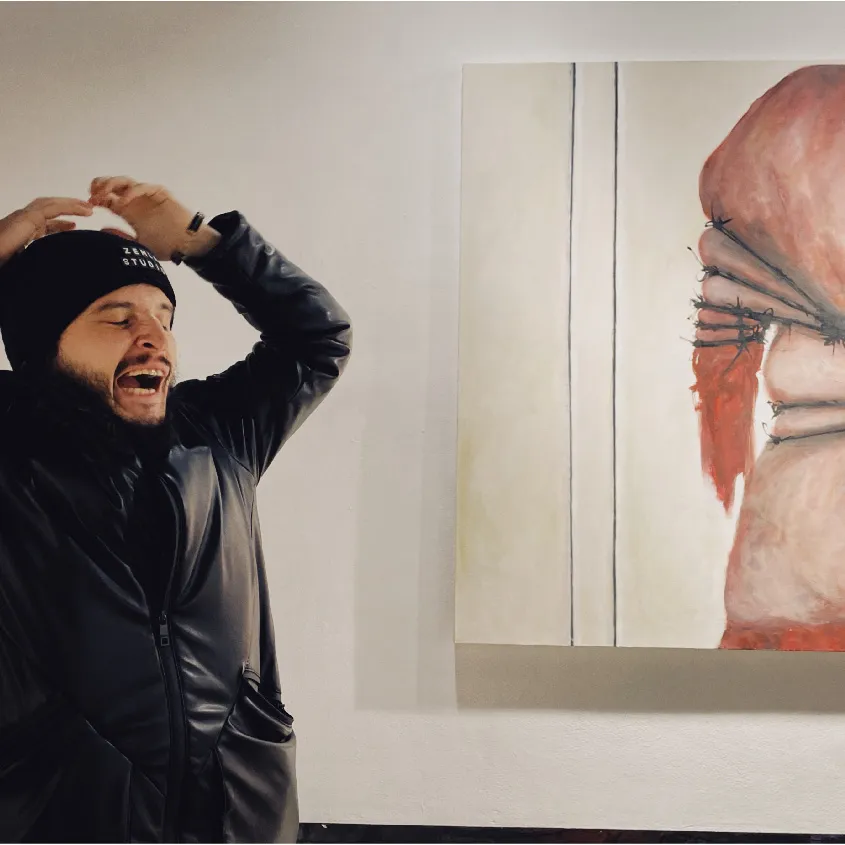
Dr. Myroslav Trofymuk
Born in Lviv. Designer, director, musician, researcher, founder of ZEMLA STUDIO. Master of classical philology and digital marketing, PhD in the history of Ukrainian literature. Member of the National Union of Journalists of Ukraine. Since 2022 he has authored the CENTRUM MUNDI audio show for Polish Radio for Ukraine, continuing the same research into the contemporary music scene in Ukraine and Poland.
Full bio →

