Opening of the First International Forum of Independent Initiatives ’KHATNIEHRANNIA: KITCHEN’ at Fredra 61 in Lviv. Composer and lecturer at the Lviv National Music Academy Ostap Manulyak, together with Miroslav Trofymuk, leads a comprehensive practical session on auditory perception, field recording, and digital audio processing prior to the participants entering the city for an acoustic sound hunt.
Introductory Module: ’How Our City Sounds’ and Sonic Cartography
Welcome to our workshop! Today you will hear a lecture by Ostap Manulyak and Miroslav Trofymuk regarding the acoustic textures of the city. You will discover that an urban environment does not merely look a certain way, but also possesses a unique voice. Together we will conduct field research on how Lviv sounds, capture these audio signals, and map them onto an interactive interface so that places like Teodor Square can be listened to directly.
Hello everyone! My name is Ostap Manulyak. I am a composer and teach composition and electroacoustic music at the Lviv National Music Academy. Daily I deal with capturing and transforming all kinds of sounds. To break the ice, Miroslav found a great video showcasing how sound effects were engineered for the film Transformers.
Foley Art, Cinematic Sound Design, and Physical Acoustic Baffles
To construct a film soundtrack, one needs concrete environmental sounds that sync beneath the picture. In contemporary cinema this is a crucial factor in building emotional immersion. Consider the Ukrainian film The Guide: when the secret police officers appear in leather coats, you hear the dry friction and squeak of the material. Sound designers construct specialized acoustic isolation boxes to separate single sounds from ambient noise.
Even without video footage, audio alone constructs a vivid spatial scene in your imagination. There are two primary avenues in sound work: the first is internal spectral transformation (altering pitch, frequency, and time), while the second is montage, cutting, and sequencing.
Demonstration of Transformation: Train Car Acoustics and Perceptual Shift
Listen to this recording. What connects this track to the next one? They are identical: a raw field recording of a moving train carriage, slowed down multiple times and transposed down in pitch. This demonstrates how radically subjective perception shifts with minimal processing. A mundane train sound turns into a dark, resonant ambient drone.
Here is another recording: I just recorded the street noise outside Fredra and Dobrobut — passing cars, tram bells, and engine rumblings. In its unprocessed form, it is an acoustic document of a specific coordinates in time. On its own it lacks artistic finish, but it serves as the raw sonic clay for the composer.
Digital DAW Processing in Audacity: Reverse, Tempo, and Composition
For foundational audio manipulation, the open-source program Audacity is ideal. It offers a clean interface and all necessary editing tools. We import our street file, select a short snippet, and apply the Reverse effect. The sound swells smoothly out of silence.
Next we isolate a tail that decays naturally, duplicate it onto a parallel track, and loop it to create a steady rhythmic pulse. By transposing the pitch downward, we obtain a distinct rhythmic groove that forms the backbone for an electronic piece.
Field Gear: Zoom Recorders, Wind Shielding, and Normalization
For urban field recording, a modern smartphone is the simplest starting point and often yields decent fidelity. However, the standard tool among sound artists is a dedicated Zoom handheld recorder (such as the H1 or H4n), which is portable, affordable, and easily fits in any bag.
The primary adversary of outdoor recording is wind. When gusts slam into the mic capsule, low-frequency clipping ruins the recording. You must use furry windscreens (’deadcats’) or dense foam, or position your back against the wind to shield the microphone. In improvisation, even a folded bandana or thick scarf wrapped around the device will save the capture.
A quiet recording made through protective fabric is easily boosted using Peak Normalization in your DAW. Setting the ceiling to -6 dB gives you full dynamic headroom without introducing digital distortion.
Historical Roots: Pierre Schaeffer (1948) and Mindful Urban Listening
 LIVE43:17Vox Electronica 2013_ Concert 1via: Pierre Schaeffer
We should remember the origins of contemporary experimental sound. In 1948, French radio engineer and composer Pierre Schaeffer recorded locomotives at the Batignolles train depot, producing the Five Studies of Noises (Cinq études de bruits) and founding Musique concrète. Pitch and rhythm remain the two pillars that elevate raw noise into musical art.
My core advice to you today: as you walk the streets of Lviv, listen consciously. Pay attention to acoustic pedestrian signals, electrical transformer hums, footsteps in stone archways, and tram rail friction. Isolate these details from the background haze — they will become your sonic inspiration. Thank you, and over to Miroslav!
- Forum Organizer [person]person
- Ostap Manuliak [person]Ostap Manulyak (1983) – was born in Lviv. Studied composition at Mykola Lysenko Lviv State Music Academy (composition: prof. Viktor Kaminsky, orchestration: prof. Myroslav Skoryk). During… · Ostap Manulyak: Electroacoustic Music, Algorithms and Tools
- Audacity [instrument / technology]instrument / technology. T.A.M. Club / Centrum Mundi corpus · Centrum Mundi — Night Broadcast: Bohdan Sehin on Anastasia Lozova's 54…
- Pierre Schaeffer [person]person. Paryż, FR. T.A.M. Club / Centrum Mundi corpus · Luigi Russolo, 100 Years of The Art of Noises and Intonarumori
- DAW [instrument / technology]instrument / technology. T.A.M. Club / Centrum Mundi corpus · Centrum Mundi — CXVII — UKRAINIAN MUSIC ENGINEERING: Kostyantyn Lobanov
- Zoom [instrument / technology]instrument / technology. T.A.M. Club / Centrum Mundi corpus · Centrum Mundi — XXXVIII — Overcoming Inferiority, Field Recordings of…
- The Guide [work]work · EvLoExCTRONICA 2015
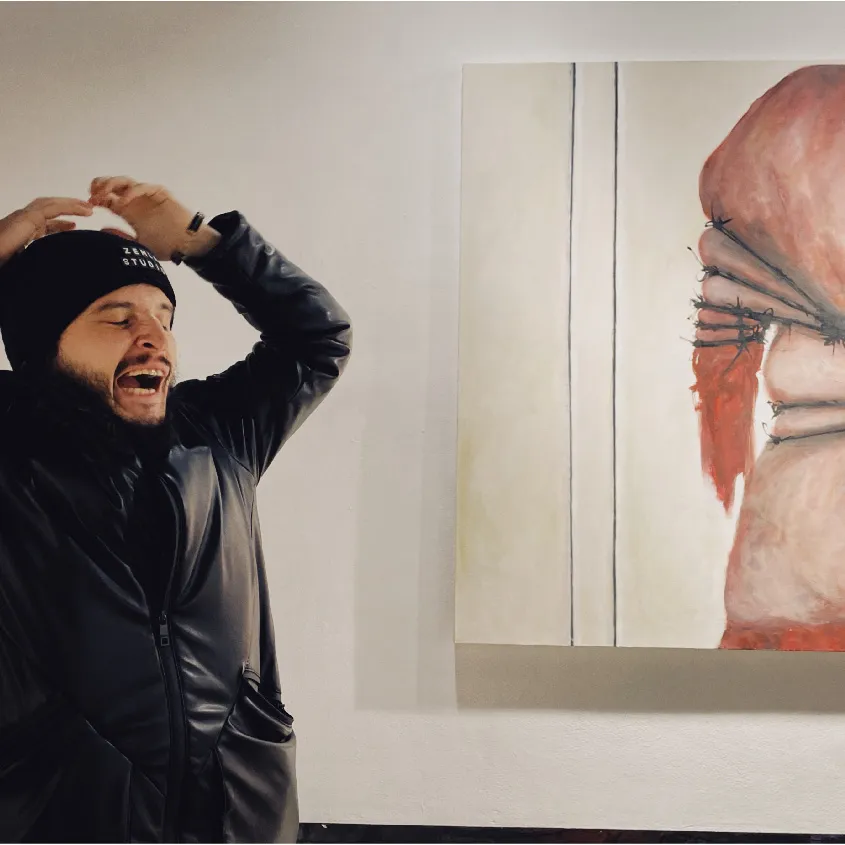
Dr. Myroslav Trofymuk
Born in Lviv. Designer, director, musician, researcher, founder of ZEMLA STUDIO. Master of classical philology and digital marketing, PhD in the history of Ukrainian literature. Member of the National Union of Journalists of Ukraine. Since 2022 he has authored the CENTRUM MUNDI audio show for Polish Radio for Ukraine, continuing the same research into the contemporary music scene in Ukraine and Poland.
Full bio →