
Club-Cafe Lialka and Yizhak’s Performance: Burning Barrels and Plastic Bottles
You were a regular eyewitness and active participant in events at the legendary Lialka. Yet for most people, that venue is associated primarily with rock music. How did you find your way there, and what was actually taking place across Lviv’s club landscape back then?
I cannot say that I frequented many places back then aside from the storied Lialka. In fact, I am not even sure if anything truly worthwhile was happening outside its walls. Surely there were events, but for me the primary nucleus was Club-Cafe Lialka beneath the Puppet Theater. People do traditionally connect it with rock music—that was how history shook out. But the truth is, I was never one to wander into all sorts of generic nightlife spots where crowds of thoroughly unpleasant people gathered. So in my early youth, I went almost exclusively to Lialka.
Chronologically speaking, my most vivid memory revolves around a project by Yizhak. I cannot recall the exact title of that action now, but he dragged mountains of empty plastic bottles into Lialka and carpeted the entire floor with them. Everyone walked around with plastic crunching relentlessly underfoot. Then he hauled heavy metal drums into the room, ignited fires inside them, and began furiously hammering them with crowbars or rebar!

I remember that moment vividly: everyone present was completely stunned. Absolute shock—from the bartenders and waiters right down to myself! Yet Yizhak represented perhaps the ultimate nonconformist, both in his philosophy of life and in sound. To my ears back then, it felt almost too extreme. But it was precisely through actions like that that I gradually became infused with the spirit of nonconformism, especially within musical aesthetics and noise. For whatever reason, that particular scene surfaces in my memory as the most powerful early impression.
Everyone who lived through that era inevitably brings up Yizhak. Do you know where he is now, or how his life unfolded?
You could say he fundamentally changed his outlook on life. Not that he surrendered to conformity—not at all! Rather, he began moving in an entirely different direction. He became a radical nonconformist with regard to contemporary state affairs and politics, if I could frame it that way. In its own way, that is a compelling transformation. Forgive me, I am running a bit tired today, so these recollections tend to surface in waves.
That is completely understandable. But looking back at the electronic dimension of Lialka—breakbeat, drum’n’bass, Derrick and Tonika’s sessions—what did that world mean to you?
 LIVE43:33XXI КОНТРАСТИ - CONTRASTS SESSION - Picasso club - 09.10.2015 - Lvivvia: Derrick
Radio Initsiatyva and ’Livyi Efir’: Anarchy Without Formats or Censorship
I must confess that back then I was not particularly focused on club parties alone. Radio fascinated me far more—it served as my primary aesthetic compass. Initially, there were specialized shows on Nova Khvylia and Lvivska Khvylia, followed by the iconic Radio Initsiatyva broadcasting at 102.5 FM.
Yizhak’s authorial broadcasts on Radio Initsiatyva were utterly extraordinary. The way they unfolded, the sonic collisions taking place on air... There was an unwavering sense of pure immediacy. Not a shred of formatted commercial dogma existed—no rigid notions of ’radio-friendly formats’ or similar nonsense. Nobody was expected to, metaphorically speaking, ’tuck their shirt neatly into their trousers.’ Even today in techno culture, if you step half an inch outside orthodox boundaries, people panic: ’What is this? I do not get it.’ Yet Yizhak managed to orchestrate total creative anarchy without ever allowing it to devolve into brainless trash.
He continually urged listeners to participate: to dial the studio landline directly and speak their minds on air. Remarkably, it never degenerated into polite, drowsy radio chatter that puts you straight to sleep. It was genuine provocation and unfiltered discourse.
Did you experience that strictly as an avid listener glued to your receiver, or were you already participating in radio broadcasts yourself?
Both, in a sense. Today I evaluate that era through retrospective analysis. At the time, I lacked theoretical frameworks: you listened in disbelief thinking, ’What madness is this, and why on earth are they doing it?’ The show was called ’Livyi Efir.’ Yizhak spelled it as ’Live Efir,’ but it was deliberately pronounced and understood as ’Livyi’—rogue, illicit, left-field. That was his signature sardonic humor. And in truth, it was a wildly unpredictable, raw acoustic sausage grinder.
Did you happen to preserve any recorded tapes of those historic broadcasts?
I definitely have them, and I will gladly pass them along! Has Markiian shared anything with you yet? There is an ongoing archival project around 102.5 FM curated by Anton, so he likely gathered a substantial database. Personally, I have about four full cassette recordings of those broadcasts preserved.
Project Restart and the Transition from Breakbeat to Techno
What about the Restart project? I remember your parties at the jam factory space, but how did that collective originally take shape?
We indeed organized substantial events. If I recall correctly, Restart actually began in Lublin, Poland, during the Noc Kultury festival at Warsztaty Kultury. From that initial spark, the energy flowed smoothly back to Lviv in the form of underground gatherings.
Zoza handled most of the organizational heavy lifting while also playing DJ sets. The core squad consisted of Markiian Talypa, Marta, Insane, and myself. Heaven forbid I forget anyone—that was essentially the lineup: Zoza, Markiian, Marta, Insane, and me. By the way, Marta was entirely a DJ, not a visual artist.
I have heard that your own personal path toward techno was somewhat circuitous—you circled around it for years as though deliberately delaying the encounter.
That is completely true! My entire musical universe circled around techno, yet I refused to take the plunge directly into it. Even when playing breakbeat, a distinct techno mood saturated the selections, but I stubbornly evaded the straight four-on-the-floor kick drum. I gravitated close to dubstep and downtempo, yet kept bypassing that rigid four-four pulse.
The turning point arrived without warning. I had a DJ mix playing quietly in the background—at first it seemed like nothing more than pleasant ambient texture. Suddenly, in a single flash, something resonated deeply within me. I comprehended its true depth, and from that moment onward, I dove into techno headfirst.
Yet I never felt as though I was fickle or jumping between musical camps. When I gaze across my vinyl collection, it exists as an indivisible continuum. Within three tracks, I can effortlessly glide from one sonic territory to another. I never segregate tracks by rigid binaries like broken rhythms versus straight kicks. In my imagination, it is all deeply interwoven.
When I first embarked on my path as a selector, I approached the choice of genre with pragmatic clarity. I faced a difficult crossroad between drum’n’bass and breakbeat. Soon I realized that drum’n’bass locked at 175 to 180 BPM was a closed corridor. Beyond half-time downtempo at 90 BPM, there was nowhere to expand, no matter how diverse the style claimed to be. Breakbeat at 130 BPM, on the other hand, granted total freedom: I could naturally steer into techno, house, dubstep, or half-step. Although nowadays I dislike these generic labels—they have been so cheapened and commercialized that people imagine something utterly detached from their authentic meaning.
The Lifecycle of Musical Genres: From Basement Sparks to Commercial Clichés
You touched upon a very precise point regarding the aesthetic decay of musical styles. I vividly remember the late 1990s: purchasing a single disc loaded with five full-length albums—ranging effortlessly across trance, ambient, and breakbeat. Every single album, indeed every solitary track, felt like a distinct universe! Yet by the mid-2000s, everything suddenly homogenized, becoming sanitized and interchangeable. When, in your eyes, did that fracture occur?
When did the music turn stale? It seems to me that every musical genre inevitably traverses an organic lifecycle. It climbs toward an creative apogee, explodes into commercial hype, hardens into a widely recognized formula—and at that exact juncture, surrenders its founding spark, the singular mystery that justified its birth in the first place. It is a sorrowful trajectory, but an unavoidable cultural law.
Naturally, styles mutate incessantly. One strain cross-pollinates with another, spawning intriguing hybrids such as dub infused with 2-step. Eventually, dubstep emerges, erupts onto global festival stages, and the mainstream heralds it as an overnight miracle. Meanwhile, the basement originals merely smile wryly: ’You are just waking up to this hype, while we have been refining this exact frequency in damp cellars for over a decade.’ The timeless question: what did you truly sacrifice for hip-hop in your day?
If we step away from the global arena and zoom directly into Lviv’s local underground during those formative years, how did that ecosystem manifest on the ground?
We possessed our own legendary pioneer—a veritable Ukrainian Kool Herc in the form of DJ Boborovsky! It demanded immense artistic courage around 1997 or 1998 to step behind the decks and proudly drop broken beats when the assembled crowd was totally bewildered: ’What sound is this? How can anyone dance to this?’ For me, witnessing that felt almost like a heroic act, sparking intense curiosity.
Remember, the internet did not exist back then. Western cultural waves washed ashore purely through dedicated individuals who positioned themselves at the tip of the stream. To local onlookers, it appeared as though these figures were inventing new worlds out of thin air, but in truth it required boundless passion and physical effort to hunt down imported sounds and present them to a conservative town.
Raves erupted in the most improbable architectural environments: inside the Polytechnic sports facility, at ’Starushka’—the venerable university gym hall—and outdoors inside Park Kultury directly adjacent to the amphitheater stage. However, I was hyper-young during that initial wave, so I barely attended those earliest gatherings myself.
Lviv’s Musical Sanctuaries: Dandari, the Cassette Cult, and Compact Discs
I did not arrive at electronic music instantaneously. In fact, at a certain crucial juncture, it quite literally saved my life! At the beginning, I did not even possess a cassette deck—only a radio. I would sit beside that speaker through an entire multi-hour broadcast solely to catch one specific track, waiting patiently for it to surface.
Later on, I sank so deep into obsession that I recorded audio directly from the television—stalking MTV broadcasts, capturing music videos on VHS, and dubbing them onto audio cassettes. Back then, I lacked the vocabulary to parse micro-genres: to my adolescent ears, even Apollo 440 registered as relentless techno. Broken beats, four-four kicks—everything sounded like one monolithic, heavy rave. Only gradually did true analytical comprehension arrive, unveiling intricate layers of sound design.
Did that deeper understanding crystallize primarily through those pirate broadcasts on Initsiatyva and Lvivska Khvylia?
Unequivocally! Such sonic shocks inevitably leave an indelible mark. When a radio host throws open every mixer fader simultaneously live on air, cases fall, turntables hum and crackle—a philosophy of ’whatever happens, goes straight out.’ Open the microphones, knock over jewel cases—listen to the unfiltered reality! It fostered an acute sensation of raw, living presence. Everything in life is interconnected: had those broadcasts not existed, my internal universe would have crystallized into something entirely different.
What other cultural outposts across Lviv shaped your sonic worldview back then?
There was the storied Dandari shop on Dzerzhynskoho Street—others must have already mentioned it to you. They stocked virtually everything! You would walk in as a terrified teenager and stammer: ’I am looking for this sound... I have no idea what it is called.’ The shopkeeper would instantly lean forward: ’Describe it.’—’Well, you know that Philips boombox commercial where kids are sitting on the stoop...?’ Without missing a beat, he would grab a cassette, wind the tape with a pencil, slot it into the deck, press play—and the exact track exploded from the monitor!
 LIVE2:34:38ХАТНЄГРАННЯ №22 - Пре-паті до фестивалю Гамселить - Електропоїзд № 6040via: Svarog · Philips

He possessed an extraordinary, encyclopedic ear. You would sketch a vague, shapeless sonic mood, and he would slide three tapes across the counter—every single one landing dead on target! Every kopeck of lunch money my parents gave me was surrendered entirely at Dandari.
Then there was the storage sanctum belonging to Oleh Masesov—a legendary compact disc hub. You could unearth utterly astonishing imports there. I spent a staggering amount of time inside that tiny space.
Derrick and Tonika also recalled that shop—entering to see vinyl sleeves arrayed along the walls almost like museum artifacts.
Precisely—the sheer tactile atmosphere exerted an almost mystical pull! It is remarkable how seemingly minor encounters can pivot your entire destiny. You wander into a shop by chance, someone hands you a few discs, and you disappear into that world for the next three years. You skip university lectures, spending five uninterrupted hours with headphones surrounded by towers of CDs, and nobody disturbs you. You felt more at home there than in your own bedroom. I hold immense gratitude toward those shopkeepers: my portable cassette player and those physical sanctuaries constituted a private dimension that sustained my entire youth.
Today we have the internet, and anything can be retrieved in three seconds. Yet the web has devolved into a bottomless swamp. I experience profound exhaustion from social media and this ceaseless deluge of digital noise. It leaves you with mental porridge; your memory falters under the weight of it. Searching for music used to be a sacred pilgrimage; today, one merely drowns beneath terabytes of disposable noise.
Yizhak and the First True Techno in Lviv: Music Between the Beats
What about cassette swapping among comrades? That subterranean bootleg network must have functioned as a powerful pipeline as well?
Without question! Tapes circulated from hand to hand in an endless physical loop. Through Yizhak, one could dub an astonishing wealth of underground releases. And that brings to mind a pivotal historical milestone!
Today the term ’minimal’ has been vulgarized beyond recognition, but back then those discs represented peak sonic mastery. Around 2001 or 2002, we attended an unforgettable session at Lialka and inside the Baraban / Aviator record shop (run by Romik Sarkisian near cinema Pryzma). What Yizhak unveiled during that set was a monumental revelation. It blew my perception of electronic music wide open.
For the casual observer, techno is inextricably associated with the relentless thud of a four-on-the-floor kick drum.
That is the standard, pedestrian reaction! To me, techno operates on an entirely different plane. The kick is there, certainly, but one must learn to read between the lines and listen between the beats. The kick drum is merely the skeletal armature holding the structure upright. Everything of genuine consequence, all the sonic sorcery, unfolds within the void between those impacts.
There is a profound Eastern adage regarding the clay pot: the true utility of the vessel resides not in the fired clay, but in the emptiness within. Techno functions by the exact same principle! The rhythm hammers, yes. But the fundamental question remains: what atmospheric architecture will you erect within that internal emptiness? What emotional resonance will you conjure there?
If techno were reducible to a mechanical rhythm, I would have abandoned it instantly—it would be excruciatingly dull. Instead, I discovered within authentic techno a private sanctuary for personal associations, a vessel for meditative immersion. You seek shelter inside that frequency realm from the banality of the world. I never dreamed that this quiet refuge would blossom into the defining artistic devotion of my entire life.
Gary Shumov’s First Seven Records and the Debut at Drum’n’Bass Session
Where did the craft of DJing as a tangible, physical engagement with material sound originate for you?
It all began when I purchased my first seven second-hand breakbeat records from Gary Shumov. I could scarcely fathom that music of such ferocious intensity could actually exist pressed into physical vinyl! At first, I simply wanted to hold the wax in my hands, to feel its physical heft. When I arrived home and dropped the stylus onto the groove—I was struck by sheer wonder: the music I cherished most was emanating directly from a spinning vinyl disc! It felt completely surreal.
From that moment, everything accelerated. Derrick invited me to perform a guest set at his signature Drum’n’Bass Session at Lialka. That was my first substantial public performance, and I remain profoundly grateful to Derrick for that opening.
It was an exhilarating sensation: stepping out into the subterranean hall to channel the exact sonic frequencies you loved unconditionally. The notion of an audience member ’requesting a song’ simply did not exist—commercial compromise was out of the question.
In the Lialka of that era, walking up to the booth to request a commercial pop hit was unthinkable.
Naturally! Once the movement gained momentum and cultivated an initiated audience, random drop-ins vanished. You established an unbending aesthetic corridor: moving strictly from point A to point B, brooking zero concessions. Yet, you know, such stubborn purism carries its own shadow.
I detest dogmatic sectarianism. Nowadays you witness it frequently: you play a techno set, slip two house tracks into the mix—and orthodox purists sneer: ’How dare you?!’ Let us take that absurdity to its logical conclusion: let one clique spin exclusively hi-hats and despise anyone who touches a snare, while four-four kick enthusiasts declare everyone else heretics!
Back on our home blocks we engaged in the exact same nocturnal debates—standing on street corners until sunrise dissecting drum patterns and album arrangements.
Precisely! We would return from parties in the city center and spend four straight hours lingering on the corner, smoking, passionately arguing: ’Listen to that drum fill—it is pure genius; but that other track is utter garbage!’ Today, that organic friction is largely gone. You open SoundCloud and a deluge of 150 disposable tracks washes over you. Follow a producer, receive lackluster weekly podcasts, wait a month, and finally hit unfollow just to stop your skull from fracturing under digital clutter.
The Physics of Vinyl: Grappling with the Machine vs Digital Convenience
Your devotion to physical vinyl is legendary across the circuit. Is that an exercise in nostalgic romanticism, or a deeper sensory necessity for tactile friction with the medium?
I harbor zero snobbery toward laptop DJs or digital controller interfaces. One can craft a breathtaking performance using two Winamp windows or two YouTube tabs! But for me personally, playing vinyl represents an organic extension of my physical body. Behind the decks, the crossfader, tonearm, and rotating platters seamlessly integrate into my own nervous system.

Vinyl is tenfold more inconvenient and unforgiving than digital files. Every single record behaves uniquely: the center spindle hole might be misaligned by a millimeter, the pressing might be subtly warped, or it reacts unpredictably to low-frequency cabinet rumble on a club floor. One track spins at 45 RPM, another at 33. You are forced to wrestle physically with the machine. And that tactile friction imparts a living pulse that sterile digital algorithms cannot replicate.
What about digital files—do you ever purchase digital downloads online?
No, I do not purchase them because I do not perform digital sets. Naturally, one ought to support fellow artists. Yet I believe authentic artistic freedom only thrives when you sustain yourself through a regular day job. You earn your living independently, leaving your musical vision entirely uncompromising—forged strictly according to your inner truth, never contorted to court commercial buyers. The moment music becomes your sole financial survival, insidious calculations creep in: ’How can I soften my sound to generate more bookings?’ In my philosophy, that compromise marks the death of the artist.
Counterculture, Nostalgia, and the Lack of a Local School
I recently began outlining an extensive historical essay on the trajectory of the Lviv electronic underground. Years ago, we imagined that 90s institutions like Metro or Beat were monuments of vitality. Today, parties migrate into forests, abandoned warehouses, and autonomous cultural enclaves. In your assessment, has our scene progressed, stagnated, or merely shifted its contextual skin?
It is difficult to pronounce a simple verdict. Today we are inundated by waves of pseudo-oldschool techno, where younger producers mimic classic 90s tropes. Laurent Garnier articulated this paradox with razor sharpness: he observed how bizarre it felt to headline an event and witness 18-year-old kids losing their minds to vintage Green Velvet anthems produced before they were even born.
Electronic music originated as counterculture—an acoustic revolt aimed squarely at the complacency of the previous generation! It was designed to stick like a bone in the throat of established society. When today’s youth merely venerate thirty-year-old museum pieces instead of unleashing their own destabilizing sonic reality, an uncanny historical vacuum emerges.
Has Lviv, or Ukraine at large, ever succeeded in crystallizing a singular, indigenous electronic music school?
Genuine artistic evolution manifests when a localized community ingests global idioms and synthesizes a distinct, recognizable lineage—comparable to French Touch in house or the Birmingham school in industrial techno. In Ukraine, regrettably, such an autonomous school never fully coalesced. For the most part, we remain provincial imitators circulating polished covers of foreign movements.
Yet rare anomalies exist. I would specifically highlight Svarog. He possesses an authentic, deeply personalized vision of techno. Even if an uninitiated ear might hear standard driving techno tinged with hypnotic trance accents, beneath that surface lies extraordinary architectural depth and uncompromising philosophy. To me, he is a deeply respected producer working with absolute honesty, completely uncorrupted by vanity.
Intimacy Over Club Frenzy: Between a Book and a Puzzle
How do you perceive contemporary club nightlife? Do you still find yourself drawn to parties today?
I have grown far too old for this shit, as the saying goes! Nightclub events can be so dreadfully boring at times that language fails to describe it. For me, techno is deeply intimate, solitary music. It demands to be experienced in headphones, in complete isolation. It resembles a profound, multifaceted novel: each time you revisit it, you peel back an entirely distinct layer of meaning. At its worst, club music resembles flavorless chewing gum that you cannot even chew through; at its finest, it is a complex Rubik’s cube or a labyrinthine puzzle that awakens the imagination.
So for you, the priority is not dancefloor utility, but rather an exploratory realm for avant-garde texture and auditory associations?
Without question. I approach record shopping through radical intuition. I walk into a vinyl shop and deliberately ignore the artist names or prestigious label branding, purely to preserve an unclouded, sober ear. I simply flip through releases and listen blindly. If a frequency triggers an internal resonance within my chest—I purchase it on the spot, indifferent to genre dogma.
In my vinyl bags, there are records that languished untouched for seven years before suddenly unlocking their rightful place inside a mix. When I assemble a set, I seek to compose a unified journey, a cinematic auditory canvas. Of course, inside a nightclub that ambition frequently collides with pedestrian reality: many patrons could not care less about your sonic pilgrimage; they merely demand a blunt peak-time banger. You either navigate that internal friction between crowd pandering and creative conscience, or you stand firm and play strictly what your artistic truth demands.
90s Testosterone, Rock Roots, and Zero Tolerance for Pop
I remember lingering in Lialka after a rock show sipping a beer, when suddenly an entire horde of kids sporting baggy cargo trousers and bandanas flooded the room—a drum’n’bass session was getting underway. It was an astonishing collision of completely alien subcultural tribes.
Today’s scene is incomparably more peaceful and tolerant. Back in the nineties, you could be brutally assaulted simply for listening to the wrong tape! Ravers, rappers, punks, metalheads—turbulent inter-tribal skirmishes flared up constantly. Young men had overflowing testosterone and an urge to establish dominance. And what is the easiest path to asserting dominance when you possess neither turntables nor vinyl records? Breaking someone’s nose because their subcultural insignia offended you. A savage, feral era.
Personally, I hung around closely with rock circles back then—primarily those playing hardcore or punk, even if that music often felt somewhat formulaic to my ears. Yet at home in private, I listened to Pink Floyd or intricate experimental electronics. I adamantly refused to wear a single subcultural uniform.
How was the DJ booth constructed in Lialka? If I remember rightly, it stood perched overhead above the crowd?
You caught Lialka in its later incarnation, after it adopted a darker industrial redesign. In the beginning, the interior operated strictly under the motto: ’Make do with whatever scraps are at hand.’ For a certain period, I actually worked as a resident house DJ at Lialka. My peers tend to romanticize that tenure, but to me it was an agonizingly difficult experience.

I arrived brimming with youthful idealism—eager to cultivate refined musical tastes and elevate the dancefloor. Instead, I had to fend off belligerent drunks climbing into the booth waving fifty-hryvnia notes, slurring: ’Play something we actually know!’ My romantic illusions shattered against that club wall very swiftly.
Derrick once brought up your legendary, uncompromising hostility toward tracks featuring high-pitched female pop vocals. Does that reputation hold true?
It is undeniably true! If it is classic Chicago house where the vocal loop is tongue-in-cheek and humorous, that is totally fine. But when producers compose self-important, dramatic synthesizer anthems with sweeping pads—and suddenly a high-pitched, pitch-corrected female vocal cuts across the center channel screeching hysterically... I experience genuine physical distress! It obliterates the solemn acoustic architecture of the entire track.
That is my uncompromising rock heritage speaking, refusing to bow before commercial syrup: I swallowed the four-on-the-floor kick, but pop music—never! Thank you very much for this dialogue.
- Derrick [person]person. Львів, UA. T.A.M. Club / Centrum Mundi corpus · Centrum Mundi — II — Nature vs. Culture: A Conversation with Derrick…
- Radio Initsiatyva [institution]institution · Centrum Mundi — LXIII — Markiian V.: Radio Initsiatyva 102.5 FM, Lviv…
- Svarog [person]person. Львів, UA. T.A.M. Club / Centrum Mundi corpus · Centrum Mundi — XXXI — Club Life in Georgia and Ukraine, VST vs.…
- Lvivska Khvylia [label / press]label / press. T.A.M. Club / Centrum Mundi corpus · Centrum Mundi — LXIII — Markiian V.: Radio Initsiatyva 102.5 FM, Lviv…
- Dandare [place]place. Львів, UA · Centrum Mundi — LXIII — Markiian V.: Radio Initsiatyva 102.5 FM, Lviv…
- Efir [place]place. Київ, UA. nests: T13 “Basements and fragile clubs”, T72 “Independent space: love instead of subsidy” · T13 Basements and fragile clubs, T72 Independent space: love instead of subsidy · Centrum Mundi — XLIV — Work Discipline, the Kyiv Underground, and…
- Night of Culture [festival]festival. T.A.M. Club / Centrum Mundi corpus · ХАТНЄГРАННЯ: Fredra 61 Terrace and Lviv Acoustic Spaces
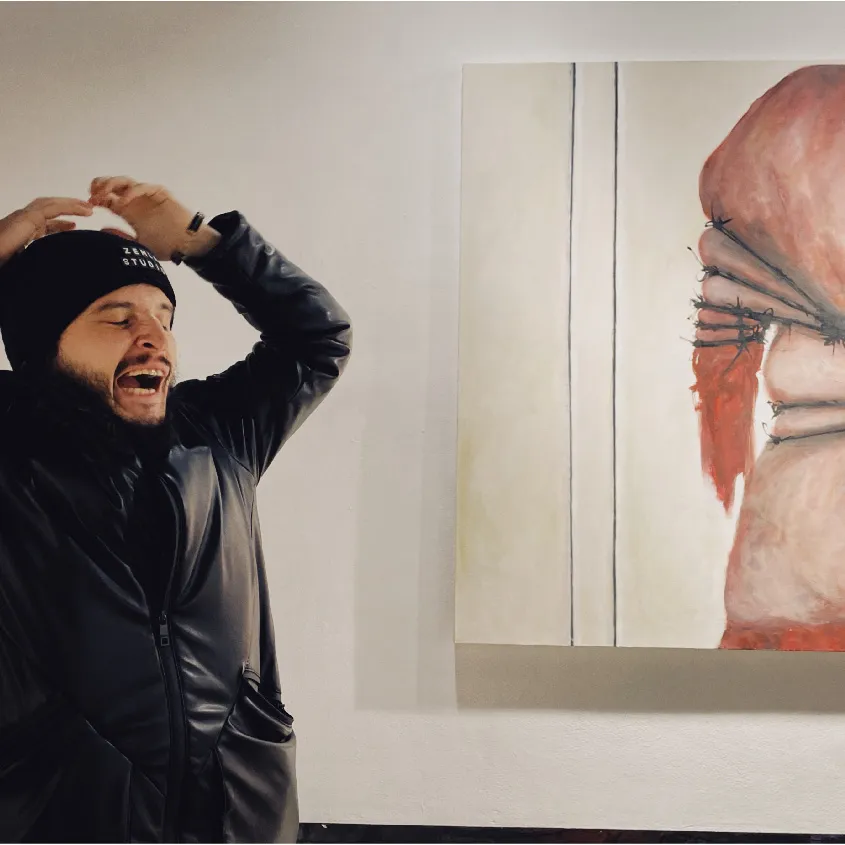
Dr. Myroslav Trofymuk
Born in Lviv. Designer, director, musician, researcher, founder of ZEMLA STUDIO. Master of classical philology and digital marketing, PhD in the history of Ukrainian literature. Member of the National Union of Journalists of Ukraine. Since 2022 he has authored the CENTRUM MUNDI audio show for Polish Radio for Ukraine, continuing the same research into the contemporary music scene in Ukraine and Poland.
Full bio →


