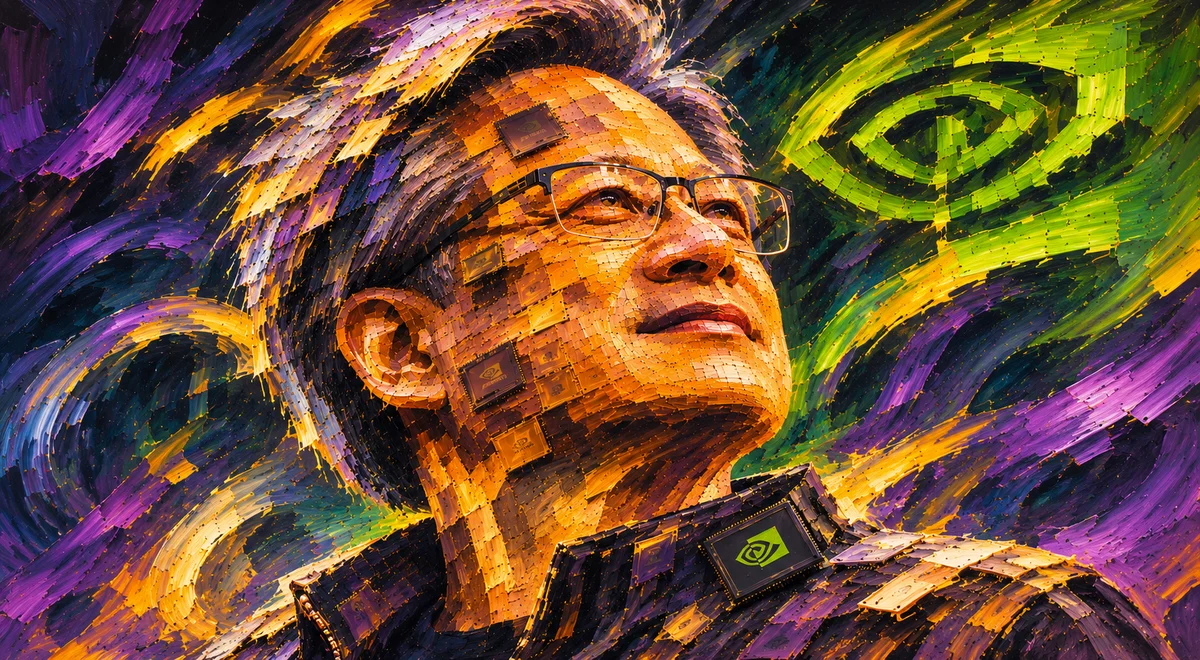
“I think all these affairs, workplace relationships that should never have existed, and specifically a relationship with the woman running that strange shell company Megaspeed — supposedly set up to build data centers in Southeast Asia while in reality mainly funneling chips into China — none of this was something nobody knew about. That is how I would put it. And the fact that it has surfaced right now, as the Democrats retake control of the US Senate and Congress, is no coincidence. The balance of power has shifted. After the midterms, Donald Trump’s authority has visibly weakened, and some tongues have simply loosened.”
Nvidia denies allegations of shipping chips to China through Megaspeed. Yet according to the scholar, Huang had accumulated enemies long before — particularly among companies selling closed AI models by subscription. Anthropic, for instance, filed in October to go public:
“I often point out that even inside the Trump administration, Jensen Huang did not have unanimous backing — there were plenty who had little sympathy for him. He always pushed aggressively for open AI, meaning open-source models of the kind China offers as well. That clashes directly with the interests of powerful Silicon Valley players who want to monetize models via subscriptions — a lucrative business model for them. Right now they are heading for IPOs — Anthropic, and likely OpenAI next — and they need enterprises paying for proprietary solutions, so open weights are hardly to their liking. For Huang, who sells the underlying AI compute infrastructure, it makes essentially no difference whether the model is open source or closed: he just wants to sell as much hardware of his own as possible.”
US intelligence — whose assessments Ukraine also relies upon — had tracked these connections for some time. According to The New York Times, as far back as spring Marco Rubio oversaw a classified memo on Huang circulated to senior officials ahead of Trump’s May visit to China. Przegalińska recounts unofficial reports:
“And that intelligence already existed, didn’t it? Word is that half a year ago Marco Rubio warned fellow members of Donald Trump’s cabinet that Jensen Huang was going to bring trouble down on them because his ties with Alice Huang were far too close. I also listened to an interview with Jensen Huang’s biographer: he told The New York Times he knew half of this already too, yet it remained unspoken — corridor gossip nobody dared put on record. There are even reports that clearance to let all this surface came from inside the Trump cabinet itself — from figures like Marco Rubio — so the press would pick it up and publish widely. They concluded that his push for open weights and close China links were starting to threaten major US firms or strategic interests — and that it had gone too far.”
Huang’s lobbying clout had been very real: in December 2025, Trump cleared sales of H200 chips to China subject to a 25 percent cut paid to the US Treasury. Yet in our guest’s view, Washington’s patience finally snapped:
“Jensen Huang persuaded Trump to ease part of the chip export curbs toward China. He may even have assumed he was flying slightly ‘under the radar’ with nothing grave at stake — reasoning that he was supplying Chinese buyers indirectly while the administration tolerated it. Up to a point that may have held true, until it turned out patience had run out. The power structure shifted. US tech giants are expected to capture revenue, and what Huang was doing did not necessarily serve the interests of at least a major camp among them.”
Beijing itself urges domestic firms to buy Chinese silicon, Huawei in particular. Why, then, does it still seek US hardware — and was China’s reliance on Nvidia ever anything more than temporary?
“Still, technological reconnaissance never hurts, right? Getting hold of a batch of American chips, copying them, reverse-engineering the architecture, and building equivalents at home works purely to their advantage. Huang has repeatedly said in interviews that he is cementing American dominance and hooking the Chinese market on his silicon. Yet I think your intuition is right that this dependency was only temporary. For their top frontier models, Chinese labs gladly ran Huang’s GPUs, while already specializing domestic accelerators for other workloads. Ultimately they definitely wanted both their own chip designs and manufacturing fabs capable of turning out top-tier silicon. Industrial espionage — potentially part of what was happening around Alice Huang — could have fed into that as well. In effect he bet on getting China hooked on his hardware, while China may have been playing a longer game: sure, hook us for now, and in five years we’ll make everything ourselves. Or perhaps officials in Washington concluded that opening up to China like that wasn’t paying off after all, and decided Huang had to be neutralized slightly because he was leaning too hard in that direction. That, of course, is my interpretation.”
For Poland, the episode highlights technological autonomy. Can the country manufacture semiconductors at home?
“Look, different countries produce different links across this entire AI infrastructure stack. Poland does not have a fab churning out leading-edge microchips at industrial volume. It holds other links in the chain: chip design capabilities, R&D centers, and electronics assembly. We were slated to land an Intel fab investment, which Intel walked back. Now there is a Foxconn investment — announced back in June at Taiwan Expo in Warsaw, indicating semiconductors would be produced here as well, though construction is only scheduled to begin in 2027.”
Foxconn picked the former Intel site in Miękinia near Wrocław for a tech park, though Taiwan has yet to confirm wafer fabrication there specifically. Meanwhile, semiconductors also power the drones flying in Ukraine. What does this mean for the region?
“To me it is crystal clear — both from Ukraine’s standpoint and from the perspective of our country and neighbors supporting Ukraine — that total reliance on the United States carries real risk right now. We have to bet on ourselves. Only these aren’t investments that pay off in a few months. It isn’t a short game, it’s a long one: first you absorb the upfront pain before harvesting the returns. Europe is waking up terribly late, lacking sufficient domestic compute infrastructure and top-tier frontier AI of its own. We are behind the curve, though that hardly absolves us from acting. We’ll see — we still hold a few cards in our hand, though I’d say they are already fairly weak.”
Chinese open-weight models meanwhile continue gaining users — capable of running even on consumer desktop machines. Is this first and foremost a commercial battle for the AI market?
“American models are simply expensive, and their pricing keeps climbing every year. US labs try to win on quality, whereas China appears to compete ever more sharply on cost and above all convenience. We’ll see — for now, I’d call it a neck-and-neck race.”
Could fear of Chinese models spill over into bans? The EU is phasing in the AI Act — what lies ahead in Washington?
“The United States currently has the lightest AI regulation. After the Democratic victory in the midterms, that could shift to some degree: the Senate may try to advance federal legislation. Data centers have already become a flashpoint in the US with widespread local protests, so Congress may move to act. I would also expect — potentially paving the way for new rules — that Jensen Huang and perhaps several other Silicon Valley titans will be summoned in January to testify before the new Senate, where Democrats hold the majority and view them coolly.”
Hearings could start even sooner: Senate Banking Committee Chair Tim Scott requested testimony from Huang and Commerce Secretary Howard Lutnick on December 3, threatening subpoenas, before Democrats assume committee leadership in January:
“And that too could have far-reaching consequences. Democrats have already announced they will trace financial flows between Big Tech and the Donald Trump administration — scrutinizing how Trump was funded, including major tech-company money and overlapping ties. They want to press Jensen Huang hard on his China dealings, and unfortunately for him he cannot refuse such a summons. You cannot simply say ‘no,’ because it isn’t a voluntary witness invitation — it’s a formal congressional hearing, where failing to appear is a crime. So I would expect the US tech landscape from 2027 onward to shift dramatically, directly because Democrats won control.”
Huang’s resignation is not merely personal drama. It could reshape chip export rules, the AI hardware market, and even the balance between open and closed models. For Europe and Ukraine, our guest’s takeaway is straightforward: total reliance on any single supplier is a strategic vulnerability — and we have to play our own cards now, while we still hold them.
UPDATE
On November 23, 2026, Jensen Huang was reinstated as chief executive officer of NVIDIA. The company’s board of directors voted unanimously to restore him as president, CEO, and board member following his departure on November 12. NVIDIA stated that ahead of the decision it had consulted with senior US government officials and saw no national security threat in Huang’s return.
Huang’s reinstatement was also backed by US President Donald Trump, who said he had spoken personally with members of NVIDIA’s board. Following the announcement, the company’s shares surged sharply — jumping more than 30 percent according to media reports. At the same time, investigations into Huang’s potential contacts with Chinese intelligence and related circumstances remain ongoing, while questions persist in California and the US Congress regarding security, corporate governance, and potential political influence over corporate decisions.
- Donald Trump [person]person. T.A.M. Club / Centrum Mundi corpus · Centrum Mundi — CXVI — Professor Mykhailo Zarichnyi: Can Mathematics…
- Anthropic [institution]institution · Who should hit the brakes: the world argues over the speed of AI…
- Taiwan [place]place. T.A.M. Club / Centrum Mundi corpus · ArtReview Power 100 — Tetramatyka Festival Retrospective
- Washington [place]place. T.A.M. Club / Centrum Mundi corpus · Centrum Mundi — CVI — Maksym Son | Volyn Field: Music Straight from the…
- R&D [band / project]band / project. T.A.M. Club / Centrum Mundi corpus · Centrum Mundi — LXI — Anton Lapov: Donbas Identity, the Luhansk R&D…
- Silicon Valley [place]place · Who should hit the brakes: the world argues over the speed of AI…
- China [place]place. CN. T.A.M. Club / Centrum Mundi corpus · Centrum Mundi — CXVIII — UKRAINIAN MUSIC ENGINEERING: Kostyantyn Lobanov
Dr. Myroslav Trofymuk
Born in Lviv. Designer, director, musician, researcher, founder of ZEMLA STUDIO. Master of classical philology and digital marketing, PhD in the history of Ukrainian literature. Member of the National Union of Journalists of Ukraine. Since 2022 he has authored the CENTRUM MUNDI audio show for Polish Radio for Ukraine, continuing the same research into the contemporary music scene in Ukraine and Poland.
Full bio →


