
Introductory Setting and Concert Preparation
The MULTIPLE NATURES (MULNA) project is an experimental electroacoustic trio formed by Italian sound designer and spatial sound philosopher Lorenzo Brusci, programmer and sound artist Yuri Bulka, and media researcher and musician Myroslav Trofymuk (АЙКТРОНЕР). Originating from a sequence of spontaneous improvisation sessions in Krakow (notably at the Audio Art Festival) and Florence, the collective investigates real-time electroacoustic performance, algorithmic sound diffusion, and redefining architectural volume as a dynamic acoustic body.
This video document captures the rehearsal session prior to their live concert, featuring sound engineers Franco and Francesco. It illuminates the workshop mechanics of multichannel live performance: from scheduling logistics and microphone gain staging to profound aesthetic debates concerning psychoacoustics, cognitive spatial labels, and the boundaries of personal artistic voice within an ensemble.

So, what does our schedule look like today? We need to cross-check where we are heading tonight — the email mentioned an organizational pre-concert meeting.
Yes, it is more like an orientational meeting right before the concert to go through the schedule and clarify the technical setup. So we will likely go together.
I will certainly be there, and you will be there as well. How long do you expect to stay there today?
It is hard to predict because there is a lecture scheduled first. And how long can an academic lecture possibly go? Who knows where the discussion will lead! But I think right now our priority is simply to play through the first track, and then pivot to discussions. The guiding principle for this section: melody is the keyword. Agreed?
Understood, melody as a navigational compass. Let us begin the run-through.
The ensemble begins their opening rehearsal section: synthetic textures, low-frequency resonances, and microtonal string parts gradually emerge into the hall, layering over subtle analog noise.
How did that register at the input — was it overly loud?
Mhm, the signal was hovering right on the ceiling. Let us take it once more from the very beginning.
Apologies, one moment! We need to dial in the sensitivity of this microphone more cleanly to prevent clipping and transient clutter in the path. Are we ready to restart?
Alright, the signal is clean and calibrated now. Let us go!
Spatial Diffusion Versus Static Localization
Following an extended improvisation piece exceeding ten minutes, where digital synthesis and live acoustic instruments thoroughly activated the hall, the musicians pause to analyze the acoustic propagation in the room and the behavior of the loudspeaker setup.
Well, well... In my view, this is sounding remarkably compelling. However, it is essential to establish clear criteria for when a sonic event remains firmly localized within an individual point-source speaker versus when it blossoms out to envelop the entire spatial perimeter. That is the fundamental crux. I appreciate precise spatial localization, but sustaining that rigid point-source identity uninterrupted for forty-five minutes will inevitably fatigue the audience. That is why I bring it up.

Franco understands this completely. Franco, if we can structure the signal routing along the lines Francesco suggested... At present, we have four distinct performance streams, four individual acoustic sources, but we need the capability to diffuse them seamlessly across a broader stereo or quadraphonic matrix filling the room. In other words, we require two distinct operational models that we can fluidly alternate between.
Precisely! Exactly, that provides the necessary spatial breath and dynamism.
That would be wonderful. Because the run-through we just completed reveals two distinct aesthetic poles: either the sound is sharply pinned down at an exact geographic point on stage, or it expands into total ambient wash. To my ear, it never felt cluttered — quite the contrary, it felt remarkably articulate and disciplined. And that succeeded because we consciously deployed a psychoacoustic anchor: a cognitive label.
The Psychoacoustics of Sonic Labels and Technical Stability
You have no idea how potent establishing such a cognitive label inside the listener’s mind truly is! Even the most minimal acoustic gesture suddenly acquires immense presence. At least within my perceptual framework, that is paramount: when an event possesses sharp harmonic or timbral clarity, it projects an unmistakable spatial object. Our performance was unquestionably polytonal, yet in perceptual reality it functioned much closer to pure timbral definition.
You know what? I think I should reboot my computer right now. Yesterday the audio interface dropped out repeatedly, cutting audio mid-stream... You know how it unfolds: first the studio monitor output dips, then the video projector blacks out, and ultimately the entire rig freezes. It might be fluctuating line voltage, so restarting now is the safest measure.

Lessons from Krakow: Ensemble Balance and Collective Presence
Reflecting back on our earlier sessions in Krakow, one significant challenge emerged: Yuri’s voice was dropping out of the sonic texture at pivotal junctures. His contribution felt exceedingly fragile and indistinct. Under those circumstances, an artist must either thoroughly rethink their sonic presence or boldly amplify their output. Seriously! That imbalance effectively collapsed the performance into a duo between you and me, and all too frequently left me playing completely unaccompanied on stage. That was the core issue.
Of course hardware glitches happen, that is understandable. Yet it clearly exposed how collective structural choices impact the piece. That is precisely why shared labels and sonic attributes are indispensable. At a certain point, group improvisation cannot degenerate into performing what you do when practicing alone in an empty room. Otherwise, what is the point of forming an ensemble? One might just as well perform solo. And that applies equally to myself.
Performing solo is genuinely far simpler for me from a psychological standpoint. When working individually, I rely on a familiar palette of instruments and direct my own aesthetic trajectory. In an ensemble, however, our central task is arriving at a shared territory, an environment of reciprocal trust where every musician feels comfortable and grounded.
When an ensemble locks in during an inspired improvisation, what you experience is essentially the freedom of playing alone, but multiplied and elevated through collective synergy — it feels powerfully amplified.

The Sound Archive as a Jungle: From Kyma to Intuitive Discovery
True, but consider my own setup: right now I am opening a sample databank that has sat untouched for over three years! I cannot fully explain why, but across every performance or sustained drone piece, I instinctively return to field recordings of animal vocalizations filtered through an acoustic harp in Germany. I return to them continually, especially when layered against bowed string passages or legacy patches. Over time, this has grown into a vast personal archive where I frequently lose my bearings.
And I genuinely cherish that sense of being disoriented! Opening that library makes me feel delightfully lost. I look back on how I built those intricate architectures in Kyma and Pro Tools... They involved such mind-boggling signal routing and DSP patching that I would never dare attempt rebuilding them today! Navigating through that material feels exactly like hacking through an untamed jungle, discovering whatever lies hidden along the path.
Gradually, the internal logic of these timbres is returning to me; the fluency is noticeably higher than a year ago. I understand the overall contour of my library, yet I do not command every nuance — and that margin of unpredictability gives me tremendous creative energy. Furthermore, it contains a wealth of fresh timbres that never made their way into my formal studio releases. The sheer volume of material is overwhelming, which is why I have zero desire to learn a new instrument right now.
You are right about comfort zones, but this represents an entirely separate creative domain for me. In my other musical engagements, this freedom simply does not exist: working with Francesco is exclusively focused on processing the acoustic human voice, while my pieces for string quartet involve classical instrumentalists where my role is strictly restricted to composition and spatial production. Therefore, MULNA represents a rare sanctuary to unearth archival material that remained silent for years without an expressive outlet.
Here, I can consciously cultivate spontaneous exploration. Frequently, I trigger a timbre live on stage without knowing what will erupt from the loudspeaker bank in the next millisecond, requiring immediate micro-adjustments on the fly. Aesthetically, this state of radical vulnerability is something I deeply relish, and it is impossible in my other professional spheres.

Ergonomics of the Sonic Gesture: Meta-Composition and Questioning Less is More
I also stepped away from live performance for nearly a year, perhaps slightly less. What I relied upon before constituted a safe, predictable zone. I knew with absolute certainty that sweeping a low-pass filter across a warm synthesizer pad would produce an inviting, elegant texture. In that scenario, the performer retains total acoustic dominion.
Each practitioner arrives at their own methodology. Yet observe how I manipulate my sound matter now: I essentially adjust only three parameters — pitch, reverberation depth, and channel gain. In essence, that mirrors the fundamental expressive gestures available on an acoustic instrument. When developing the Dante project, I ran multichannel Pro Tools directly on stage because I demanded micro-spatial fidelity.
Yet today, using straightforward DAWs like Ableton Live or Logic, I deliberately restrict myself to elemental actions — exactly what I would do with an acoustic guitar: play louder, soften dynamics, or bend pitch. I have even grown skeptical of elaborate MIDI control surfaces. I find far greater intimacy in the deliberate, physical movement of an analog fader than in flashing rotary encoders or pad matrices.
It seems amusing to speak this way about modern digital audio software designed under the banner of simplification. How much simpler can it become? The framework is already elementary because I work with prepared, pre-composed sound sculptures. Unlike modular synthesists or generative coders, I do not synthesize sound from raw oscillators in real time. My praxis is meta-composition: choreographing pre-existing sonic entities across physical space.
At times I feel clumsy because I am accustomed to calculating every gesture before executing it, even though the raw material is already pre-composed. That is why the maxim ’less is more’ is highly conditional: it hinges upon the artistic project. Radical austerity is not a universal virtue. In deep sonic exploration, excessive self-restraint can easily starve an improvisation of its vital acoustic richness.
Polymorphic Density and the Final Take
I am also debating whether projecting my laptop screen to the audience adds any aesthetic value. Often during solo concerts, visual data is projected overhead, but here I doubt it serves our narrative. What do you think? Shall we run one final take — making it thoroughly polymorphic, intensely dense, and continuous in texture?
Just let us not drift into a rhythmic dance track! Highly dense, yes, but not dance.
Definitely no club beats! Pure polymorphic acoustic density.
The trio dives into their culminating rehearsal run: the electroacoustic texture intensifies dramatically, weaving dissonant noise, granular mutations, and cavernous sub-bass into an unbroken vortex of spatial sound.
Incredible! Brilliant work, everyone!
That structural shape is considerably more challenging formally, but I love how it breathes!
Yes, the polymorphic architecture locked in seamlessly. When we translate this onto the full multichannel diffusion rig in front of the audience, the spatial presence will be truly extraordinary.
Without question! Across a dedicated multichannel loudspeaker array, these microscopic timbral layers will unfold with breathtaking depth.

- Lorenzo Brusci [person]person. IT. T.A.M. Club / Centrum Mundi corpus · Lorenzo Brusci: Acoustic Architecture, Dynamic Spaces, and Artificial…
- MULNA (Multiple Natures) [band / project]Multiple Natures, or MULNA, is a musical trio — a collaboration between Mirek Trofymuk (CEO of Zemla Studio, music curator and musician from Ukraine), Lorenzo Brusci (Italian composer…
- Yurii Bulka [person]на кларнеті. У 2008 вступив на оркестровий факультет Львівської Національної Музичної Академії ім. М. Лисенка. З вересня 2010 навчається на теоретико-композиторському факультеті того ж ВНЗ… · Yuriy Bulka, Algorithmic Composition and Live Code
- Pro Tools [instrument / technology]instrument / technology (USA). KORINNIA map (1 conversation) · Centrum Mundi — Night Report: Edward Sielicki and Barbara Okon-Makowska…
- Audio Art Festival [festival]festival. Linked with: Muzyka Centrum, Kraków. KORINNIA map (2 conversations) · Centrum Mundi — CXIX — АЙКТРОНЕР: Ukraine Was Flooded with Russian…
- Logic [instrument / technology]instrument / technology · Centrum Mundi — XLIII — Performer vs. Composer and Music Without Drums…
- DSP [instrument / technology]instrument / technology. T.A.M. Club / Centrum Mundi corpus · Centrum Mundi — CXVII — UKRAINIAN MUSIC ENGINEERING: Kostyantyn Lobanov
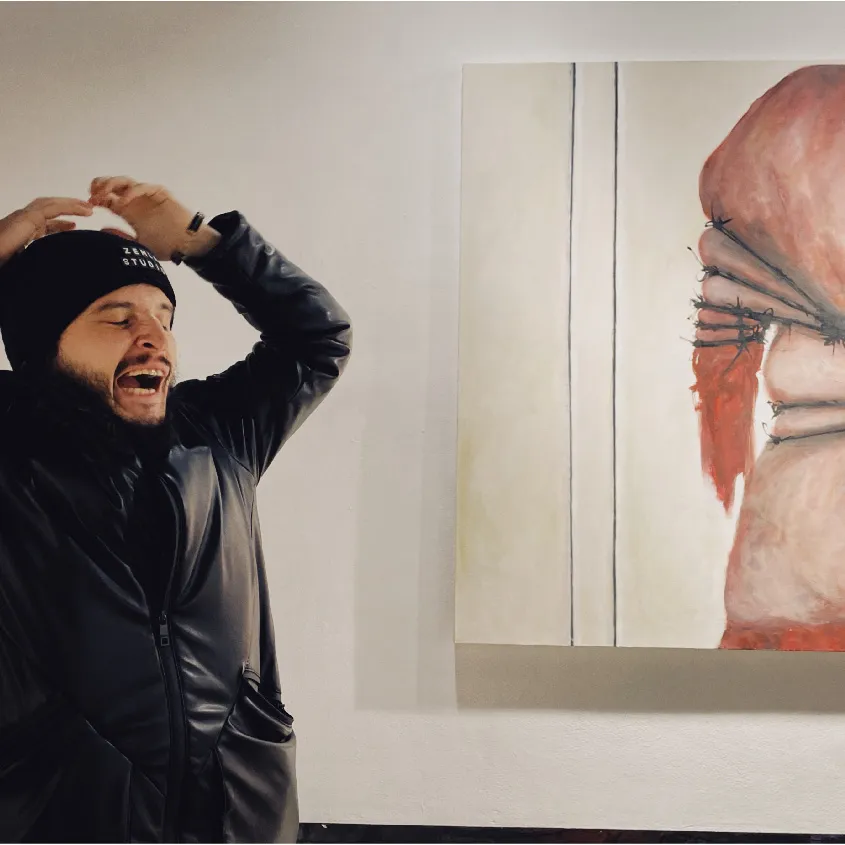
Dr. Myroslav Trofymuk
Born in Lviv. Designer, director, musician, researcher, founder of ZEMLA STUDIO. Master of classical philology and digital marketing, PhD in the history of Ukrainian literature. Member of the National Union of Journalists of Ukraine. Since 2022 he has authored the CENTRUM MUNDI audio show for Polish Radio for Ukraine, continuing the same research into the contemporary music scene in Ukraine and Poland.
Full bio →


