
He analyzes how club culture evolved to embrace hardware modular live sets, explains Berlin’s magnetism for synth builders, and outlines the performance-first philosophy behind his instruments designed for fluid real-time improvisation.
From Teenage Bands and Drum Machines to Illegal Factory Raves in 1992
Today we are recording our episode at Berlin’s Superbooth, the premier global gathering for synthesizer designers, acoustic innovators, and musicians who cannot live without turning analog potentiometers. My guest is Mark Verbos, the founder of Verbos Electronics. Mark, your musical journey started long before your synth company. How did your early transition from acoustic instruments to electronic music unfold?
I began playing music as a five-year-old child, starting on the violin, then moving to trumpet, piano, and eventually taking up guitar in my early teens. Around thirteen or fourteen, I was playing guitar in a rock band, but at the very same time, I started programming drum machines, tinkering with synthesizers, and recording on a four-track cassette deck. Soon I ran into a classic problem: my bandmates didn’t want to work constantly and rigorously. That frustrated me immensely, so I decided to do everything myself. That was how I plunged into producing solo electronic music at home.
And how did your home studio bedroom work break into the outside world? Back in the early nineties, the American rave scene was still purely underground.
When I was sixteen, a guy from the local rave scene happened to visit my place. Hearing the tracks I had produced, he said: ’Look, you should perform this live instead of a DJ at our upcoming party.’ That was 1992. Back then, almost no one even understood what a live electronic music performance was supposed to look like. Most live acts were either fake playback from tape while pretending to twist knobs, or chaotic amateurism. Soon after, I connected with the Dropbase Network crew in Milwaukee, who were pushing hard acid techno. They encouraged me to record a record and play their parties. By seventeen, I was performing live in abandoned factories before crowds of a thousand people.
Lessons from Full Sail, Mentorship by Grant Richter, and the Vintage Buchla World
You didn’t stop at underground club gigs; you went on to pursue a formal degree in sound engineering. What did that educational period give you?
In 1994, I enrolled at Full Sail University in Florida. Orlando was a terrible city to live in, but the school itself provided an exceptionally rigorous education. We were trained not just in recording and mixing, but in foundational electronics, soldering, calibration, and studio hardware maintenance. After graduating, I returned to Milwaukee and bought a broken vintage EMS VCS3. Someone recommended a local technician who might fix it. Walking into his workshop blew my mind: this man possessed virtually every mythical synthesizer ever built — an ARP 2600, EMS Putney, EML modulars, a Buchla 200 originally from CalArts, and two Buchla Music Easels. That man was Grant Richter, who later founded Wiard Synthesizers. He repaired my VCS3 in minutes and showed me his own custom modular inventions.
Was Richter the mentor who guided you into Don Buchla’s unique modular architecture?
Precisely. Grant became my mentor and guiding light. I would sit beside him opening two vintage Music Easels, examining their complex oscillators and wavefolders. Grant was repairing Buchla gear for owners across the globe. Simultaneously, I worked as a commercial recording engineer: during the day, I aligned tape machines, soldered patchbays, and tracked sessions; at night, I etched circuits and produced techno. Over the next decade, I gradually became the premier specialist for Buchla 200 restoration. There were barely thirty functioning systems worldwide, and I knew almost every owner personally. I began building custom modules tailored for vintage Buchla cases and the modern 200e, while running my Buchla Tech blog. At that point, launching my own manufacturing company was simply inevitable.
The Evolution of Club Culture: From DJ Hegemony to Modular Live Sets
You have often noted that nightclubs resisted live electronic performances for decades. How did that perceptual breakthrough among promoters and clubbers finally occur?
People quickly forget that barely a decade ago, a live hardware performance in a prestigious techno club was treated as an unwanted hazard. Throughout the nineties, DJs maintained an uninterrupted dancefloor energy flow with polished vinyl pressings. When a live act plugged in their raw machines, the sonic dynamics often shrank, timings drifted, and the room emptied out. When I played my first live set at Berlin’s Berghain in 2015, the stage managers literally struggled with where to place me — the booth had never been configured for an extensive modular flight case. Yet within four or five years, modular live sets became a standard feature there every single weekend. Audiences today genuinely crave tangible risk, physical interplay with the machine, and real-time unpredictability that a pre-recorded DJ playlist can never deliver.
Berlin Across Three Decades: Why the City Became a Synth Mecca
Your life story is deeply intertwined with Berlin: you lived here in the late nineties, returned to the United States, and later relocated back permanently. What does this city represent for you historically?
I first moved to Berlin in 1999 and left for New York in 2003. Back then, I believed the Berlin myth had run its course: the post-Wall euphoria was fading, civil servants were being relocated from Bonn, and city authorities were sanitizing districts into an orderly capital. However, when we brought Verbos Electronics to the Frankfurt Musikmesse in 2014 and later to Superbooth, I realized Berlin had evolved into something far greater than merely a party capital. It had transformed into the world Mecca for synthesizer designers. The densest concentration of electronic instrument makers, parts suppliers, and discerning sonic pioneers was right here. In 2016, I moved back permanently. Today, roughly three-quarters of my company’s business is based in Europe. The US has almost no sustainable infrastructure for genuine underground techno — it is dominated by commercial EDM. Every serious American electronic musician knows that without a foothold in Europe, you don’t have an international career.
 LIVE21:15Visiting Superbooth 2023 / Відвідини Superbooth 2023via: Superbooth · Musikmesse
Design Philosophy: Complex Hard-Wired Routing for Expressive Live Improvisation
Verbos modules stand out immediately through their distinctive golden faceplates and unique ergonomics. What guides your thinking when designing a new instrument?
I never rely on focus groups, social media polling, or Kickstarter crowdfunding. I design exclusively what I personally need as a performing musician on stage. The market is saturated with brands offering generic VCO oscillators or basic VCAs — replicating standard schematics holds zero interest for me. Every module bearing my name must offer a distinct, idiosyncratic capability that justifies its inclusion in a rack. My core philosophy is to pre-patch intricate, musically expressive routing right behind the faceplate. When performing live in a dimly lit club, you have no time to untangle twenty patch cords to sculpt a timbre. The instrument must respond instantaneously: moving a single fader or switch should unleash nuanced harmonic textures, leaving the performer completely free to improvise.
To conclude, a question we always ask in our program: have you crossed paths with the Ukrainian music scene?
Honestly, I know very little about Ukraine’s contemporary experimental scene. I remember Ukraine winning Eurovision, though Eurovision’s pop theatricality has always struck me as slightly absurd. Still, what stood out was that fascinating fusion of modern hip-hop rhythms with authentic ancestral ethnic roots. I am genuinely eager to explore Ukraine’s modular and underground scene further, because Eastern European sound creators possess immense resourcefulness and an unorthodox way of reinventing electronic tools.
- Mark Verbos [person]person (Berlin, Germany). Linked with: Berlin. Nests: T04 “A mentor who gives freedom”, T36 “Ukrainian modules: an Eastern European record” · T04 A mentor who gives freedom, T36 Ukrainian modules: an Eastern European… · Night Report: Michal Fetler — Middle Ages 2.0, the Polivox Synthesizer…
- Verbos Electronics [label / press](2014). label / publisher (Berlin, Germany). KORINNIA map (1 conversation)
- Grant Richter [person]person (Chicago, USA). Nests: T04 “A mentor who gives freedom” · T04 A mentor who gives freedom
- Buchla [instrument / technology]instrument / technology. US. nests: T04 “A mentor who gives freedom” · T04 A mentor who gives freedom · Night Report: Alina Calancea — Romanian Roots, Buchla Synthesizers, and…
- Dropbase Network [label / press]label / publisher (Milwaukee, USA). KORINNIA map (1 conversation)
- Milwaukee [place]place (Milwaukee, USA). KORINNIA map (1 conversation)
- Musikmesse [festival]festival (Frankfurt, Germany). KORINNIA map (3 conversations) · Centrum Mundi — Night Report: Andreas Schneider — Patriarch of the…
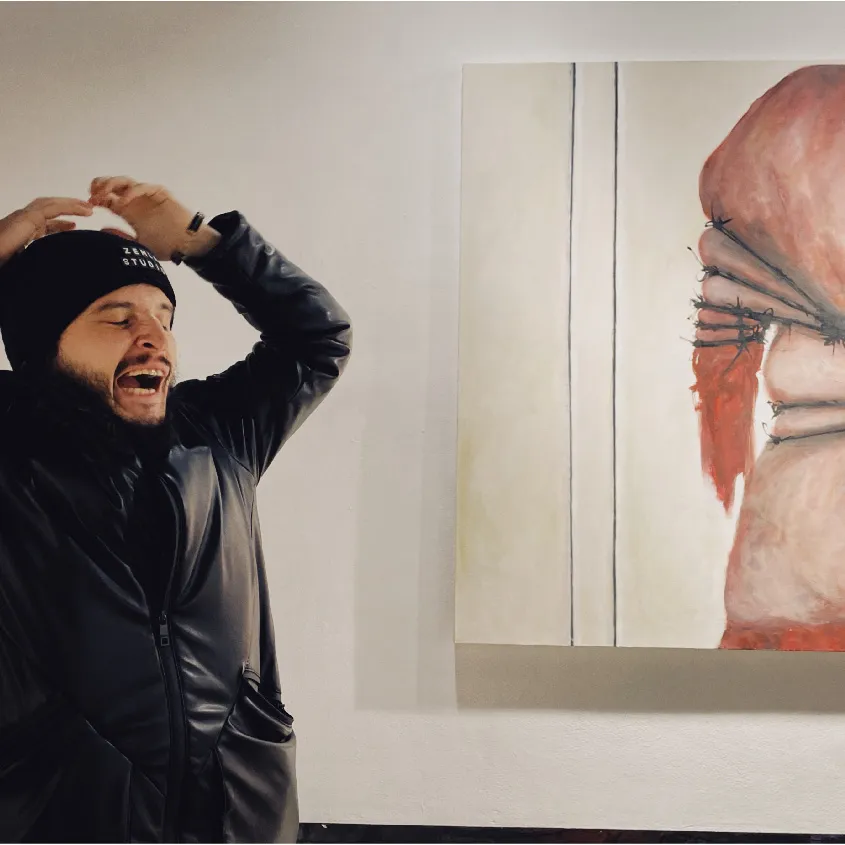
Dr. Myroslav Trofymuk
Born in Lviv. Designer, director, musician, researcher, founder of ZEMLA STUDIO. Master of classical philology and digital marketing, PhD in the history of Ukrainian literature. Member of the National Union of Journalists of Ukraine. Since 2022 he has authored the CENTRUM MUNDI audio show for Polish Radio for Ukraine, continuing the same research into the contemporary music scene in Ukraine and Poland.
Full bio →


