
Novyi Lviv, tucked away between Stryiskyi Park and Sykhiv, has three things going for it: quiet, the park and prospects. That’s it — the list of advantages ends there. Since Soviet times there have been neither decent shops nor reliable transport links here: all the public transport connecting the Centre with Sykhiv bypasses us as if on purpose. Nobody will admit it, but believe me, it was the residents of Novyi Lviv who prayed every night before bed that the laying of the tram line to Sykhiv would go on for ever. Those were wonderful times, after all, when we had more minibuses than you could ride in a lifetime — but those times are gone…
The park and the quiet speak for themselves, so let me go straight to the prospects. They were illusory until a miracle happened. Miracles usually happen unexpectedly. When one starts happening, you barely notice, and then suddenly — bam! — you’re surrounded by a miracle. I think it’s perfectly logical that the epicentre of this miracle was the Ukrainian Catholic University — after all, who in Lviv, apart from UCU, could know more about miracles? UCU’s new building was the first sign that the miracle was coming. But while the main part of UCU’s miracle — the Sheptytsky Centre — was still being completed, a second miracle happened: Bohdan Tykholoz became head of the Franko Museum; and a third: positive tectonic shifts at the Academy of Arts (lately I have been to three lectures at the Academy — Alfred Maksymenko talked about 1990s video art in Lviv, Orest Holubets about contemporary sculpture, and on the first of December I attended Orest Chekal’s lecture on calligraphy, typography and the philosophy of design at the Department of Graphic Design of the Lviv National Academy of Arts).
I try to believe that the World around us is structuring itself and taking shape as a system; there are certain coincidences that build a chain of events so logical it seems unreal, but once that chain has formed, it is no longer a series of coincidences but a trend. So what trend emerges from all this? It so happens that several organisations have ended up in one place, with the potential to create a kind of arts-and-science cluster. A research institute, two museums (let’s not forget the Hrushevsky Museum), an exhibition hall, a library, a university, an academy of arts and the Sensoteka — these are no longer randomly placed buildings, but a system and an environment conducive to the birth of new ideas. [An unexpected excursion into autobiography.] I must say that I first came across electronic music as a concept, as they say, “on the block”: it was my neighbours who told me about software you could use to make music. There was a strong core of electronic musicians and DJs here who experimented with sound, and if that worked back when they had nothing but old computers and headphones, just imagine the potential of a “dormitory” district that grows into one of the epicentres of Lviv’s cultural life…
What I actually want to tell you about is the Franko Laboratorium project, because it is the best practical illustration of how the positive changes we introduce in the “just go and start living differently” format affect the environment around us and gently steer it towards proactivity. Start one grassroots initiative, and tomorrow — presto — visa-free travel to the EU.
If you asked me to picture a still life called “The Franko Museum”, until 1 December 2017 it would have looked roughly like this: yellowed leaves, sunlight flooding the uphill stretch of Franko Street, a LAZ coach with a “Children” sign parked at the museum entrance, and next to it children lined up in pairs with their teacher. A recurring picture, but not a frequent one; most of the time there were neither children nor a coach. After 1 December, when someone says “the Franko Museum”, quite different associations will spring to mind: groups of young people, students, cadets in camouflage, lively conversations, debates, shouting, camera flashes, bicycles, an exhibition of contemporary art… Because on 1 December the Franko Museum opened an exhibition of works by Academy of Arts students who had chosen the course “Foundations of Spatial Contemporary Art”. The theme of the exhibition: Franko. Over three months, thirty-five young artists created thirty works in a huge variety of techniques, too many to list here. The works were integrated into the museum’s permanent exhibition.
Why does this project matter? You can talk at length about how to promote museums, how to make reading popular among young people, or about this or that figure of Ukrainian culture — or you can simply do Franko Laboratorium, an ideal, one might even say textbook, example of a win-win project. On the one hand, it is good promotion of Franko among students. After all, to make a work of art you have to take an interest in Franko’s life and delve into the subject, which means getting deeper into the details of his biography and rereading his works. This is not like being bored at your desk in Ukrainian literature lessons. This is getting to know him through practice — and therefore truly, seriously, genuinely. “I have a great interest in contemporary art, and especially in art that works with the historical past,” says the director of the Franko House, Bohdan Tykholoz. “Here people are used to treating the historical past as a kind of preserve — you take it, seal it in a jar, and it is supposed to keep there in its original state. But the use-by date runs out, and preserves go off… I always tell myself that history is the past that does not pass, a past that can be the basis for the future, for contemporary experiments. What interests me about Franko is that he is open to such experiments. Franko was a man who resonated with the winds of modernity and with his own past, and worked with it actively. He was not only a transmitter of cultural experience but also a reinterpreter of it. When Vasyl Odrekhivskyi and his students were looking for a space for their experiments, we decided together that this space could be the Franko Museum.
I think of the museum as a space for creativity, not just as an altar to the cult of the great Kameniar. And I don’t think Franko himself would much like his home being turned into a place of nothing but stale air… The eternal revolutionary, the spirit that drives the body into battle… — so let it drive it in new forms like these.
It was a very demanding, interesting, intensive collaboration, in which I was given the role of the Franko scholar, someone who could suggest directions, while the students asked very awkward questions. Most of them came to us sceptical about Franko — for them he is a textbook writer straight out of the school reader, whom everyone knows but nobody really knows. In their eyes Franko boiled down to a few typical sets of stereotypes and clichés. As we talked, it turned out that he could be interesting to them, and we tried not so much to confine the students within any framework as to offer them food for inspiration and reflection.”
Franko Laboratorium is the best possible promotion for the museum itself and a way of drawing in new visitors, above all the artists’ friends and colleagues. And that means, at the very least, the Academy of Arts, and therefore a sizeable share of Lviv’s student elite. There were a great many visitors at the opening. Later I happened to overhear two ladies on the phone saying something like: well, she never thought so many people would come… she was even worried about the exhibits… Comments like that are the best testimonial for an event and the clearest sign that positive changes are under way at the museum. Franko Laboratorium brings the exhibition itself up to date, supplementing historical exhibits with emotional ones; it is a chance not only to “learn” facts from Franko’s life but also to “feel” them, to live through them yourself.
We can say with confidence that the Franko House is an attempt to create a counterpart of the so-called narrative museum.
“The Warsaw Rising Museum in Warsaw, for instance, is a project carried out with serious money and on the state’s initiative,” Bohdan Tykholoz continues. “Here it is a grassroots initiative… Roughly speaking, Lviv is a city of creative people who need spaces to realise their own ideas, and museums, without any doubt, should be such platforms. Museums should be thinking about how to recontextualise those values and find new meanings in new contexts. Most of the projects we are now carrying out at the Franko House are made possible precisely by such grassroots initiatives. We are open to that kind of collaboration. Of course, we have our own plans and concepts, and we have to reach some kind of understanding, but if there are interesting people and an interesting idea, we connect that idea in one way or another with Franko’s life or work, without necessarily making it, you know, purely a matter of Franko studies… Franko was interested in more than just Franko. There have to be art projects in a museum, because a museum is the house of the Muses, and the Muses are the patrons of the arts.”
I also talked about the content and substance of the exhibition with its curator, Vasyl Odrekhivskyi (incidentally, this is not his first Franko-related project — I think everyone remembers the dismountable head of Franko in front of the Opera House; the sculpture is now at the Franko homestead museum in the village of Nahuievychi). “For the students this is a very important experience, since for most of them it is their first exhibition ever. They are 19 or 20, and here they can follow the whole cycle of organising a project from start to finish. From sketches to ideas, to execution, the poster, the promo video, the exhibition design and hanging the show. Each of them wrote a concept for their work. People may say: ‘Here’s the work, it speaks for itself’ (laughs)… It is very important to bring museums to life: their significance is colossal, but their exhibitions don’t change for years. For us this project was something of a challenge, because Franko is heavily stereotyped. At first, combining contemporary art with the Franko Museum blocked some of them, but gradually each found a solution in their own way — starting either from the visual form or from the concept. In the contrast between the contemporary and the old, you can read both of them better. We had two paths: either to make something that contrasts, so as to stand out, or to merge with the space as if the work had always been there. Of course, the best place for this kind of art is a white cube gallery, with white walls, where you hammer a nail into the wall and the work is ready — but try making something in a space like this one…”
On the new course “Foundations of Spatial Contemporary Art”
“Thirty-five students signed up for the course — that’s a lot for the Academy. First comes the theory: the history of art from the beginning of the 20th century to the present day; we went through the genres and the artists themselves — about 80 names. It wasn’t just me lecturing: the students could also prepare presentations on artists who interested them and talk about them. It has quite a different effect when people learn from one another — a slightly different interaction from a teacher telling you something. Later, each of them could put this knowledge into practice, based on what they had learned and on their own wishes. It’s worth noting that these were the students’ first attempts at working with non-classical means of representation. For many of them it wasn’t easy. The important thing here is that it shouldn’t be a ‘nicely made decorative object’, but should bring meanings together and provoke some thought in the viewer. But they all managed, they all completed a project; there were difficulties, but the result shows an interest in the subject.
I should add that next year the Academy will open a new specialisation and a new Department of Contemporary Art Practices. It is a new unit where, alongside academic training, which is of course important, we will try to find answers to the question: what should the relationship be between conventional academic training and contemporary practices?”

Of all the works on show, I will try to describe a few that struck me as the most interesting. Quite telling is Andriana Bochyliuk’s “The Double”, which uses lenticular stereo-vario technology to show two portraits of Franko in fragments. Walking past the image, we see the portrait of the young Franko gradually merging into a portrait of the older Franko; standing in front of the work, we see a jumbled image in which the two portraits intersect in vertical strips. Incidentally, several works in the exhibition touch on the theme of psychological problems and inner struggle.

But let us move from the theme of “split personality” to the multiplication of the name — Franko’s pseudonyms. Iryna Prokopchuk and Hanna Trush chose an interesting way of conveying the many facets of Franko: they photographed different street signs along the long Ivan Franko Street, labelling each sign with a different pseudonym. Why not — why can’t the endless Franko Street have several names? “Artists often hide their true faces behind various masks, whether of their own free will or out of necessity. And one of the most common kinds of mask is an assumed name, or pseudonym. A pseudonym is not in itself meant to make its bearer renounce their identity, and so in many cases it supplants the real name, becoming an emblematic element of cultural history; Franko, by contrast, is an artist known above all by his own name, although he used a good many literary ‘masks’,” reads the explanatory note to the work.
Franko virtualised, or digitised… Nataliia Vishchyk, Halyna Chepurna and Oksana Verbelchuk breathed Franko’s spirit into the shell of a chatbot. On Telegram, at @Zhurba_bot, you can chat with Franko, who replies with excerpts from his own works. The authors themselves call the work a “seance”. Well, that is probably exactly what a seance might look like in the 21st century.

Unquestionably interesting is Roman Kirpa’s “Circumstances. Action. (The Painted Fox)”, which could be called the calling card of the exhibition, if only because it was impossible not to notice it — and even harder not to trip over it by accident, since the work stood right in the doorway of one of the rooms. It is an interesting visual interpretation of the story: a fox skull lies in a vessel on the floor, and black paint drips slowly onto it, drop by drop, from a vessel hung beneath the ceiling, gradually staining and eventually submerging the skull completely.
The exhibition could be called international in a way, since one of the participants was Miriam Pieniek, a student from the Academy of Fine Arts (ASP) in Wrocław, who is currently in Lviv on an Erasmus exchange. She presented two works. One is fairly simple and could even stay in the museum as a kind of promotional gimmick: a mirror with Franko’s moustache stuck on it, in which you can take a selfie and post it with the hashtag #museumfrankalviv; all the photos are on the official Instagram page “master.franko.lviv”. Truly apt in its simplicity, though, is the work entitled “I. Franko’s Eyelash”. The artist placed an eyelash in a small glass phial. In the explanatory note we read: “This work is inspired by the great attachment to tradition in Ukraine and in Poland. These nations build statues to their heroes. They make them into their own icons. Poles cannot find any hero other than John Paul II, while in Ukraine streets, museums, schools and even a city bear the name of Ivan Franko. We not only worship them but also glorify everything connected with them. These are very important figures in our history, whom we cannot forget. Yet there are people who glorify them because they are a symbol of the country, without knowing the meaning of that symbol. We are always ready to exalt important people from history, but are we always ready to listen to their philosophical and intellectual teachings and ideas and so steer our lives in a spiritual direction?”
PS. So this is how people in Lviv tried to look at Franko from a new angle. I am sure that this year a rich cultural programme will become the norm in Novyi Lviv, and the district will turn into a local epicentre of artistic and academic life — which, it seems, is what it was destined to be.
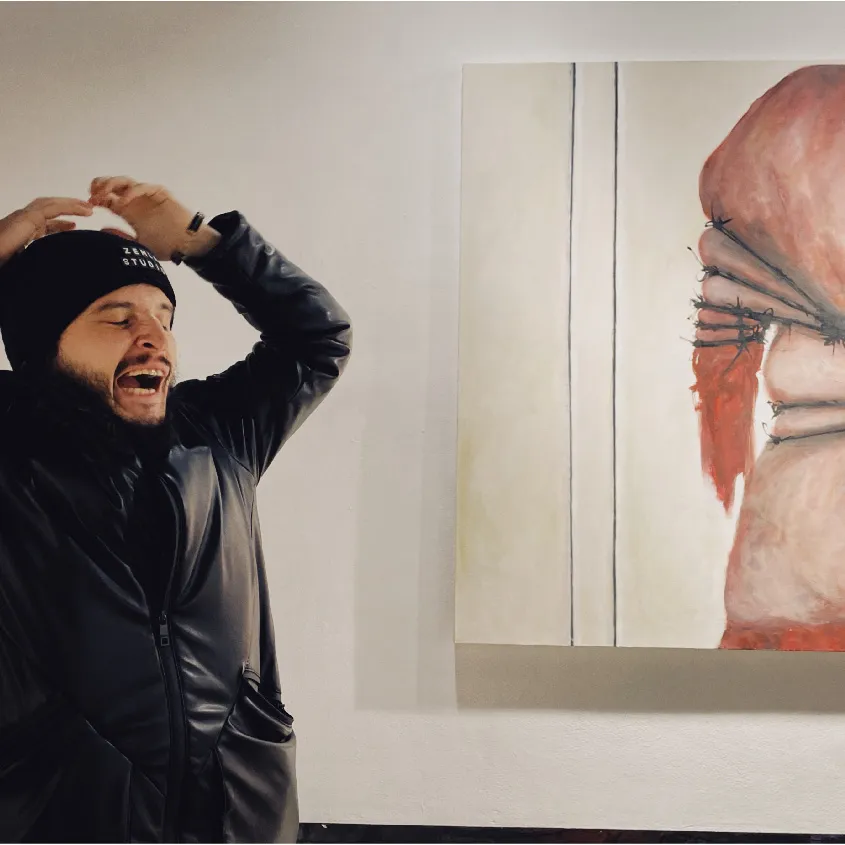
Dr. Myroslav Trofymuk
Born in Lviv. Designer, director, musician, researcher, founder of ZEMLA STUDIO. Master of classical philology and digital marketing, PhD in the history of Ukrainian literature. Member of the National Union of Journalists of Ukraine. Since 2022 he has authored the CENTRUM MUNDI audio show for Polish Radio for Ukraine, continuing the same research into the contemporary music scene in Ukraine and Poland.
Full bio →

