
“What for millennia seemed impossible, what only yesterday was a daring dream, today becomes a real task, and tomorrow an achievement.”
Sergei Korolev
– “This is Lviv-1... Attention! One-minute readiness. One-minute readiness.” – “Understood, Lviv-1. One-minute readiness. I was getting into my starting position, so I was slow to answer. Over.” – “Key to start!” – “Key at start.” – “Start. Tape drive 1.” – “Tape drive on.” – “Purge!” – “Purge.” – “Key to drain!” – “Drain on.” – “Launch. Tape drive 2. Ignition!” ...
On 2 October 2013, at 18:00 Kyiv time, thanks to the efforts of Mykhailo Barabash and Ostap Manuliak, founders of the NURT art association, a new festival of audiovisual art, Tetramatyka, entered the orbit of Ukrainian contemporary culture. The festival sets out to explore the interplay of musical and visual means and also aims to bring the IT cluster into collaboration with artists and musicians. The city authorities share this mission: City Hall supported the festival. It is no secret that Lviv has good grounds to call itself “the Silicon Valley of Ukraine”, and this postulate was borne out both by a speech from Yaroslav Muzychka, chair of the standing council committee on culture, at the opening of one of the exhibitions, and by conversations on the sidelines in which guests from Kharkiv and Kyiv confidently spoke of Lviv as “a city of programmers”.
Interest in programming keeps growing among artists and musicians. The name that springs to mind is Andrii Linik, one of whose works, made with software, was bought by the Polish WRO Art Center. Linik, incidentally, said at the festival that he keeps “hacking away at the Java rockface”, and bit by bit the “rock” is giving way. Not all artists, however, are prepared to devote their time not only to learning what terms such as “object-oriented programming”, “parsing” or “coding” mean, but also to mastering the “command line”, asleep and awake. To them “Java” sounds more like a Soviet-era motorbike, an island in Indonesia or a brand of tea than a programming language, so the effective solution seems to be the Artist–Programmer double act. And since most local Lviv programmers today are, frankly, “raking in the dosh”, and look in the direction of art either with a sceptical squint or not at all, we get “Problem 2.0”: an “IP address conflict”. And contemporary Ukrainian media art, like our factories, is at a standstill. It is precisely this problem that our “art-building engineers” are working on, NURTuring the Lviv public with all sorts of projects, festivals and exhibitions.
– “Lviv, this is Tetramatyka, feeling fine. G-forces building slightly. Continuing the flight.”
Since we have been talking about programmers, let us move on to numbers... However precise these people may be in their calculations, to make real contact with artists they will have to believe that between black and white there lie countless further achromatic shades, and accept that three and five together may not make eight. Right in the middle between 3 and 5 sits the number 4. It is associated with stability: a car has four wheels, a house, in the most basic sense, has four walls, and let us not forget Malevich’s Black Square, which to this day is interpreted in every conceivable way and used as a stable, solid foundation for new works. Curiously, 4 is also the most ambiguous and fickle of numbers, like a woman — for, as we know, two times two rarely makes four, except in school textbooks. So I venture to suggest that it was no accident that Mykhailo Barabash and Ostap Manuliak took the number four as the basis of their festival and gave the event a Greek-style name: Tetramatyka. The festival’s four components are “sound”, “video”, “action” and “interplay” (or “interaction”). As Mykhailo Barabash admitted to me in private conversation, at least two of the four components had to complement each other evenly, creating a whole — that was the festival’s main postulate, and works were selected on that principle. The visual and sound components of a work had to emerge in parallel and develop simultaneously, inseparably, so as to form a coherent audiovisual piece. Works in which a sound or visual part made by one artist was later completed by others were not admitted. Thus the festival took the stability of the means of representation as its foundation, brought together the all-important human factor of artist and viewer, and crowned the whole edifice with the majestic dome of the “golden ratio”, as a metaphor for art in general. The festival’s concept earns a solid five out of five. Now let us turn to the “telemetry” of its “flight”.
– “Lviv-1, this is Tetramatyka, nose fairing jettisoned. I can see the Earth through the ‘Vzor’ viewport, I can make out details of the Earth’s surface.” – “Tetramatyka, this is Lviv-1, all OK, the vehicle is flying steadily, over.” – “Understood, I can see the Earth, everything’s fine, visibility is excellent!”

Tetramatyka reached first cosmic velocity on the very first day of its “flight”. Within an hour, people thirsting for contemporary media art had converged on the Museum of Ideas. And there are more and more of them in Lviv, as the growth of the Week of Actual Art shows: this year it outgrew its own time frame and caused quite a stir among the Lviv public. The organisers of Tetramatyka, together with their guest from Russia, Marina Fomenko, talked about the treats in store, while downstairs, beneath them, art was already happening. In the halls of the Museum of Ideas we immediately come across a work by Jerzy Dobrzański and Joanna Zemanek, artists from Kraków. Dobrzański is interested above all in integrating his “pieces” into public space, but, as if through the looking-glass, their work Chorus Structuris integrated public space into the exhibition hall. By mirroring and symmetrising the video, the artists get to the essence of a structure that seems mundane and familiar in any big city: the construction crane. They let their imagination play over the nature of these mechanical structures, majestic as dinosaurs, which “spring up unexpectedly from the ground overnight, like a plant”. Cranes are always in motion, and the artists believe they are dancing — there is some truth in that: boldly by day, and at night only gently swaying, these gigantic structures rise above our cities as if alive. The effects Zemanek and Dobrzański use in their video could hardly be called innovative. These days every other person can stylise a photo like that with a few apps on their phone. Yet it is precisely this treatment, which turns the regular geometric forms of construction cranes into symmetrical “fractals”, that calls to mind the patterns in a kaleidoscope and lets us penetrate these wonderful mechanical structures even more deeply. The kaleidoscope, as we know, was also first invented as a scientific instrument and only later became a children’s toy. Perhaps this work from Kraków, a city so close to us in mentality, carries an echo of that childlike spirit which Oksana Zabuzhko describes in her essays on Winnie-the-Pooh and Alice in Wonderland.
We move on through the halls of the Museum of Ideas. On the right stand two switched-off monitors. The digital world has its own realities — you must submit to the whims of electronics — and so Mykhailo Barabash’s installation could not be seen at the opening. I did, however, manage to quiz the artist about it. It was an interactive installation on a military theme. Soldiers appeared on the screens: a Ukrainian, a Russian and a German. At the press of a key one soldier shot another, after which the system replaced him with the next. The roles were assigned at random: you could not choose which soldier you shot as, you could only shoot. A kind of invisible hand of God, or a chance to feel like Her Majesty History. The work is also interesting in terms of artistic process, since it came about through the collaboration of an artist, a 3D graphic designer and a programmer — proof, in other words, that such interdisciplinary collaboration in art can deliver results. Though the artist admits it was hard going, and they even had to “change programmers in midstream”, in the end “a bit of time, money” and it all worked out, Mykhailo Barabash continues.
Right next to them another monitor flickers, beckoning: “Come over here, quick — they’re not working, but I am.” You put on the headphones and start watching a video object by another guest from Poland, Grzegorz Sztwiertnia, called Together Through Life. A long, 20-minute video made with the “found frame” technique, the description claims. What is meant, evidently, is the English term “found footage”, which Ukrainian viewers know from countless horror films that purport to show material shot by the people caught up in the events. But found footage has also been used to edit collage films made up of cut-up newsreels. These very often serve as visuals at electronic music gigs. I am not sure how accurate it is to call such footage “found” — after all, it is often material that was never lost in the first place. So, from clips of the series about Dr House (also well known to us all), Grzegorz Sztwiertnia edits a video formally divided into two parts: “one shows the outer sphere of contemporary human life, the other the inner one”. Perhaps because the artist is interested, among other things, in medicine and psychiatry, he decided to depict the “outer world” with a montage of every moment in which House takes his painkillers — and modern man really is a creature of doping. The second part is more “transparent”: here Sztwiertnia uses a montage of shots of the inside of the human body. Again, if you dig into the nature of the source he takes his excerpts from, we can assume that we are being shown the diseased bodies of various people — and if you go further still, this is not footage at all but 3D visualisations… So the link with reality here is relatively weak.
On the way to the video installations, in a narrow dark corridor, a little flock of Hriumchyky blocks our path. The Hriumchyky are the creations of the SVITER art group, guests from Kharkiv Liera Polianskova and Maks Robotov. Together with Ivan Svitlychnyi, the group creates fascinating performances and sound objects, but the projects shown in Lviv were not exactly breathtaking. Perhaps I have been spoilt by Andrii Linik and his work Om, with its strong philosophical underpinning and its questions about the search for oneself and the meaning of life. Comparing the two works (if it is worth doing at all), one is tempted to see the Hriumchyky as a travesty of Om. Not a travesty of a specific work, though, since Polianskova and Robotov did not know that Linik’s robo-brood existed; I would simply venture that travestying life itself is in the SVITER group’s nature. Let us not forget that they grew out of an electro-punk band, hence the light, cheerful, perhaps somewhat anarchic motifs in their work: the pieces are colourful and grab your attention first of all with how they look, and only then does their deep social subtext (protest) become clear. Perhaps these are exactly the kind of artists Kharkiv needs to draw attention to the urban and social problems of a big city. As for the little Hriumchyky, what sets them apart from Linik’s “robots” in the literal sense of the word is that they are analogue: these “critters” are entirely mechanical and run on batteries. In open space they move freely and nimbly, but watching them, so clumsy in this enclosed space, as if pleading for help, huddling together at one spot and vainly trying to get past one another, you wanted to pick them up and put them somewhere else. Now the sentences in the “Distribution” section of the Hriumchyky’s description make sense: “Hriumchyky are widespread as subjectively experienced mental phenomena, and also as a disorder of the functional state of the central nervous system. Attempts at extra-geometric acclimatisation are rare and largely unsuccessful.”

In the next room two video works sit side by side. What catches the eye at once is Mariia Seinev’s video installation. Two videos are projected onto a pair of screens. In one, a naked Mariia walks out of a lake. Lines of text are visible on the artist’s body, but the text itself is barely legible: the water has washed the lines away. The words have not disappeared completely, but they are almost impossible to read. According to the artist, these are texts about travel, about the road, about the journey. Most of the quotations are of Roma origin: it is Roma poetry. One cannot help thinking of the symbolism of lost roots, of being torn away from national identity. In her description of the work, the artist stresses that the water in the lake is very cold, so she had to force herself to wade through it every day: this was part of the work’s narrative, since it was made at a workshop on the theme “Forced migration of Eastern European peoples during the Second World War”. Everything brilliant is simple: a mix of sadomasochism, exhibitionism and voyeurism is perhaps the best way to shed light on this subject. It is also interesting that the artist invites the viewer to become a participant in her installation. On the second screen, which hangs behind, we see a close crop of Mariia’s face and eyes as she watches the room intently — though you don’t notice this straight away. The artist invites you to take a step and find, if not your own identity, then at least your own “I”: to step over taboos, hang-ups or prejudices, come right up close and let her look you over — to become not just a viewer but a co-creator of the video installation, which in that case would have every right to be called a performance. I suspect that in her wildest dreams Mariia dreamt of seeing someone naked and real step towards the naked, virtual her — then the “network channel” would have opened at full bandwidth, and one of Tetramatyka’s four components, Her Majesty Interaction, would have reached its apogee. As shock therapy, this video installation is best prescribed for the countries of the post-Soviet space, where the remnants of identity, like gum chewed up and spat out on the kerb, stick only to the soles of contemporary Ukrainians’ imported shoes — and we diligently scrape it off so that it won’t get in the way.
In the same hall, right next to it (hats off to the curators), is another work with an obvious reference to the dissonance present in today’s cultural and art scene, but one also bound up with the post-Soviet “legacy”. The video object Image/Idea works through opposition. Its author, Witold Stelmachniewicz, placed a picture of Karl Marx and the name of Groucho Marx in offset print in the office of the rector of the Kraków Academy of Fine Arts (where, incidentally, he teaches himself). The painting and the print appear in the frame by turns, in a specific sequence, synchronised with music and voice-over: “The whole situation is a kind of ‘game of ideas’ that calls up now the painting, now the print,” the description says.

In the next little corridor is Oleksii Khoroshko’s A/D MMXIII — which is to say, “the Year of Our Lord Two Thousand and Thirteen”, or, well, “2013”. Is it a title? Or simply the date the work was made? Or just a nod to the “Now” as the moment in time in which we exist? Perhaps next year the work will be called “2014”? Perhaps it is eternal and cyclical? Perhaps it is not material at all, and only its spirit is present here? The artist declined to explain what the work was and supplied only a list of terms from Wikipedia that the abbreviation “A/D” might stand for (a search on Wikipedia lets anyone look through all the possibilities for themselves). The image shows hands folded in prayer — Albrecht Dürer’s work. So Khoroshko points us to Dürer’s theory of art and his Four Books on Human Proportion. The precise mathematical approach to the nature of the body that Dürer preached sits nicely alongside our “digitised present”, but in the foreground there is still the ritual of prayer. I notice a pair of headphones nearby; at first they seem to be plugged into something, but I take a closer look and it immediately becomes clear that they are ordinary builder’s ear defenders, used to block out noise. I put them on. Now, with no extraneous sounds getting in the way, I can concentrate fully on the picture shown on the touchscreen. Contemplating the ideal proportions of Dürer’s Praying Hands reveals the deeper essence of Khoroshko’s work, in which Dürer’s scientific treatises intersect and one may even catch an echo of Skovoroda’s philosophical ideas. We need to shut out the superfluous, purify ourselves and understand ourselves, and then we will find the way to knowing God and the meaning of life; in knowing ourselves, we come to know nature; and by delving into the nature of things, we come closer to the nature of art.
The last hall shows a work by Marina Fomenko, a guest from Moscow and curator of the international video art festival Now&After. The work is called Modus operandi/lotus&viola (the practice of giving works Latin titles is hereby solemnly declared a Tetramatyka trend, since the number of such titles has reached the “magic” number three). Modus operandi is a term used to denote a particular behavioural pattern. In the video we watch several men at work: they float in a small boat through the water garden of Kyoyochi Pond, clearing it of water lilies. At first glance it is routine work, so routine and polished down to the last detail that it would be hard to say when the video was shot: in theory the work would have looked exactly the same 900 years ago. This is precisely the modus operandi the artist is hinting at. The soundtrack chosen for the work is Oleg Paiberdin’s Hymn in Memory of G. Pervel, performed by the Viola ensemble under Valery Averin.
The same hall hosted Ivan Svitlychnyi’s performance 0 dB/10^3. To understand what the performance is about, you first have to decode its title. Noise levels are measured in decibels, but strictly speaking the decibel is not a unit of measurement: it is just a relative value showing how many times a given sound level exceeds the quietest predetermined level, taken as 0 dB. 30 dB is the standard noise level in a home: quieter than the human voice but louder than rustling leaves, a whisper or a soft shuffle. This is the threshold at which the human voice is still fully intelligible; as the noise rises, the voice becomes more and more distorted. Beforehand, SVITER and the artist had hung microphones around the Museum of Ideas and recorded the sounds of the building and people’s voices. Ivan Svitlychnyi took up position against a projected triangle, dressed in colourful clothes and holding a bright yellow (apparently home-made) guitar which, probably working like a MIDI controller, controlled pre-prepared audio patches. Maks Robotov kept an eye on the audio equipment. As the guitar was manipulated, the quiet sound of the rooms turned into a louder noise that exceeded 30 dB many times over and, pulsating, fluctuated between 30 and 120 dB, even reaching the pain threshold of 130 dB, as my own senses told me.
The performer declined to explain the performance, remarking that he had said everything through his actions and there was nothing to explain. Unfortunately, reading his fingers, it was impossible to guess what tune Svitlychnyi was playing. Perhaps knowing that would have made the point of the event clearer. We are also free to speculate about the triangle behind the performer’s back: there are references to the pyramids and an allegory of the number 3, since 30 dB is 10^3, that is, “ten cubed” (which brings us back once again to the festival’s “numerical spirit”).
– “Lviv, this is Tetramatyka. All going wonderfully. I can see the Earth. I can see the horizon through the ‘Vzor’. The horizon has partly shifted towards my feet.” – “Tetramatyka, this is Lviv. Understood. Excellent connection. Keep it up.” – “Understood. Everything’s working perfectly. Moving on!”
(To be continued...)
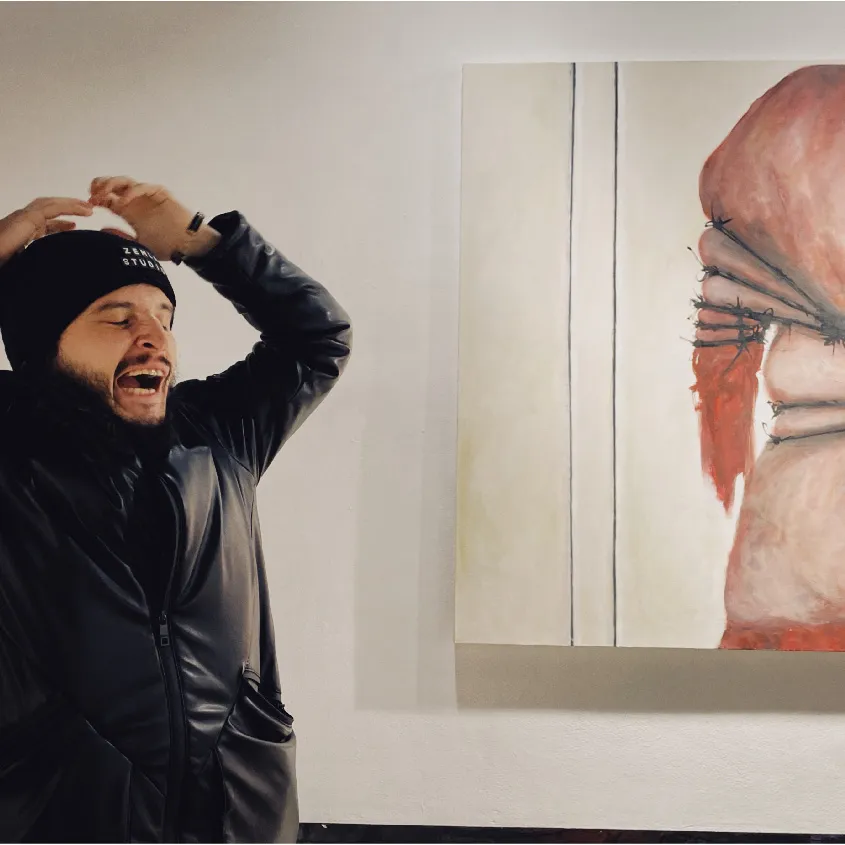
Dr. Myroslav Trofymuk
Born in Lviv. Designer, director, musician, researcher, founder of ZEMLA STUDIO. Master of classical philology and digital marketing, PhD in the history of Ukrainian literature. Member of the National Union of Journalists of Ukraine. Since 2022 he has authored the CENTRUM MUNDI audio show for Polish Radio for Ukraine, continuing the same research into the contemporary music scene in Ukraine and Poland.
Full bio →

