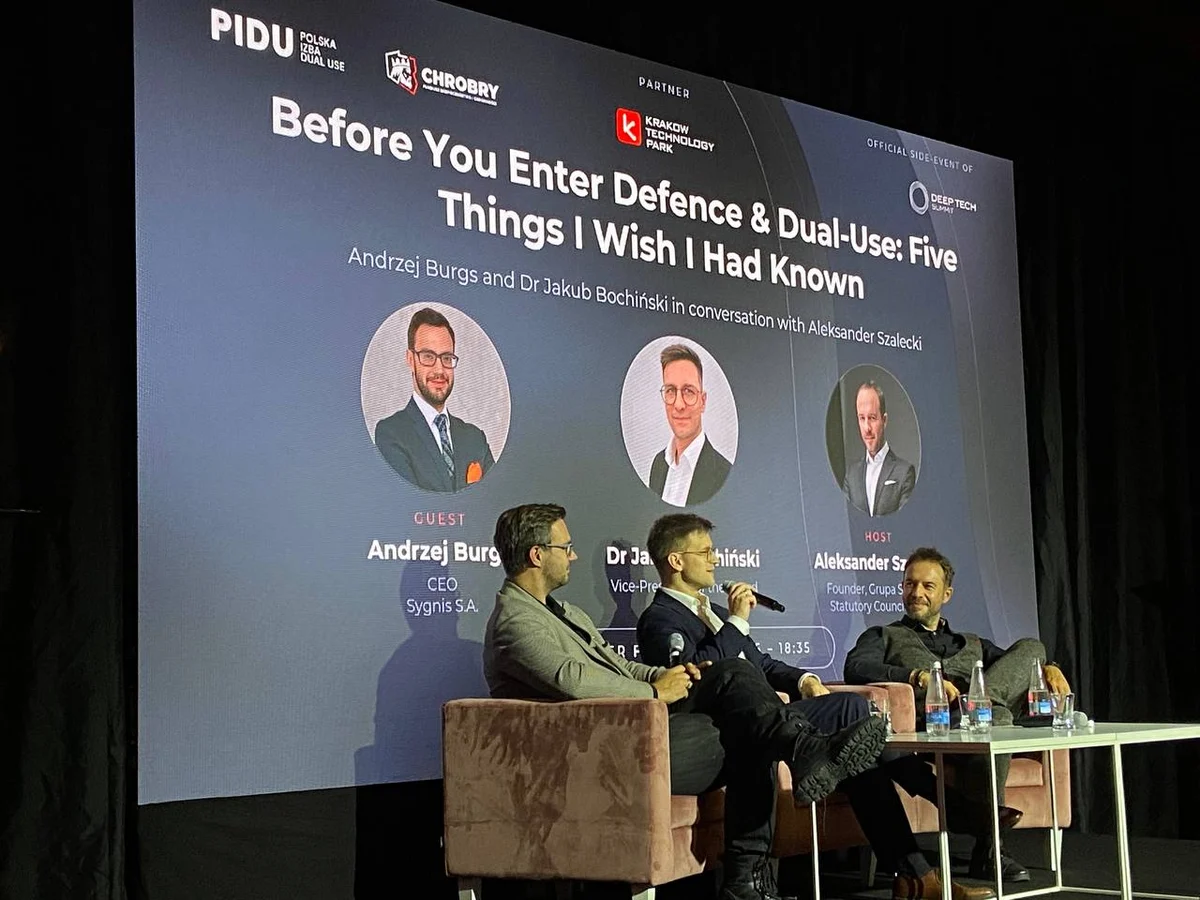
First to answer is investor Aleksander Szalecki, head of the Space Committee at the Polish Dual-Use Chamber of Technology:
Szalecki: “I sincerely hope for a two-way exchange of information and technology between Poland and Ukraine that benefits both sides. Ukraine genuinely has a wealth of compelling innovations — and, paradoxically, it is not necessarily about drones, as Poland itself has very strong drone manufacturers. What Ukrainians could truly pass on to NATO are electronic warfare solutions. There is tremendous momentum in Ukraine in this field: it gets far less media attention than drones, yet it is at least as important — or even more important.”
Electronic warfare rarely makes the front pages, yet it is what decides who controls the sky. The best-known example is Ukraine’s “Lima” system from Cascade Systems: it spoofs the satellite navigation of incoming enemy missiles.
Szalecki: “First and foremost, this concerns communications and electronic jamming technologies. From open sources one can cite Ukraine’s ‘Lima’ system, which effectively neutralized Russian Kinzhal aero-ballistic missiles. These are remarkably clever solutions that make it possible to shield wide territories at relatively modest cost.”
According to the developer, in the first three months of 2026 alone, “Lima” diverted 26 Kinzhal missiles off target, and 58 overall. Electronic-warfare resilience is just as decisive on the front line. Polish company Sygnis supplies equipment to Ukrainian brigades; its head, Andrzej Burgs, told the summit:
Burgs: “And it’s not only about evacuating the wounded. For example, our reconnaissance drone transmitted crisp imagery to the troops and performed brilliantly because other drones dropped out of the sky under enemy jamming, while ours stayed aloft. Thanks to that, the unit could see the tactical picture and pull back or regroup in time. Ultimately, outcomes like that are what fuel our motivation most.”
Protected communications lie at the heart of Szalecki’s investment focus — and for him, it is a question of sovereignty for the entire continent:
Szalecki: “I believe advanced communications technologies are the future, especially in the context of becoming independent from systems like Starlink and from American solutions in general. Europe must have its own communications — and I believe Ukrainians feel this need just as acutely.”
Can Europe move fast enough — or will it get bogged down in declarations?
Szalecki: “These are undeniably technologies that cannot be built overnight: Starlink is a phenomenal system, and constructing something comparable on a tight timeline is extraordinarily difficult, if not impossible. Yet similar capabilities must be rolled out as rapidly as possible to shed dependence on the United States. Europe — and ideally Poland itself — must possess its own reconnaissance, communications, and space systems controlled directly from Warsaw.”
Poland is already taking its first steps in orbit. On October 1, 2026, the last of four Mikroglob military satellites entered orbit under an army contract worth over 550 million złoty. They were built by Creotech Instruments. Company vice president Jakub Bochiński explains:
Bochiński: “We build satellite platforms on which we integrate payloads, engineer full space missions, and launch them into orbit for government, civilian, and military customers. Four of our Mikroglob satellites are already looking down at us every day, and we will soon hand them over to the military. Along that path we crossed a defining threshold — becoming a full-fledged dual-use company supplying both civilian and defense systems, even though the boundary between the two is often far from obvious.”
Who stands to gain more from this technological alliance — Kyiv, Warsaw, or Brussels?
Szalecki: “Ukraine is at war, so Ukraine is undeniably the more urgent stakeholder — its needs are ‘here and now.’ At the same time, both Poland and the European Union have a real stake in Ukrainian technologies, and we must do everything to ensure battlefield-proven solutions are adopted here as quickly as possible.”
Sygnis’s story shows how the front transforms business. In the first days of the full-scale invasion, the company sent a bus loaded with twenty 3D printers to Lviv; today it builds mobile containerized factories for the military. Andrzej Burgs:
Burgs: “For us it all started by chance. When full-scale war broke out in Ukraine, like many people in this room, we mobilized, bought a bus, packed it with 3D printers, and drove them across the border. The printers went out to brigades, and soldiers began sending us requests, files, asking for engineering support. We started designing tourniquet parts, rifle components, and printing tank spares for them — and suddenly it became clear this tangibly raises unit combat readiness because troops can act far faster.”
Yet the overarching lesson is about scale. Jakub Bochiński recalls traveling to Kyiv under bombardment:
Bochiński: “There is one quote from our colleagues in Kyiv that etched itself into my memory above all else. We were there under attack, drones were overhead, and they asked how we could help. We described our capabilities — not everything I can state publicly — and immediately got the reply: ‘That’s cool, that’s good, but we need more. You have what works, just not enough of it. In war we’ve learned one thing: you need more of everything. War devours gigantic volumes of hardware and supplies. If you cannot manufacture at mass scale, all you have is a toy. A clever toy, maybe, but we need huge quantities.’ When I returned to Poland and drafted Creotech’s three-year strategy, it became a direct answer to those words from Kyiv: we must produce in volume. That is why we are building a factory for serial satellite manufacturing. We need industrial-grade production at the scale, quality, and specs that don’t just showcase a bespoke prototype, but genuinely meet frontline and security demand.”
Has the war merely opened a temporary window of opportunity for deep tech — and would peace shut it again?
Szalecki: “I think so to a degree. Still, even if the war ended tomorrow, Europe has woken up and will keep striving for its own technological independence — whether the war ends tomorrow, in a year, or in two. From my standpoint, of course, the best outcome would be for the war to end as soon as possible.”
Re-armament capital is already flowing: Poland is the largest recipient of EU SAFE defense loans, €43.7 billion, more than a quarter of which is earmarked for air and counter-drone defense. So has this war awakened Europe for good?
Szalecki: “Without question. In my view the Russians made a colossal strategic mistake: their position in 2022 was far stronger than it is today. Now Europe is determined to defend itself independently, is actively developing these technologies, and the end of the war will not reverse that trajectory. And it is worth stressing: certain sectors physically cannot be rushed. Space launch and rocketry, for instance, take time. You cannot simply pour money over a project and get instant results: engineering cycles have to run their course. Yet I do not believe peace will make anyone shut them down.”
The Polish Dual-Use Chamber of Technology launched only in March 2026 and already unites more than 70 companies. Does Szalecki personally invest in Ukrainian startups?
Szalecki: “Personally, I do not yet. However, very many member companies of the Polish Dual-Use Chamber of Technology (Polska Izba Dual Use) are already either partnering with Ukrainian firms or investing directly in Ukrainian projects — and I hope we will see more and more of these joint initiatives.”
The Ukrainian front is no longer merely an aid recipient: it is now both proving ground and instructor for Europe’s defense industry. The formula is straightforward — electronic warfare, sovereign communications, independent space capabilities, and industrial scale. Because without scale, as they put it in Kyiv, even the sharpest technology remains just a toy.
- 3D printer [instrument / technology]instrument / technology. T.A.M. Club / Centrum Mundi corpus · Night Report: Maneco Urquhart | DIY Synthesizers, China, and Uruguay's…
- Starlink [instrument / technology]instrument / technology · Are wars in space possible? A conversation with expert Łukasz Wilczyński
- NATO [institution]institution. T.A.M. Club / Centrum Mundi corpus · Are wars in space possible? A conversation with expert Łukasz Wilczyński
- Left Bank Theatre [place]place. T.A.M. Club / Centrum Mundi corpus · Centrum Mundi — XXI — Local and Global Popularity: Oleh Kopeliuk, Ihor…
- Deep [place]place. T.A.M. Club / Centrum Mundi corpus · Centrum Mundi — N027 — Voices of the Cosmos: Rafal Iwanski on Radio…
- Unia Europejska [institution]institution. T.A.M. Club / Centrum Mundi corpus · Are wars in space possible? A conversation with expert Łukasz Wilczyński
- Brussels [place]place. T.A.M. Club / Centrum Mundi corpus · Iannis Xenakis and the Challenges of Music Education in Ukraine

Dr. Myroslav Trofymuk
Born in Lviv. Designer, director, musician, researcher, founder of ZEMLA STUDIO. Master of classical philology and digital marketing, PhD in the history of Ukrainian literature. Member of the National Union of Journalists of Ukraine. Since 2022 he has authored the CENTRUM MUNDI audio show for Polish Radio for Ukraine, continuing the same research into the contemporary music scene in Ukraine and Poland.
Full bio →