
We often spot propaganda in films, music and cartoons (such as the notorious “Masha and the Bear”, which has been promoted successfully on international markets). Far less attention, however, goes to computer games, even though that is exactly where processes unfolded that shaped the perception of political reality no less than traditional media did.
Today it is well understood how quickly propaganda and disinformation spread through the media and through various forms of cultural product. Russia systematically used films, music, cartoons and other formats to build a picture of the world that suited it. This became especially noticeable in children’s content — for example, the cartoon about Masha, which was widely distributed on international markets. Far less attention, however, is paid to how propaganda narratives seeped into computer games, even though this area also played an important role.
Recently Viktor Pushkar, a Ukrainian electronic musician and former writer on computer technology, shared a memory. He recalled a case from 2005: a modification for the game Tom Clancy’s Ghost Recon that created an alternative political reality and effectively twisted events in favour of Russian narratives. It is a good example of how the gaming environment was used to model the desired ideological picture.
Tellingly, as far back as the 1990s–2000s the Ukrainian computer media market was under total Russian-language domination. This applied to publishers, to software sales and even to hardware components. Pirated discs and Russian localisations were the main source of content. The gaming clubs that flourished at the time were usually basement rooms with bare-minimum conditions, yet they were popular. The hits of the day, such as Counter-Strike or Battlefield, were an everyday pastime for many, and hardly anyone cared where a game came from or what it contained.
Many games had modifications that let players change not only how the characters looked but also the context of the missions. The aforementioned Tom Clancy’s Ghost Recon was one of them. Practices like this made it easy to introduce whatever ideological slant was wanted.
Against this background, the Ukrainian “Cossacks” became a phenomenon in its own right. The idea for the project came about in 1997 under the influence of Age of Empires, and active development began in 1998. The original plan was a game with four factions — Ukrainians, Russians, Europeans and Ottomans — aimed at the domestic market. But after a successful showing at the MILIA trade show in Cannes, the game was scaled up: the number of nations grew to sixteen and it was taken to the international market. Opting for 2D graphics made it possible to display thousands of units at once and keep the gameplay stable. Development continued until 2001, when “Cossacks: European Wars” went on sale.
After the studio resumed work in 2014, “Cossacks 3” followed. Development had been under way since 2013, and the game was released in 2016. It came in standard and deluxe editions and received a series of free DLCs with new nations and seasonal updates.
Meanwhile, the popular game “Civilization” still offers no way to play as Ukraine. Instead, the Russian civilisation has a “Cossack” unit — a telling example of the blending and appropriation of the region’s historical heritage so typical of Russian culture. The Metro series is sometimes counted among Ukrainian games too, but despite the involvement of Ukrainian developers it is based on a Russian book and rooted in Russian culture, so it can hardly be called Ukrainian. Today’s mods for ARMA Reforger that recreate events of the war in Ukraine more often look like a reaction to a trending topic than a carefully thought-out Ukrainian cultural product.
Alongside this, a more independent indie scene is growing, offering an alternative to the big studios. Three notable games from it deserve a mention.
The first is SAND, a project that has earned the unofficial online nickname “the one about Galicians in space”. In its storyline, the Austro-Hungarian Empire discovered a new form of energy at the start of the 19th century, which made it possible to conquer space. The colony of Sophie turned into a desert world after an ecological disaster, and it is to this world that settlers with a distinctly Ukrainian flavour set out. The game combines the aesthetics of a space western with the cultural motifs of Galicia in western Ukraine.
The second is a project originally known as 1505: Knight Becomes Kozak. It is being made by two Ukrainian artists, Mykhailo Burlakov and Nikita Biriukovych. Its story was set in the 16th century, in the age of the Ukrainian Renaissance. Later the concept changed and the game was renamed Bygoner. It is now an action-adventure with elements of Slavic folklore. A demo is planned for 2025 and an early-access release for 2026. A Ukrainian text localisation is planned.
The third is Ostriv (“Island”), a city-building economic strategy game about the growth of an 18th-century settlement. The player manages construction, farming, crafts and trade. The game is full of historically accurate detail, from the architecture and everyday life to the music. At first a single person worked on the project; since 2018, a small team has. The game’s realism owes something to the fact that the developer personally photographed landscapes and buildings in Ukrainian towns.
All these examples show that computer games can model a distorted reality, but they can also offer a more authentic and considered view. The Ukrainian games industry is gradually moving away from its peripheral role and creating products that do not depend on Russian narratives or reproduce borrowed cultural templates.
Let us hope that from now on our reality will resemble the plot of a computer game a little less, and that Ukrainian games themselves will become even better and more diverse.
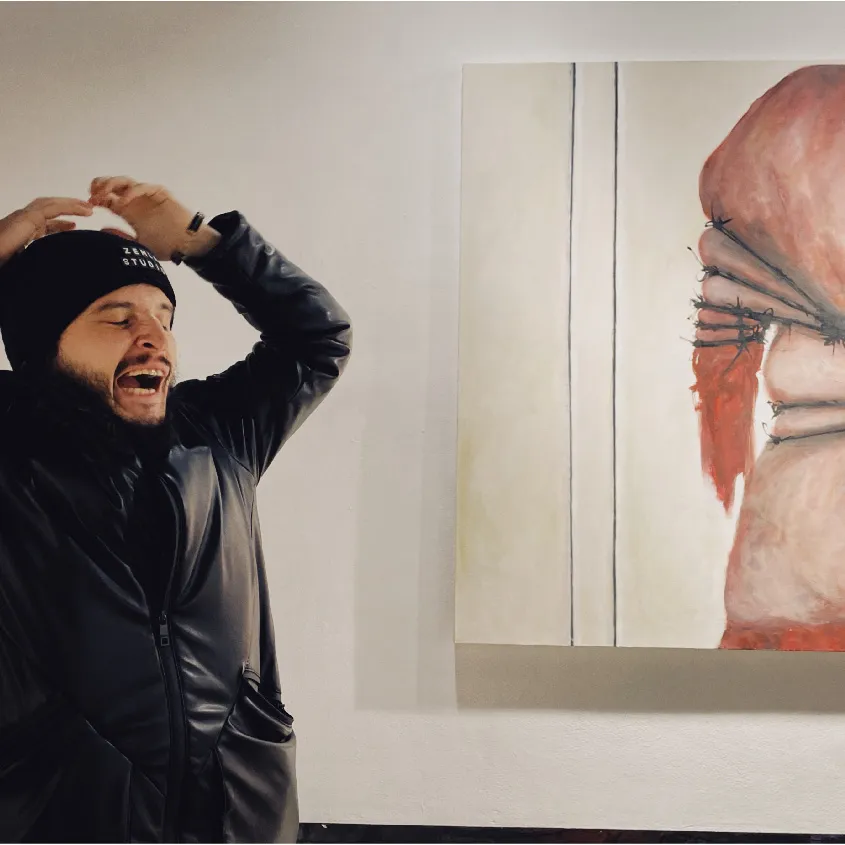
Dr. Myroslav Trofymuk
Born in Lviv. Designer, director, musician, researcher, founder of ZEMLA STUDIO. Master of classical philology and digital marketing, PhD in the history of Ukrainian literature. Member of the National Union of Journalists of Ukraine. Since 2022 he has authored the CENTRUM MUNDI audio show for Polish Radio for Ukraine, continuing the same research into the contemporary music scene in Ukraine and Poland.
Full bio →
