
Our subject is hybrid and remote work. The conversation, with people from various industries and professions, comes from the programme “Let’s Talk!” on Polish Radio Programme 4 (Czwórka).
Magda Błaszczyk, who works for Nozbe, a company with no office, shares her experience:
“Yes, back in 2007, before I joined, my boss decided to set up a company without an office. Contrary to what is usually seen as prestigious — a big office, a neon sign, elegant premises and an open-plan space — he went a different way: he hires people, works with them, checks the results, but trusts them a great deal.”
This shows how stereotyped our idea of a company can be. After all, many creatives deliberately rent small studios, not so much for practical reasons as for the image: “somewhere to invite clients”. Some kinds of work, especially manual ones — with paint, clay or wood — simply can’t be done at home. So the picture is mixed: not all freelancers want to work from home, and some, after working that way for a while, begin to long for a separate space where they can fully come into their own.
Adam Romański, a YouTuber who goes by the handle “Halo Roman”, talks about his experience:
“Yes, I’ve worked both in an office and remotely. Once upon a time, ‘in the olden days’, when I was a copywriter at advertising agencies, I went into an office. I remember well what it’s like. I even recently rewatched an episode from about six years ago, I think, in which I compared the two formats. My impressions still hold. And for eight years now I’ve been working remotely as a programmer — from the comfort of my own home.”
But this format doesn’t suit everyone. For some it means freedom; for others, a closed space with no social contact. Which raises the question: what does work mean to us today? Is it part of life, or merely a way of earning a living? People often mention the myth of the “dream job” — find it, and you’ll never have to work again. But is that really possible? Perhaps the Italian vision of a sweet, slow life is closer to normality than a romanticised infatuation with work.
Magda adds:
“Sometimes I miss people terribly. If none of my friends or acquaintances can meet up after work, I start ‘going crazy’. Because eight hours in front of a computer with only cats, dogs or guinea pigs for company — for an extrovert like me, that’s not enough. Sometimes I dream of being able to go to an office. But at Nozbe there simply isn’t one, so I have to cope somehow.”
But the opposite happens too. Some people, on the contrary, get tired of too much contact and prefer silence. As Adam says:
“Social contact wears me out very quickly. I like spending time with people, but only up to a point. And when it comes to really productive work, I prefer silence: sitting at home on my own, sometimes with a cat or a dog on my lap, and working without distractions.”
Even at the interview stage, according to Magda, you can see who is better suited to working from home:
“When we hold the final interview online, where the candidate no longer just writes but appears on camera, I can see that those who move around a lot, joke and talk loudly either decide not to join at all or drop out quickly. Whereas the calmer ones, who answer briefly and without unnecessary emotion, stay with us for seven or eight years.”
There is another widespread myth — about freelancers working from the beach.
“In my field, IT, the biggest myth is the image of the programmer lying on a beach and coding from any corner of the world. I’ve never met such a person. I do know people who’ve worked from Australia, the Philippines or Tenerife, but it was always at a desk, in a room that at least resembled an office. Nobody ever joined a video call straight from the beach. It’s unrealistic — conditions like that aren’t conducive to productive work,” says Adam.
But another participant in the programme disagrees:
“I’ve worked from beaches, from bars, from airports and from my car — when a deadline was ‘burning’. If you’re a freelance designer, you have to be ready to get in touch from anywhere. But there’s a cognitive dissonance here: people who choose remote work so as not to sit in front of a computer for nine hours a day end up working 12 hours or more, because there’s simply no fixed schedule.”
Magda agrees:
“A friend of mine, for example, went to Tenerife for three months. He really did work from there, but during working hours he sat at a desk, and only afterwards did he go to the beach. And that’s why I really envy him.”
Another myth is that a remote worker has to be constantly monitored via a camera or software. But people often get round such systems: they put an object on the keyboard or attach the mouse to a robot vacuum cleaner. In the end, what matters in remote work is the result. If productivity drops, it shows immediately.
Not everyone agrees, though. Adam from Ciechocinek says:
“I can’t imagine working remotely. You have to be very disciplined. Maybe some people can do it, but I wouldn’t get any work done at all.”
Others, by contrast, think that office work is more often “pretend work”: there are hardly any tasks, but you have to sit there for eight hours, creating the illusion of being busy. In remote work, everything depends on responsibility. Once the job is done, you can set aside time for yourself.
The common assumption is that the home environment is nothing but distractions. But experience shows that it all depends on how you organise yourself. Household chores — making coffee, putting on a load of washing — simply become short breaks. That doesn’t harm the work, since people take breaks in the office too: they go for a coffee, a cigarette or to the loo.
Paulina from Warsaw recalls:
“At first it was hard to concentrate. I looked for co-working spaces and chances to get out of the house. But then I set up my workspace, found my own rhythm, and now I feel very comfortable working from home.”
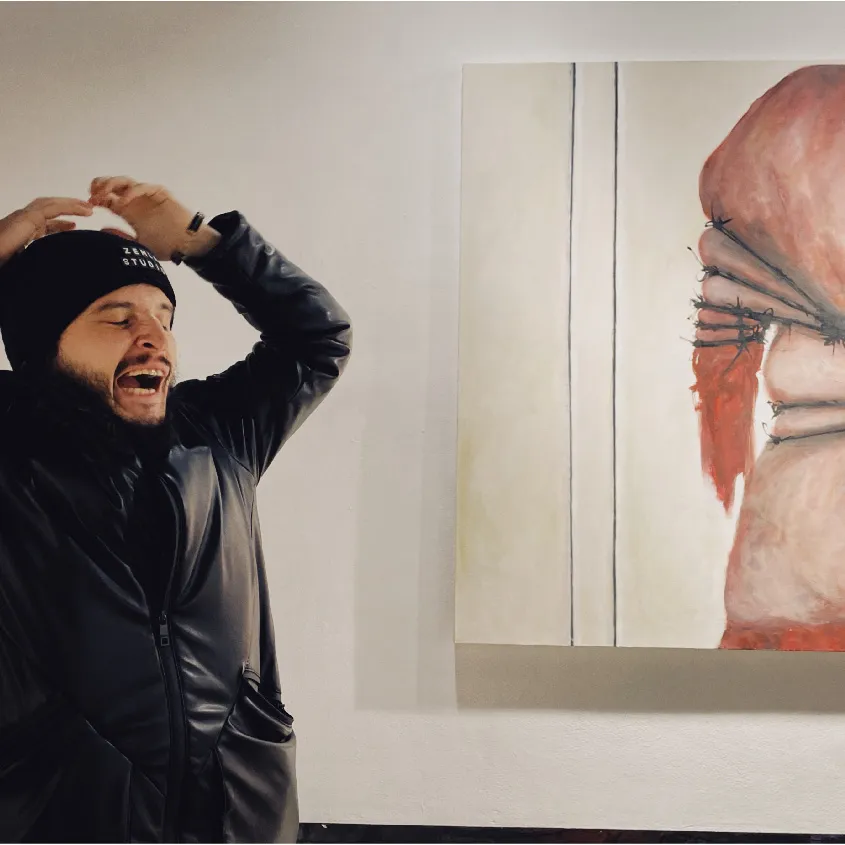
Dr. Myroslav Trofymuk
Born in Lviv. Designer, director, musician, researcher, founder of ZEMLA STUDIO. Master of classical philology and digital marketing, PhD in the history of Ukrainian literature. Member of the National Union of Journalists of Ukraine. Since 2022 he has authored the CENTRUM MUNDI audio show for Polish Radio for Ukraine, continuing the same research into the contemporary music scene in Ukraine and Poland.
Full bio →

