
Alexandr Sushinski is a philosopher, cultural theorist, and curator of the Laboratory of Contemporary Art in Donetsk. At the First International Forum of Independent Initiatives ’KHATNIEHRANNIA: KITCHEN’ at Fredra 61, he delivered an incisive critique of the boundaries of artistic gestures, aesthetic reception in an era of hyper-consumption, the dialectic between pop art and the underground basement, the punk movement, and the agency of grassroots networks to alter reality.
Tiers of Reception: From Passive Observation to Existential Affect
Miroslav invited me to speak, and I wish to address a fundamental question: what does art genuinely achieve within a human being? There exist several tiers of spectator engagement. The primary and most prevalent tier is passive consumers, for whom an exhibition or concert is merely background diversion. Even intense aesthetic stimuli fail to penetrate as a transformative, searing internal experience.
Authentic art is inevitably an affective shock. It resembles profound existential upheaval, where upon reading a transformative book or absorbing a seminal film, one can no longer perceive the world through prior assumptions. Yet today, under relentless commercial pressures, the spectrum of human aspiration has been drastically attenuated. Following the collapse of 20th-century grand ideological utopias, utilitarian pragmatism reigns supreme.
Pop Art Versus the Basement: Gradient States and Underground Integrity
One frequently encounters the question: what lies between pop art and the subterranean basement? In truth, there is no rigid partition; there is a dynamic gradient of transitional states. Consider the early minimalist circle around John Cage or nascent New York punk. These phenomena originated on the absolute periphery — in cramped basements gathering fifteen or twenty participants. Why did they press merely one hundred or five hundred copies of a cassette? Not out of exclusionary snobbery, but because it reflected the natural scale of an organic micro-community.
Does Art Alter Society? The 20% Principle and Sovereign Networks
There exists a naive illusion that if we broadcast avant-garde expression across stadiums and mass television to reach millions, society will instantaneously transform. History demonstrates the opposite: art has never transformed the masses through direct broadcast. Structural transformation is always initiated by a self-aware 20% minority who accept responsibility for meaning and articulate a vector that the remaining populace gradually navigates toward.
Consequently, self-organized nodes like Fredra 61 are far more than leisure clubs. They are intellectual crucibles refining the density and rigor of our cultural resistance. Each participant selects an individual trajectory, yet collectively we sustain the living alternative without which culture decays into a static mausoleum. Thank you for your attention!
- Oleksandr Sushynskyi [person]Curator of MUZAHiST! FEST at the First Lviv Mediatheque; played detuned acoustic guitar at PLUA AND PLAY in Dzyga. · Anton Lapov: Media Archaeology, R&D and the Sound Underground of Luhansk
- Donetsk [place]place. T.A.M. Club / Centrum Mundi corpus · Anton Lapov: Media Archaeology, R&D and the Sound Underground of Luhansk
- John Cage [person](1912–1992). composer, music theorist (USA). Linked with: New York. Nests: T27 “What counts as music”, T28 “Silence, noise and the physics of sound” · T27 What counts as music, T28 Silence, noise and the physics of sound · Pawel Szroniak: Rozkurz, the Dematerialization of Sound, and Curating…
- Fredra 61 [place](since 2013). place (Львів, Ukraine). Linked with: Lviv. KORINNIA map (4 conversations) · Yuriy Yaremchuk on Free Improvisation and ХАТНЄГРАННЯ
- HOMEPLAYING [band / project]Improvisational & experimental music laboratory and label founded by Myroslav Trofymuk (AЙKTRONER), Taras Shpot and Andriyan Veremiyenko (2013—2026): 99 live sessions, festivals, Forum of… · Antek Michnik and Myroslav Trofymuk: The Paradox of [NIE]ZALEZNOSC
- New York [place]place. Нью-Йорк, US. T.A.M. Club / Centrum Mundi corpus · Yuriy Yaremchuk: New Music Concerts and Free Improvisation
- Forum of Independent Initiatives [concept]concept. T.A.M. Club / Centrum Mundi corpus · Anton Lapov: Media Archaeology, R&D and the Sound Underground of Luhansk
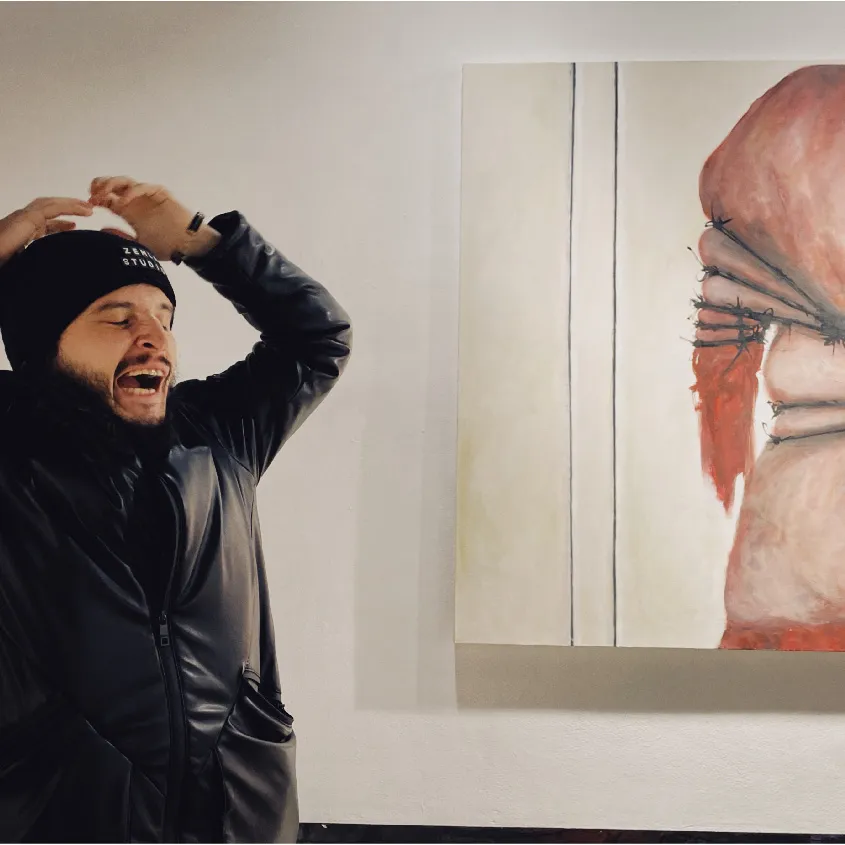
Dr. Myroslav Trofymuk
Born in Lviv. Designer, director, musician, researcher, founder of ZEMLA STUDIO. Master of classical philology and digital marketing, PhD in the history of Ukrainian literature. Member of the National Union of Journalists of Ukraine. Since 2022 he has authored the CENTRUM MUNDI audio show for Polish Radio for Ukraine, continuing the same research into the contemporary music scene in Ukraine and Poland.
Full bio →


