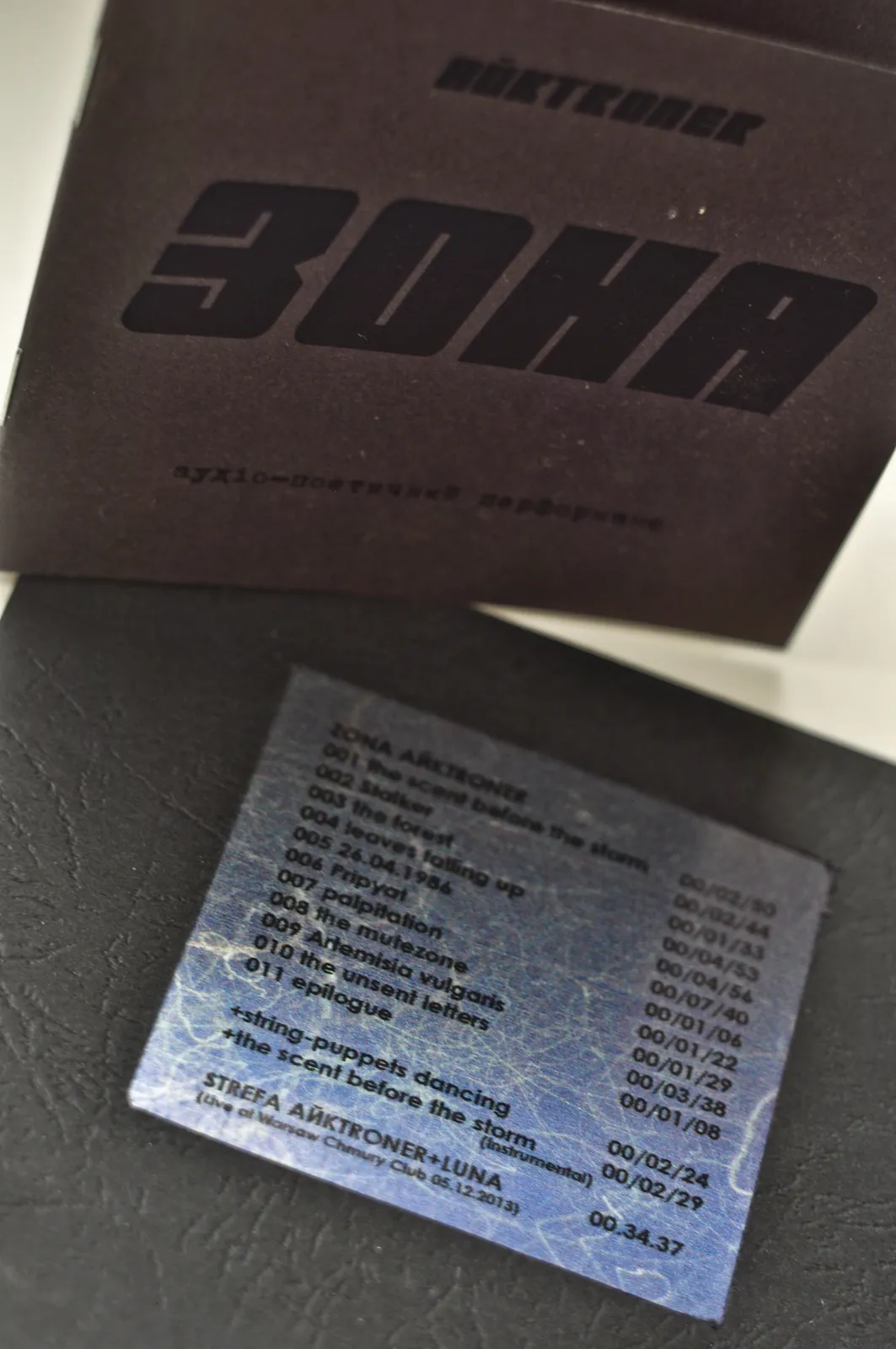
An essay by Myroslav Trofymuk behind the video «The Mutezone — semantics behind the ZONA concepts». The text was first delivered in Polish as «Strefa».
…later it became clear that we can learn to live with horror, even the last, apocalyptic one. And, in my opinion, this is the most valuable thing in the entire history — maybe even in the entire history of the 20th century. Oksana Zabuzhko, «Planet Wormwood: Dovzhenko — Tarkovsky — von Trier, and the discourse of the new horror»
In the beginning was the word. So let us start with the word itself.
Zona
In Polish strefa, in English zone or area, in Ukrainian — зона. We could say that strefa is etymologically related to the German der Streifen — belt, strip, which is logical enough. But zone or zona goes back to the Ancient Greek ζώνη — belt, ring. What is remarkable is that the Old Greek ζωή means life; Polish życie, Ukrainian життя. Even phonetically you can notice the similarity: one letter separates those two words. There is a thin line between them — in Ukrainian we say тонка межа. Межа — між — między. Межа is the border between two parts of a field. In English there are also marge or margin; in Polish margines — the edge or border of something.
So it may be only me playing with words — or there are certain interconnections between these terms and notions across many languages and cultures.
Let us go into the semantics of the term zona through the perspective of Ukrainian culture and everyday life. In Ukraine the word is related mainly to two occurrences. First place goes to the prison; second to the Zone as the whole area of some four thousand square kilometres around the Chornobyl Nuclear Power Plant — also called the Zone of Alienation, the Chernobyl Exclusion Zone, or the 30-Kilometre Zone. Third place goes to the occupation zone, which was related to the Nazi and Soviet occupation of Ukraine, and today to the russian one.
Google Trends gives some idea of what people actually search for. Looking from Ukraine over the last year there are a few requests: the JFO Zone — the Joint Forces Operation Zone in eastern Ukraine (30 April 2018 — 24 February 2022); then the no-fly zone, the war zone and the safety zone; and the newest trend, growing more and more popular — the nuclear bomb damage zone. From peacetime, over a longer period — say from 2004 until today — the term appeared in conversation as part of the Schengen Zone, or of the comfort zone, especially in the idiom «getting out of the comfort zone».
Summarising this semantic area around the word zona: it sits mainly at the intersection of prison, war, and post-nuclear, post-soviet reality.
Prison
From the perspective of cultural anthropology the prison has at least two displays in post-soviet Ukrainian culture. One is widely known as the place where criminals are kept as punishment. The other was the so-called GULAG. We could say that the gulag system is more or less a legacy of the Roman Empire. After the Romans conquered a region they established a castrum — a military camp necessary for the control of the colony. Once the colony grew big enough, Rome assigned it ius Italicum: a clear sign of incorporation into the common area of interests of the Empire. In Poland we call the German Köln Kolonia. Cologne is one of those cities that grew out of a Roman military camp.
But in contrast to Roman camps, russian gulags were established not only for dangerous prisoners but also for so-called political ones — artists, the opposition, russian soldiers released from German captivity, farmers whose land was taken by the government, Ukrainian intellectuals, poets and writers.
Gulag labour camps are really similar to those known from nazi Germany, with one main difference: the gulags were focused on the oppression of local people — starting with russians and, after a few decades, focusing on Ukrainians. They were used to provide human resources for industrialisation: building railway tracks, logging, developing the so-called virgin lands. During the stalinist repressions the camps, especially Solovky, were also places of execution. During the 1930s more than 9,500 people were shot in the Sandarmokh forest, among them 1,111 intellectuals of mixed nationalities. People were buried in mass graves.
Officially the gulags were active for fifty years, from 1917 until 1967. It is legitimate to say that gulag culture was at some point determinative for the generation of russian society during those fifty years. Remarkably, three generations changed during that time — the Lost, the Greatest and the Silent.
At some point the gulag was dematerialised and became a spirit of soviet times. History books claim it did not exist after the 1960s — yet Vasyl Stus, Ukrainian dissident and writer, died in the Perm-36 prison in 1985, twenty years after the project was formally shut down. From my perspective of guerrilla social studies I can say out loud that during the 1990s in Ukraine — even in its western part, in Lviv and Galicia — there was a strong magnetic field of prison culture, intensified by the media.
The everyday agenda on TV was built on prison, post-prison, post-soviet, hopnik and street-gang media products — video shows, shanson music, language constructs. It was a particular influence zone and a dispersal of prison culture through society. Today we can be sure it was a deliberately planned informational war and media oppression.
That is how it looks from our Ukrainian perspective. But the question remains: is this prison culture of vertical hierarchy, strict restrictions, minimum comfort, maximum effort and sacrifice for the state, mixed with Stockholm syndrome, also the natural habitat of russian society?
Vor v zakone — thief in law — is one of the privileged statuses in russia. The criminal culture with its own slang, customs and laws (called ponyatiya) became known as vorovskoy mir, the thieves' world. I assume the thieves' world is inseparable from the so-called russkiy mir. A vor would not participate in political activity, but this changed a little after the Second World War, when many were forced to join the army. Coming back to prison they lost their official status, and a big war broke out — the «bitch war» — between those who had stayed inside and those who had fought.
After the breakup of the Soviet Union in the 1990s the vory assumed a leading role in the russian criminal hierarchy. The group was able to infiltrate the top political and economic strata while taking command of the crime network spreading murderously through the post-soviet countries. The era from 2001 to the present should be considered an example of an alliance between organised crime and the state. Mark Galeotti defines this strategic effort thus: «Russia's recent operations in Ukraine, especially the integrated use of militias, gangsters, information operations, intelligence, and special forces, have created a concern in the West about a “new way of war”, sometimes described as “hybrid”.»
Vor is the highest status on the zona — which means prison in russian. The lowest will be opushchenyi, the downcast. One becomes opushchenyi through a special ceremony: being collectively raped by other prisoners. One can be raped after being convicted through a public court called bazar — chatter — for insubordination or for collaborating with the prison authorities; but gays, policemen, or those convicted of sexual violence could be condemned to rape without any court at all, by prisoners of the highest status. Once one becomes opushchenyi, the status has no statute of limitations and cannot be pardoned.
A few facts
There is a media portal called Prime Crime, the official media channel for the criminal world in russia and abroad. Comfort Zone is the title of a russian YouTube show that started in 2020, about a man imprisoned in a Norwegian prison and trying to manage there; the series was and still is high in Google Trends across Ukraine and russia. After the mobilisation in russia, videos appeared of men refusing to join the army because they did not want to fall into the opushchenyi status. During the occupation of Bucha, Mariupol, Izium and other cities, Ukrainians of all genders and ages were raped, killed and buried in mass graves with their hands tied behind their backs. According to the United Nations, the youngest victim of the russian rapists is four years old; the oldest is eighty-two.
Post-nuclear reality
Last month I recorded an interview for my radio show Centrum Mundi with Alla Zahaykevych, the Ukrainian composer. It was at the Warsaw Autumn festival, and Alla presented her newest piece, Prostory Svitla — Light Spaces: an attempt to bring the futurist artistic practices and constructivist principles of Ukrainian futurism into a contemporary context. Among such concepts the first is the idea of «constructive dynamism» described by Valerian Polishchuk in the magazine Avant-Garde in 1929, where the author reflects on the artistic perception of the dynamic nature of reality.
Valerian Polishchuk was a Ukrainian poet, prose writer, literary critic and publicist. He was imprisoned on Solovky and executed on 3 November 1937 in Sandarmokh. For the next seven years his relatives knew nothing about the execution: in 1943 they were issued a certificate of the writer's death, but the document contained false information. Only in 1988 did the military tribunal of the Leningrad region inform his relatives that he had been shot by a so-called special court — the nkvd troika. In fact this court sat without any public or fair trial. The three members were judge and jury at once. Very similar to a bazar, no?
Polishchuk is part of the so-called Executed Renaissance. The term was the idea of Jerzy Giedroyc, who initiated the publication of an anthology of the Executed Renaissance in 1959 in Kultura, the Paris literary and political magazine.
I asked Alla Zahaykevych about her interest in traditional music — or, as she calls it, authentic Ukrainian music. She told me a story from her student years, visiting the Chornobyl region with an ethnographic expedition. She recalls it was the village of Novyi Myr in the Polissia district. She and other students were able to record and listen to old women singing authentic Ukrainian songs around the region. That was 1985 — two years before the Chornobyl accident.
Accident — that is what they called it. We, Ukrainians, call it the Chornobyl Catastrophe.
The Mutezone
In 2012, during the Meridian Czernowitz festival in Chernivtsi, I recorded the voice of Oksana Zabuzhko. She was presenting her new book, reading an excerpt from her essay «Planet Wormwood: Dovzhenko — Tarkovsky — von Trier, and the discourse of the new horror». She remembered standing in the middle of a street in Kyiv, watching snow fall — in April. She describes the sky shining so wonderfully and unnaturally. After some time she discovered that it was not snow but radioactive ash falling on her shoulders from the sky.
Since 2006 I had been preparing sound material; I knew it had to be connected to Tarkovsky's Stalker. The film is loosely based on the Strugatsky brothers' novel Roadside Picnic. The material waited until 2012, when I was able to combine it with the Zabuzhko quotes. My project ZONA was this essence — a mixture of ecological, social and historical aspects around the Chornobyl Zone. But I also consider the Zone as a specific state of mind: limited, restricted, self-censored.
In the Zone, in general, the direct path is not the most… safe. The longer the road, the safer it is. The zone is… a very complex system… traps, whatever… and all of them are deadly! I do not know what happens here in the absence of a person, but as soon as people appear, everything is set in motion… Former traps disappear — new ones appear. Safe places become impassable, and the path becomes simple and easy, then tangled to the point of impossibility! This is the Zone. It may even seem that she is capricious, but at every moment she is what we ourselves have made her to be… our state. Alexander Kaidanovsky as the Stalker
Zone, strefa. We know these terms must describe some part of the land. The zone implies there is something inside. The term automatically includes the concept of presence, but also of demarcation. If this is a Zone, then it arose as a separated, fenced-off part of the earth; most likely there is something important here, in contrast to all the unimportant things surrounding it. These assumptions are manipulated by science-fiction screenwriters creating stories like Area 51, and by propagandists. There is an important factor of human presence — anthropocentrism, or the Anthropocene. Man made an effort to create a zone.
The history of the end of the twentieth century and the beginning of the twenty-first is an attempt to find a balance between tradition and innovation on the X axis, and nature and technology on the Y. And the main driving force is human self-confidence. Communism is soviet power plus electrification of the entire country. It was according to this formula that the Chornobyl zone arose. A nuclear power plant as a source of «safe and affordable energy» for the new «soviet zone of influence».
Consistent and total rewriting of the root code: rewriting history, banning speech, tying hands and tongue, repression and passive aggression, changing street names, violent coercion — bend the branch while it is young. Changing the course of rivers, cutting down forests, invading the self-regulating space of nature — surgical intervention in a healthy body.
The documentary Involvement from 1982 shows a series of interviews with engineers and personnel involved in building the dream city, the city of the future — Prypiat. The tone is optimistic and upbeat. All the characters talk about how wonderful the city will be in a few years. The chief doctor speaks of an unprecedented rise in the birth rate and points at the newly built maternity hospital with seventy-five extra beds. The announcer says the entire soviet union is jealous of the residents of Prypiat, because there is this magic heaven on earth.
The reason for the Chornobyl disaster was the experiment and the concealment of the reactor's technical imperfections. Those imperfections were not revealed to the station workers. Silence. The liquidators and firefighters who came to the call at one in the morning on 26 April were not informed about the real situation at the plant. They all died within the next ten days. Information about the situation was kept quiet until it began to leak out through European media — and even after that, the messages were as calm and neutral as possible. Zone of silence. The Mutezone.
Do you remember the village of Novyi Myr, where Alla Zahaykevych went before the disaster? Novyi Myr means «the new world». Until 1927 the village was called Pavlovychi. Known since 1634, in the seventeenth century it was a significant settlement with 282 households in 1691. In 1886 it had 388 inhabitants. Long ago there was a wooden Church of the Nativity of the Virgin, built in the first half of the eighteenth century. After the Chornobyl disaster all the people were resettled without the right of return. The village was withdrawn from the register in 1999. Ironically so: the New World is removed from the registers forever. All those women's voices that rang out in this and other nearby villages have been silenced for good; instead of them, stalkers and extreme tourists listen to the nervous intermittent crackling of dosimeters.
The zone means danger. Every zone is usually separated by barbed wire so that no one gets inside or gets out. In the case of the two most common concepts we spoke about above, these are two opposite natures of the Zone: there are those which cannot be exited, and others which cannot be entered. And a thin threshold in between. Limit. Line. Border. They call it the «reactor active zone» inside the RBMK-1000. One of the causes of the accident was polarisation between the upper and lower parts of the reactor core and positive feedback inside. At the moment of the accident the neutron field had a gap in the middle of the active zone and two maxima — in its upper and lower parts. So one of the biggest catastrophes of the twentieth century was the consequence of emptiness and absence. Emptiness in the context of nuclear physics; absence of experience and lack of information created something we know as the Zone.
So the Exclusion Zone arose from absence. More precisely, from the uprooting of tradition and authenticity for the needs of industrialisation and electrification. As in the time of Rome, the city of Prypiat rises at the site of the plant's construction as an improved version of the labour camps. A city-simulacrum, a city-future without a future, a city-propaganda. Happy smiling people, children, construction sites. Daily meetings of builders. Environmentalists who insist there is no danger here. Children, cranes, tall buildings, officials in suits. In four years all this will turn into a lie that will be hushed up. The victims will not need to have their mouths shut: instead of the government authorities it will be done by the «peaceful atom».
The people of Prypiat will be evicted without the right of return; the thirty-kilometre zone will be resettled without the right of return. We are experiencing the consequences of uranium-235 contamination to this day and beyond. The lack of knowledge, the lack of experience, and as a result the absence of the city, the absence of the villages, and the interrupted tradition of authentic Polissia songs and rituals — some of which Alla Zahaykevych managed to record before the accident.
The exclusion zone is only a very illustrative example of the consequences of the functioning of the ussr. It is enough to drive through the villages and small towns to notice uninhabited industrial zones with dilapidated factories, collective farm buildings, unfinished homes. And these are the visible physical projects. How many such silent projects or ideas — plays, poems, music — did the soviet and russian culture leave behind?
Invisible repression implemented by invisible people, just like the invisible atom, penetrates bodies and minds. The protracted passive aggression of the authorities towards Ukrainian culture, freedom and non-conformism is much more frightening. This is a complex activity at different levels. The repressive and visible gulag system seems to cease to exist in 1967 — but in fact it does not disappear anywhere; Vasyl Stus dies in the prison called Perm-36 in 1985, two years before I and my generation were born, and police lawlessness continued in Ukraine at least until the second Maidan in 2013.
Tying of hands, mass murders and group rapes were the main weapon and communication strategy in the ussr until its dissolution. On our way to independence, after the 1990s, there was among Ukrainian intellectuals a naive belief in the free will of Ukrainians to become independent. Instead, Ukraine was consistently bombed with complex propaganda radiation whose effects were diseases such as an inferiority complex, identity amnesia, lack of responsibility and servitude.
Permanent hibernation of state services, impossibility of self-realisation. The self-assurance of the heads of state institutions and of vertical authorities — indeed of administrative staff at all levels. Every spark of initiative was extinguished with the words «there is no money», «why the hurry?», or «let's make it simple» — a continuation of the prison culture of subjugation. The slightest manifestation of free thinking, free will, non-conformism, experimentation, criticism, irony or innovative proposals is automatically perceived by the system as a manifestation of weakness, and the person who has shown such weakness or insubordination must be immediately punished by passive group rape. Be silent, be invisible. In Poland you are familiar with that modus operandi at least from the history of Katyń.
In the sixties Stanislav Krutykov got to E. Artemyev, heard the ANS — and started making his own synthesizer… Krutykov was trying to make a synthesizer, but never did. Leonid Ivanovych Dys made one, even presented it in Frankfurt at some exhibition; I tried to meet him, but after the stroke he could not tell me anything except one word: «recursion». There are no descriptions of these tools. The most horrible thing is this: Hennadiy Kohut, author of the wonderful book Microtone Music, a great scientist and brilliant engineer. He created about a hundred different electronic instruments, including ones that would now be the basis of media art. And there is nothing left, not a single instrument — these are terrible things. That is why the history of electronic music in Ukraine is constantly being born. Alla Zahaykevych
Ukrainians call themselves a «singing folk», and music is an important part of our daily life. If we jump from the early centuries to the nineteenth, we discover that classical Ukrainian composers such as Mykola Lysenko used traditional roots in their piano works, suites and rhapsodies. Speaking of traditional ritual songs, we all know the famous «Carol of the Bells», considered international. Originally it was written by Mykola Leontovych and rearranged by Peter Wilhousky. Speaking of Leontovych — he was killed in his own house by a russian chekist in 1921.
This week Lviv held the 29th Book Forum, an annual event that still took place and was broadcast online as part of the Hay Festival in Wales. In one of the discussions Olena Stiazhkina, the Ukrainian writer, said a remarkable thing: for many years all nationalities in the soviet union were called russian — like an adjective: russian Ukrainian, russian Georgian, russian Chechen or Buryat. And it was done on purpose, because after years the main nationality was supposed to be wiped out, with only the adjective left — the russian.
Gap, absence, empty space. Silence.
In 2013 I finalised my ZONA project, which I had been preparing since 2006. It is seventy-four minutes long: a self-published CD album in seventy-four copies. A hand-printed vinyl-shaped CD with stamp printing; the box crafted from black textured paper and hand-printed with white paint using a stencil technique.
The audio material starts with a moment of silence — a one-minute composition that is not included in the tracklist, staying invisible: a gesture of respect, particularly in mourning for those who have died recently. Silence is as important for music as caesura is for poetry. Silence makes other sounds appear. We hear sounds because they are distinguishable through the silent parts. After 4′33″ by John Cage we are aware of the meaning of silence. The gap can be considered a particular zone of emptiness — and yet it is an area that literally contains nothing. An empty set between Emil Cioran's void, which blocks and disrupts, and Alain Badiou's void as a vacuum which we need to name in order to make it exist.
All properties are subtracted from being, and then, instead of the feeling of lack — that is, emptiness — we have a feeling of fullness, through lack. […] Emptiness as an instrument of salvation. As a path, a path to salvation. We are talking about the Sanskrit śūnyatā, emptiness, which is a positive state: unlike boredom, it is not a cause of bewilderment but is in itself a form of bewilderment that leads to liberation. Katarzyna Tanalska, «Wyprawa po wolność z kamieniem w bucie — Cioran»
There is also another type of zone: the unifying force of collaboration — a personal communication zone. Not accidentally Unsound chose «Bubbles» as the title for this year's festival edition. People are able to create their own zones, their own worlds inside imagination, and as a result to reanimate those imagined worlds, to make them real. What we are experiencing now in Ukraine: the new intelligentsia was creating this personal, imaginary, ephemeral bubble — subtle and fragile, but so invisible that it survived. That is why I am so interested in the grassroots movement: in Ukraine the grassroots became the official Ukrainian cultural diplomacy movement. Alternative, free from bureaucracy, autonomous and highly effective.
The album ZONA closes with an epilogue and a quote from Oksana Zabuzhko.
We, our entire modern civilisation, are affected by the melancholic expectation of our end as an organism by radiation — we are only just beginning to inhabit the zone of silence. The Mutezone. Oksana Zabuzhko, «Planet Wormwood»
Listen to the album on Bandcamp · see the ZONA section · edition design — ZONA CD